



Norquetiapine dihydrochloride
Based on 1 publication(s) in Google Scholar
Norquetiapine ( N-Desalkylauetiapine) dihydrochloride, a metabolite of Quetiapine (HY-14544), is a selective HCN1 channel inhibitor, with an IC50 of 13.9 μM. Norquetiapine dihydrochloride selectively inhibits noradrenaline reuptake, is a partial 5-HT1A (Ki = 45 nM) receptor agonist, and acts as an antagonist at presynapticα2 (Ki = 237 nM), 5-HT2C(Ki = 107 nM), and 5-HT7 (Ki = 76 nM) receptors. Norquetiapine dihydrochloride blocks the human cardiac sodium channel Nav1.5 in a state-dependent manner. Norquetiapine dihydrochloride shows partial anti-inflammatory effects in LPS (HY-D1056) injected C57BL/6 mice. Norquetiapine dihydrochloride can be used for the study of depression and inflammation.
For research use only. We do not sell to patients.
- Purity : 99.91%
- CAS No.: 111974-74-4
- Formula: C17H19Cl2N3S
- Molecular Weight:368.32
-
Storage:Powder -20°C, 3 years , 4°C, 2 years ; In solvent -80°C, 6 months , -20°C, 1 month


To place orders, for customer services and technical support, please contact: MedChemExpress USA
Tel: 609-228-6898 E-mail: [email protected] [email protected]


-
 Biological Activity
-
Chemical Information
-
Solvent & Solubility
- Protocols
- Purity & Documentation
- References
-
 Help & FAQs


-

HY-W040555R
Norquetiapine dihydrochloride (Standard) -

HY-Y0889
1-(2,3-Dichlorphenyl)piperazineDHCR7 Inhibitor -
![Dibenzo[b,f][1,4]thiazepin-11(10H)-one (Standard)](https://file.medchemexpress.com/product_pic/hy-i0212r.gif)
HY-I0212R
Dibenzo[b,f][1,4]thiazepin-11(10H)-one (Standard)Drug Intermediate -

HY-W105411
N,N'-DiacryloylpiperazineSynthetic Compound -
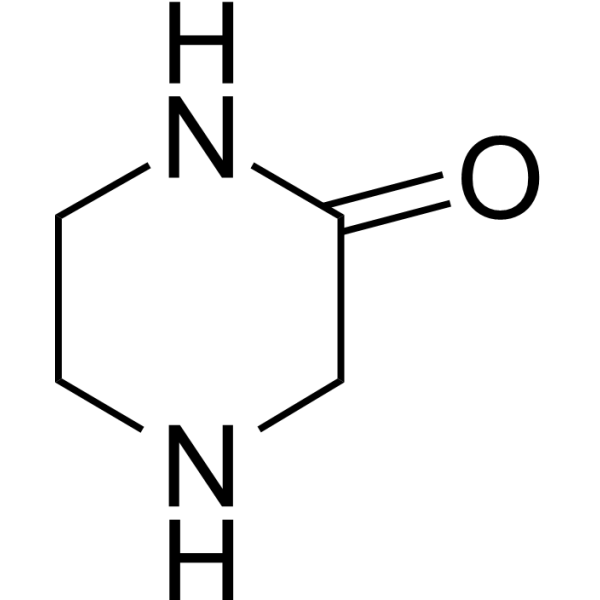
HY-20128
Piperazin-2-oneIntermediate -

HY-W011726
1-(4-Methoxyphenyl)piperazine hydrochloridePiperazine -
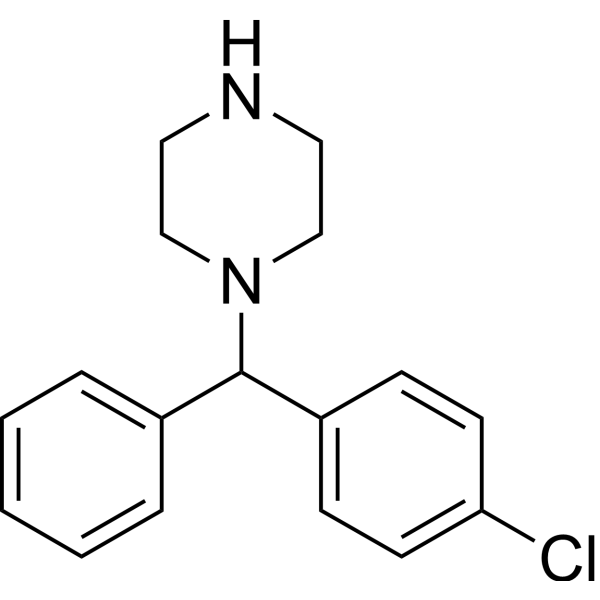
HY-W001978
1-(4-Chlorobenzhydryl)piperazineBiochemical Reagent -

HY-W014552
1-(4-Nitrophenyl)piperazinePiperazine Linker -

HY-W016777
2,2'-Piperazine-1,4-diyldiethanolPROTAC Linker -

HY-W012426
1-PiperonylpiperazineBiochemical Reagent -

HY-W015661
3-(Piperazin-1-yl)propan-1-olPROTAC Linker -

HY-I0140
1-(3-Methyl-1-phenyl-5-pyrazolyl)PiperazineDrug Intermediate
Publications Citing Use of MedChemExpress (MCE) Norquetiapine dihydrochloride
MoreAll 5-HT Receptor Isoforms
More

Biological Activity
Description


Chemical Information
-
CAS No. 111974-74-4
-
Appearance Solid
-
Molecular Weight 368.32
-
Formula C17H19Cl2N3S
-
SMILES
C12=CC=CC=C1N=C(C3=CC=CC=C3S2)N4CCNCC4.Cl.Cl
-
Synonyms
N-Desalkylquetiapine dihydrochloride
-
Shipping
Room temperature in continental US; may vary elsewhere.
-
Storage
Powder -20°C 3 years 4°C 2 years In solvent -80°C 6 months -20°C 1 month


Publications (1)
-
Journal Impact Factor
-
Most Recent
-
Drug Metab Dispos
2025 Nov;53(11):100169. PMID: 41100927


Solvent & Solubility
In Vitro:
DMSO : 100 mg/mL (271.50 mM; Need ultrasonic; Hygroscopic DMSO has a significant impact on the solubility of product, please use newly opened DMSO)
Please refer to the solubility information to select the appropriate solvent. Once prepared, please aliquot and store the solution to prevent product inactivation from repeated freeze-thaw cycles.
Storage method and period of stock solution: -80°C, 6 months; -20°C, 1 month. When stored at -80°C, please use it within 6 months. When stored at -20°C, please use it within 1 month.
Please refer to the solubility information to select the appropriate solvent. Once prepared, please aliquot and store the solution to prevent product inactivation from repeated freeze-thaw cycles.
Storage method and period of stock solution: -80°C, 6 months; -20°C, 1 month. When stored at -80°C, please use it within 6 months. When stored at -20°C, please use it within 1 month.
Concentration (start) × Volume (start) = Concentration (final) × Volume (final)
In Vivo:
Select the appropriate dissolution method based on your experimental animal and administration route.
- For the following dissolution methods, please ensure to first prepare a clear stock solution using an In Vitro approach and then sequentially add co-solvents:
- To ensure reliable experimental results, the clarified stock solution can be appropriately stored based on storage conditions. As for the working solution for In Vivo experiments, it is recommended to prepare freshly and use it on the same day.
- The percentages shown for the solvents indicate their volumetric ratio in the final prepared solution. If precipitation or phase separation occurs during preparation, heat and/or sonication can be used to aid dissolution.
Add each solvent one by one: 10% DMSO 40% PEG300 5% Tween-80 45% Saline
Solubility: ≥ 2.5 mg/mL (6.79 mM); Clear solution
This protocol yields a clear solution of ≥ 2.5 mg/mL (saturation unknown).
Taking 1 mL working solution as an example, add 100 μL DMSO stock solution (25.0 mg/mL) to 400 μL PEG300, and mix evenly; then add 50 μL Tween-80 and mix evenly; then add 450 μL Saline to adjust the volume to 1 mL.
Preparation of Saline: Dissolve 0.9 g sodium chloride in ddH₂O and dilute to 100 mL to obtain a clear Saline solution.
Add each solvent one by one: 10% DMSO 90% (20% SBE-β-CD in Saline)
Solubility: ≥ 2.5 mg/mL (6.79 mM); Clear solution
This protocol yields a clear solution of ≥ 2.5 mg/mL (saturation unknown).
Taking 1 mL working solution as an example, add 100 μL DMSO stock solution (25.0 mg/mL) to 900 μL 20% SBE-β-CD in Saline, and mix evenly.
Preparation of 20% SBE-β-CD in Saline (4°C, storage for one week): 2 g SBE-β-CD powder is dissolved in 10 mL Saline, completely dissolve until clear.
In Vivo Dissolution Calculator
Please enter the basic information of animal experiments:
-
-
-
-
Recommended: Prepare an additional quantity of animals to account for potential losses during experiments.
Please enter your animal formula composition:
-
%DMSO +
Recommended: Keep the proportion of DMSO in working solution below 2% if your animal is weak.
-
%+
-
+%Tween-80 + +
-
%Saline +
The co-solvents required include: DMSO, . All of co-solvents are available by MedChemExpress (MCE). , Tween 80. All of co-solvents are available by MedChemExpress (MCE).
Working solution concentration: 0.22 mg/mL
Method for preparing stock solution: mg drug dissolved in μL DMSO. Stock solution concentration: mg/mL.
1. Take μL DMSO stock solution;
2. Add μL .
μL , mix evenly;
3. Then add μL Tween 80, mix evenly;
4. Then add μL
Please ensure that the stock solution in the first step is dissolved to a clear state, and add co-solvents in sequence. You can use ultrasonic heating (ultrasonic cleaner, recommended frequency 20-40 kHz), vortexing, etc. to assist dissolution.

Protocols
-
Cell Cytotoxicity Assay
Cytotoxicity assays are usually based on the assessment of cell membrane damage, which can also be indirectly detected by measuring cell viability. Detection methods include MTT assay, CKK-8 assay, LDH assay and ATP assay, etc.
-
Research Protocol for Inflammation-related Diseases
The NLRP3 inflammasome is a cytosolic innate immune signaling platform that integrates priming signals and danger-signal activation to promote caspase-1 activation, maturation of IL-1β and IL-18, and gasdermin D-mediated pyroptotic cell death. The core experimental logic is to determine whether inflammatory disease phenotypes are driven by increased NLRP3 expression, ASC-containing inflammasome assembly, caspase-1 cleavage, GSDMD cleavage, and extracellular release of IL-1β/IL-18 rather than by nonspecific cell injury alone. The pathway is strongly linked to inflammation-related disease phenotypes because monosodium urate crystals activate NALP3/NLRP3 inflammasome signaling in gout-like crystal inflammation, cholesterol crystals activate NLRP3 inflammasomes in atherogenesis models, and DSS-induced intestinal inflammation has been reported to involve NLRP3 inflammasome activity. However, experimental colitis studies also show context-dependent protective effects of NLRP3 inflammasome co


Purity & Documentation
-
Data Sheet (282 KB)
-
SDS (393 KB)
- English - EN (393 KB)
- Français - FR (393 KB)
- Deutsch - DE (393 KB)
- Norwegian - NO (393 KB)
- Español - ES (393 KB)
- Swedish - SV (393 KB)
- Italian - IT (393 KB)
- Korean - KR (393 KB)
- Portuguese - PT (393 KB)
-
Handling Instructions (2659 KB)
References
[1]. Kim DH, Park KS, Park SH, Hahn SJ, Choi JS. Norquetiapine blocks the human cardiac sodium channel Nav1.5 in a state-dependent manner. Eur J Pharmacol. 2020 Oct 15;885:173532. [Content Brief]
[2]. Jean Jacques A, et al. Inhibition of HCN1 currents by norquetiapine, an active metabolite of the atypical anti-psychotic drug quetiapine. Front Pharmacol. 2024 Oct 7;15:1445509. [Content Brief]
[3]. Jaehne EJ, et al. The effect of the antipsychotic drug quetiapine and its metabolite norquetiapine on acute inflammation, memory and anhedonia. Pharmacol Biochem Behav. 2015 Aug;135:136-44. [Content Brief]
[4]. López-Muñoz F, et al. Active metabolites as antidepressant drugs: the role of norquetiapine in the mechanism of action of quetiapine in the treatment of mood disorders. Front Psychiatry. 2013 Sep 12;4:102. [Content Brief]
[5]. Jensen NH, et al. N-desalkylquetiapine, a potent norepinephrine reuptake inhibitor and partial 5-HT1A agonist, as a putative mediator of quetiapine's antidepressant activity. Neuropsychopharmacology. 2008 Sep;33(10):2303-12. [Content Brief]


Complete Stock Solution Preparation Table
Please refer to the solubility information to select the appropriate solvent. Once prepared, please aliquot and store the solution to prevent product inactivation from repeated freeze-thaw cycles.
Storage method and period of stock solution: -80°C, 6 months; -20°C, 1 month. When stored at -80°C, please use it within 6 months. When stored at -20°C, please use it within 1 month.
| Optional Solvent | Concentration Solvent Mass | 1 mg | 5 mg | 10 mg | 25 mg |
|---|---|---|---|---|---|
| DMSO | 1 mM | 2.7150 mL | 13.5752 mL | 27.1503 mL | 67.8758 mL |
| 5 mM | 0.5430 mL | 2.7150 mL | 5.4301 mL | 13.5752 mL | |
| 10 mM | 0.2715 mL | 1.3575 mL | 2.7150 mL | 6.7876 mL | |
| 15 mM | 0.1810 mL | 0.9050 mL | 1.8100 mL | 4.5251 mL | |
| 20 mM | 0.1358 mL | 0.6788 mL | 1.3575 mL | 3.3938 mL | |
| 25 mM | 0.1086 mL | 0.5430 mL | 1.0860 mL | 2.7150 mL | |
| 30 mM | 0.0905 mL | 0.4525 mL | 0.9050 mL | 2.2625 mL | |
| 40 mM | 0.0679 mL | 0.3394 mL | 0.6788 mL | 1.6969 mL | |
| 50 mM | 0.0543 mL | 0.2715 mL | 0.5430 mL | 1.3575 mL | |
| 60 mM | 0.0453 mL | 0.2263 mL | 0.4525 mL | 1.1313 mL | |
| 80 mM | 0.0339 mL | 0.1697 mL | 0.3394 mL | 0.8484 mL | |
| 100 mM | 0.0272 mL | 0.1358 mL | 0.2715 mL | 0.6788 mL |


Norquetiapine dihydrochloride Related Classifications
HY-W040555 Related Classifications
 Powered by Bioz