



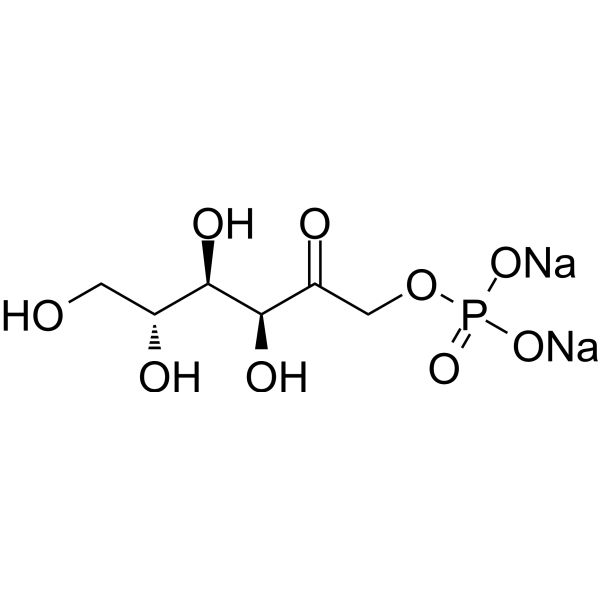
D-Fructose 1-phosphate disodium
Based on 1 publication(s) in Google Scholar
D-Fructose 1-phosphate disodium is a key intermediate metabolite in the fructose metabolic pathway. As a key signaling molecule linking fructose metabolism and glucose metabolic regulation, D-Fructose 1-phosphate disodium acts as an allosteric modulator to counteract the inhibitory effect of the glucokinase-regulatory protein complex, thereby finely regulating the direction of hepatic glucose metabolism at the substrate level.
For research use only. We do not sell to patients.
- Purity : 99.75%
- CAS No.: 71662-09-4
- Formula: C6H11Na2O9P
- Molecular Weight:304.10
-
Storage:
-20°C, stored under nitrogen
* In solvent : -80°C, 6 months; -20°C, 1 month (stored under nitrogen)

To place orders, for customer services and technical support, please contact: MedChemExpress USA
Tel: 609-228-6898 E-mail: [email protected] [email protected]


-
 Biological Activity
-
Chemical Information
-
Solvent & Solubility
- Purity & Documentation
- References
-
 Help & FAQs


Publications Citing Use of MedChemExpress (MCE) D-Fructose 1-phosphate disodium
MoreAll Endogenous Metabolite Isoforms
More

Biological Activity
Description
IC50 & Target
|
Human Endogenous Metabolite |
In Vitro
D-Fructose 1-phosphate disodium stimulates glucokinase activity in isolated hepatocytes from fed rats, with a half-maximal effective dose of 30 pmol/mg protein; glucagon attenuates this stimulatory effect[1].
D-Fructose 1-phosphate disodium (1 mM) is a specific substrate of *Clostridioides difficile* fructose-1-phosphate kinase, with a Km value of 160 μM, and it is inhibited by sulfate and phosphate ions[1].
D-Fructose 1-phosphate disodium directly dissociates the rat liver GKRP-GCK complex and relieves the GKRP-mediated inhibition of GCK[2].
D-Fructose 1-phosphate disodium inhibits PKM2 in intestinal epithelial cells, thereby driving HIF-1α activation, hypoxic cell survival, villus elongation, and enhanced nutrient absorption[2].
MedChemExpress (MCE) has not independently confirmed the accuracy of these methods. They are for reference only.


Chemical Information
-
CAS No. 71662-09-4
-
Appearance Solid
-
Molecular Weight 304.10
-
Formula C6H11Na2O9P
-
Color White to off-white
-
SMILES
O[C@H](C(COP(O[Na])(O[Na])=O)=O)[C@@H]([C@@H](CO)O)O
-
Structure Classification
-
Initial Source
-
Shipping
Room temperature in continental US; may vary elsewhere.
-
Storage
-20°C, stored under nitrogen
* In solvent : -80°C, 6 months; -20°C, 1 month (stored under nitrogen)


Publications (1)
-
Journal Impact Factor
-
Most Recent
-
BMC Microbiol
Unveiling the fructose metabolism system in Staphylococcus aureus: insights into the regulatory role of FruR and the FruRKT operon in bacterial fitness. [Abstract]2024 Jan 4;24(1):13. PMID: 38177984


Solvent & Solubility
In Vitro:
H2O : 200 mg/mL (657.68 mM; Need ultrasonic)
Please refer to the solubility information to select the appropriate solvent. Once prepared, please aliquot and store the solution to prevent product inactivation from repeated freeze-thaw cycles.
Storage method and period of stock solution: -80°C, 6 months; -20°C, 1 month (stored under nitrogen). When stored at -80°C, please use it within 6 months. When stored at -20°C, please use it within 1 month.
* Note: If you choose water as the stock solution, please dilute it to the working solution, then filter and sterilize it with a 0.22 μm filter before use.
Please refer to the solubility information to select the appropriate solvent. Once prepared, please aliquot and store the solution to prevent product inactivation from repeated freeze-thaw cycles.
Storage method and period of stock solution: -80°C, 6 months; -20°C, 1 month (stored under nitrogen). When stored at -80°C, please use it within 6 months. When stored at -20°C, please use it within 1 month.
* Note: If you choose water as the stock solution, please dilute it to the working solution, then filter and sterilize it with a 0.22 μm filter before use.
Concentration (start) × Volume (start) = Concentration (final) × Volume (final)


Purity & Documentation
-
Data Sheet (274 KB)
-
SDS (394 KB)
- English - EN (394 KB)
- Français - FR (394 KB)
- Deutsch - DE (394 KB)
- Norwegian - NO (394 KB)
- Español - ES (394 KB)
- Swedish - SV (394 KB)
- Italian - IT (394 KB)
- Korean - KR (394 KB)
- Portuguese - PT (394 KB)
-
Handling Instructions (2659 KB)
References
[1]. Davies DR, et al. Fructose 1-phosphate and the regulation of glucokinase activity in isolated hepatocytes. Eur J Biochem. 1990;192(2):283-289. [Content Brief]
[2]. Brouwers MCGJ, et al. Fructose 1-phosphate, an evolutionary signaling molecule of abundancy. Trends Endocrinol Metab. 2022;33(10):680-689. [Content Brief]


Complete Stock Solution Preparation Table
Please refer to the solubility information to select the appropriate solvent. Once prepared, please aliquot and store the solution to prevent product inactivation from repeated freeze-thaw cycles.
Storage method and period of stock solution: -80°C, 6 months; -20°C, 1 month (stored under nitrogen). When stored at -80°C, please use it within 6 months. When stored at -20°C, please use it within 1 month.
| Optional Solvent | Concentration Solvent Mass | 1 mg | 5 mg | 10 mg | 25 mg |
|---|---|---|---|---|---|
| H2O | 1 mM | 3.2884 mL | 16.4420 mL | 32.8839 mL | 82.2098 mL |
| 5 mM | 0.6577 mL | 3.2884 mL | 6.5768 mL | 16.4420 mL | |
| 10 mM | 0.3288 mL | 1.6442 mL | 3.2884 mL | 8.2210 mL | |
| 15 mM | 0.2192 mL | 1.0961 mL | 2.1923 mL | 5.4807 mL | |
| 20 mM | 0.1644 mL | 0.8221 mL | 1.6442 mL | 4.1105 mL | |
| 25 mM | 0.1315 mL | 0.6577 mL | 1.3154 mL | 3.2884 mL | |
| 30 mM | 0.1096 mL | 0.5481 mL | 1.0961 mL | 2.7403 mL | |
| 40 mM | 0.0822 mL | 0.4110 mL | 0.8221 mL | 2.0552 mL | |
| 50 mM | 0.0658 mL | 0.3288 mL | 0.6577 mL | 1.6442 mL | |
| 60 mM | 0.0548 mL | 0.2740 mL | 0.5481 mL | 1.3702 mL | |
| 80 mM | 0.0411 mL | 0.2055 mL | 0.4110 mL | 1.0276 mL | |
| 100 mM | 0.0329 mL | 0.1644 mL | 0.3288 mL | 0.8221 mL |
* Note: If you choose water as the stock solution, please dilute it to the working solution, then filter and sterilize it with a 0.22 μm filter before use.


D-Fructose 1-phosphate disodium Related Classifications
HY-112253A Related Classifications
 Powered by Bioz