



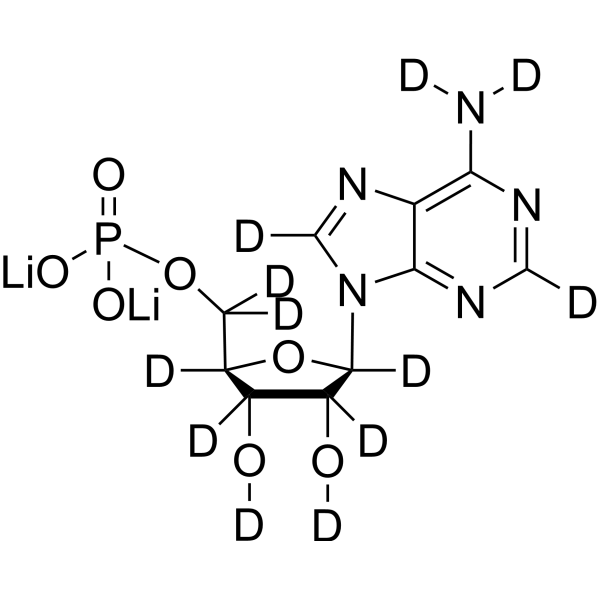
Adenosine monophosphate-d12 dilithium

Based on 1 Customer Validation
Adenosine monophosphate-d12 (AMP-d12) dilithium is deuterium labeled Adenosine monophosphate (HY-A0181). Adenosine monophosphate is an adenosine A1 receptor agonist. Adenosine monophosphate has significant antiviral activity against HSV-1 and HSV-2. Adenosine monophosphate is a key cellular metabolite regulating energy homeostasis and signal transduction.
For research use only. We do not sell to patients.
- Purity : 95.10%
- Formula: C10D12Li2N5O7P
- Molecular Weight:371.16
-
Storage:
Solution, -20°C, 2 years

To place orders, for customer services and technical support, please contact: MedChemExpress USA
Tel: 609-228-6898 E-mail: [email protected] [email protected]


-
 Biological Activity
-
Chemical Information
- Protocols
- Purity & Documentation
- References
-
 Help & FAQs




Biological Activity
Description
In Vitro
Stable heavy isotopes of hydrogen, carbon, and other elements have been incorporated into drug molecules, largely as tracers for quantitation during the drug development process. Deuteration has gained attention because of its potential to affect the pharmacokinetic and metabolic profiles of drugs[1].
MedChemExpress (MCE) has not independently confirmed the accuracy of these methods. They are for reference only. Further protocols information, click here.
Application
1. This compound can be used as a tracer
2. This compound can be used as an internal standard for quantitative analysis by NMR, GC-MS, or LC-MS.


Chemical Information
-
Unlabeled CAS 61-19-8
-
Appearance Liquid
-
Molecular Weight 371.16
-
Formula C10D12Li2N5O7P
-
Color Colorless to light yellow
-
SMILES
O=P(O[Li])(O[Li])OC([2H])([2H])[C@@]1([2H])O[C@](N2C3=NC([2H])=NC(N([2H])[2H])=C3N=C2[2H])([2H])[C@](O[2H])([2H])[C@]1([2H])O[2H]
-
Synonyms
AMP-d12 dilithium
-
Shipping
Room temperature in continental US; may vary elsewhere.
-
Storage
Solution, -20°C, 2 years

Protocols
-
Research Protocol for Infectious Diseases
Infectious-disease experiments test how pathogens interact with host barriers, innate immune receptors, inflammatory signaling, pathogen replication, and tissue injury; pattern-recognition receptors such as TLRs, RIG-I-like receptors, NOD-like receptors, and inflammasomes detect microbial molecules and activate NF-κB, interferon, and cytokine responses. The central hypothesis is that infection severity reflects the balance between pathogen burden and host response: protective inflammation restricts pathogen growth, whereas excessive or mislocalized inflammation contributes to tissue damage and disease phenotype. Unresolved questions include which host pathways are protective versus pathogenic, why some infection models fail to translate to human disease, and which combined readouts best predict clinically relevant infection outcomes.


Purity & Documentation
-
Data Sheet (275 KB)
-
SDS (251 KB)
- English - EN (251 KB)
- Français - FR (251 KB)
- Deutsch - DE (251 KB)
- Norwegian - NO (251 KB)
- Español - ES (251 KB)
- Swedish - SV (251 KB)
- Italian - IT (251 KB)
- Korean - KR (251 KB)
- Portuguese - PT (251 KB)
-
Handling Instructions (2659 KB)
References
[1]. Rittiner JE, et al. AMP is an adenosine A1 receptor agonist. J Biol Chem. 2012 Feb 17;287(8):5301-9. [Content Brief]
[2]. Zhan Y, et al. Adenosine 5'-monophosphate ameliorates D-galactosamine/lipopolysaccharide-induced liver injury through an adenosine receptor-independent mechanism in mice. Cell Death Dis. 2014 Jan 9;5:e985. [Content Brief]
[3]. Ayisi NK, et al. Comparison of the antiviral effects of 5-methoxymethyldeoxyuridine-5'-monophosphate with adenine arabinoside-5'-monophosphate. Antiviral Res. 1983 Sep;3(3):161-74. [Content Brief]

Calculators
Concentration (start) × Volume (start) = Concentration (final) × Volume (final)


Adenosine monophosphate-d12 dilithium Related Classifications
HY-A0181S2 Related Classifications
 Powered by Bioz