



Leukotriene D4-d5
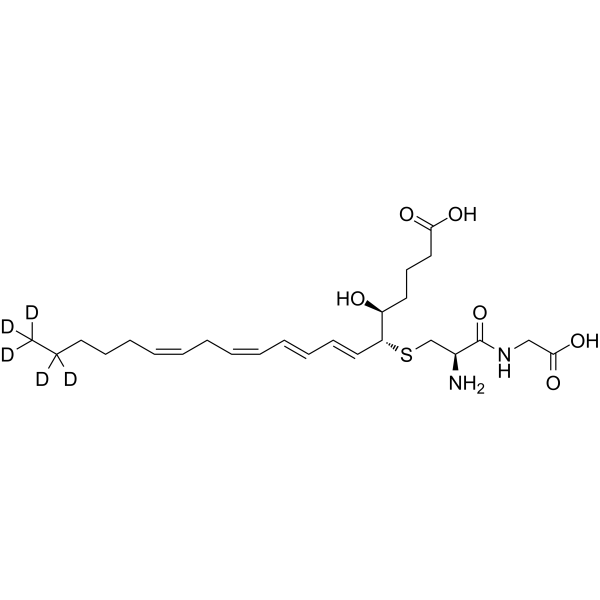
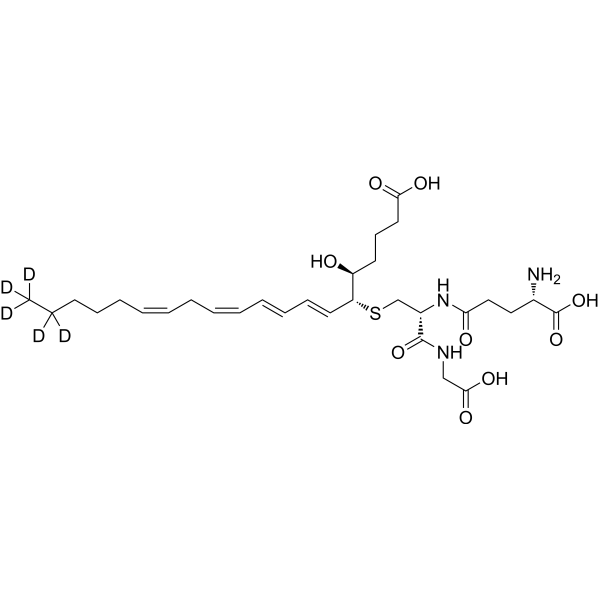
Leukotriene D4-d5 is the deuterium labeled Leukotriene D4. Leukotriene D4 is one of the constituents of slow-reacting substance of anaphylaxis (SRS-A) produced by the metabolism of LTC4 by γ-glutamyl transpeptidase. Leukotriene D4 is the first cysteinyl-leukotriene metabolite of LTC4. Leukotriene D4-induced bronchoconstriction and enhanced vascular permeability contribute to the pathogenesis of asthma and acute hypersensitivity.
For research use only. We do not sell to patients.
- CAS No.: 1240398-17-7
- Formula: C25H35D5N2O6S
- Molecular Weight:501.69
-
Storage:
Solution, -20°C, 2 years

To place orders, for customer services and technical support, please contact: MedChemExpress USA
Tel: 609-228-6898 E-mail: [email protected] [email protected]


-
 Biological Activity
-
Chemical Information
- Protocols
- Purity & Documentation
- References
-
 Help & FAQs


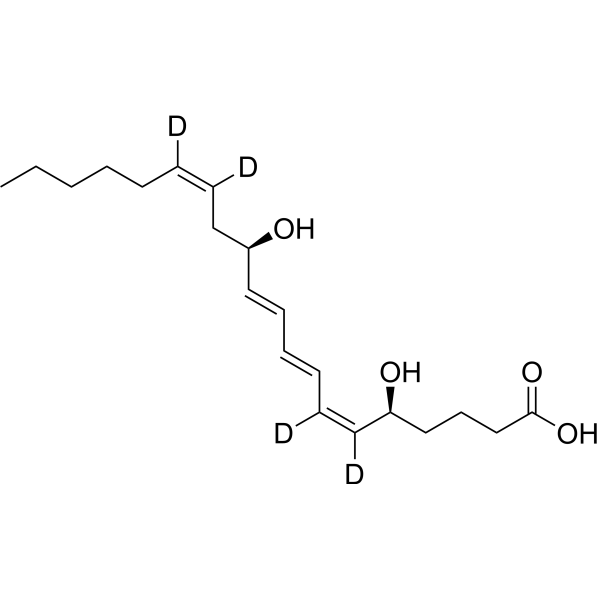
All Endogenous Metabolite Isoforms
More

Biological Activity
Description
In Vitro
Stable heavy isotopes of hydrogen, carbon, and other elements have been incorporated into drug molecules, largely as tracers for quantitation during the drug development process. Deuteration has gained attention because of its potential to affect the pharmacokinetic and metabolic profiles of drugs[1].
MedChemExpress (MCE) has not independently confirmed the accuracy of these methods. They are for reference only. Further protocols information, click here.
Application
1. This compound can be used as a tracer
2. This compound can be used as an internal standard for quantitative analysis by NMR, GC-MS, or LC-MS.


Chemical Information
-
CAS No. 1240398-17-7
-
Unlabeled CAS 73836-78-9
-
Appearance Liquid
-
Molecular Weight 501.69
-
Formula C25H35D5N2O6S
-
Color Colorless to light yellow
-
SMILES
N[C@@H](CS[C@H](/C=C/C=C/C=C\C/C=C\CCCC([2H])(C([2H])([2H])[2H])[2H])[C@H](CCCC(O)=O)O)C(NCC(O)=O)=O
-
Shipping
Room temperature in continental US; may vary elsewhere.
-
Storage
Solution, -20°C, 2 years

Protocols
-
Transepithelial/transendothelial electrical resistance assay
TEER measures electrical resistance across epithelial or endothelial monolayers cultured on permeable supports, and the readout reflects ionic conductance through the cell barrier, especially the paracellular pathway regulated by junctional integrity. TEER can be measured without destroying the monolayer and is commonly used before or during transport, permeability, barrier-disruption, and barrier-maturation experiments. TEER values are influenced by biological maturation and technical conditions; reported factors include temperature, medium formulation, passage number, electrode geometry, membrane properties, and junctional length during early monolayer maturation. Therefore, TEER should be interpreted with blank-insert subtraction, area normalization, repeated readings, and, when possible, orthogonal barrier readouts such as FITC-dextran flux or tight-junction staining.


Purity & Documentation
-
Data Sheet (263 KB)
-
SDS (251 KB)
- English - EN (251 KB)
- Français - FR (251 KB)
- Deutsch - DE (251 KB)
- Norwegian - NO (251 KB)
- Español - ES (251 KB)
- Swedish - SV (251 KB)
- Italian - IT (251 KB)
- Korean - KR (251 KB)
- Portuguese - PT (251 KB)
-
Handling Instructions (2659 KB)
References

Calculators
Concentration (start) × Volume (start) = Concentration (final) × Volume (final)


Leukotriene D4-d5 Related Classifications
HY-113456S Related Classifications
 Powered by Bioz