



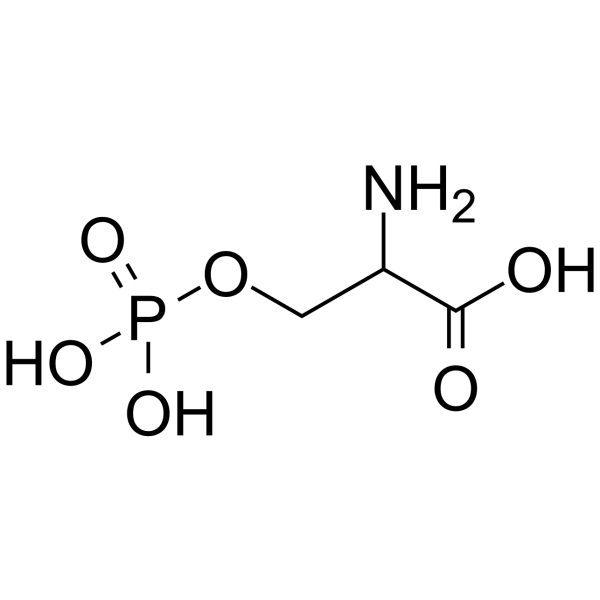
DL-O-Phosphoserine

Based on 1 Customer Validation
DL-O-Phosphoserine is a normal metabolite in human biofluids and is a mixture of phosphoserine with two stereochemical structures (D-type and L-type O-phospho-serine). O-phospho-L-serine is a competitive inhibitor of serine racemase and phagocytosis. O-phospho-L-serine inhibits the enzymatic reaction by competing with the active site of serine racemase, thereby affecting the production of D-serine. O-phospho-L-serine also mimics the phosphatidylserine head group, binds to the phosphatidylserine receptor, interferes with phagocytic signal transduction, and partially blocks the phagocytosis of apoptotic cells by cells. O-phospho-L-serin can be used in the research of retinal regeneration, bone repair, and insect growth and development.
For research use only. We do not sell to patients.
- Purity : 98.0%
- CAS No.: 17885-08-4
- Formula: C3H8NO6P
- Molecular Weight:185.07
-
Storage:
4°C, stored under nitrogen
* In solvent : -80°C, 6 months; -20°C, 1 month (stored under nitrogen)

To place orders, for customer services and technical support, please contact: MedChemExpress USA
Tel: 609-228-6898 E-mail: [email protected] [email protected]


-
 Biological Activity
-
Chemical Information
-
Solvent & Solubility
- Protocols
- Purity & Documentation
- References
-
 Help & FAQs



All Endogenous Metabolite Isoforms
More

Biological Activity
Description
IC50 & Target
|
Human Endogenous Metabolite |
In Vitro
O-phospho-L-serin shows inhibitory activity agasint serine racemase in a concentration-dependent manner, with the enzyme reaction inhibition rate of approximately 20% at 2 mM concentration[3].
MedChemExpress (MCE) has not independently confirmed the accuracy of these methods. They are for reference only. Further protocols information, click here.
In Vivo
In a miniature pig mandibular bone defect model experiment, a modified bone cement prepared by surgical implantation of a mixture of O-phospho-L-serin (Biozement D (2 g)-collagen-I (2.5%)-phosphoserine (50 mg)) was administered. Compared with the unmodified bone cement, the treated group had a higher absorption rate and bone regeneration rate, which effectively promoted bone healing[2].
In a silkworm growth and development experiment, O-phospho-L-serin (20 mM, 1 mL; added to feed; daily administration, from first to fifth instar larvae) delayed the development of silkworm larvae by about 6 days, significantly reduced the survival rate of larvae, and reduced the D-serine level in larvae until the cocooning stage compared with the control group[3].
MedChemExpress (MCE) has not independently confirmed the accuracy of these methods. They are for reference only.
-
Animal Model:Zebrafish retinal light damage model[1]
-
Dosage:0.65% saline containing either 20 mM O-phospho-L-serine (L-SOP), 0.5 μL
-
Administration:Intravitreally injection via Hamilton syringe; single dose
-
Result:Decreased the number of PCNA-positive Müller glia 51 hours after light damage.
Inhibited the regeneration of cone photoreceptors in the light-damaged retina.
There was no significant difference in the number of light-induced photoreceptor cell deaths between the O-phospho-L-serin-injected group and the control group 24 hours after light treatment.


Chemical Information
-
CAS No. 17885-08-4
-
Appearance Solid
-
Molecular Weight 185.07
-
Formula C3H8NO6P
-
Color White to off-white
-
SMILES
OP(OCC(C(O)=O)N)(O)=O
-
Structure Classification
-
Initial Source
-
Shipping
Room temperature in continental US; may vary elsewhere.
-
Storage
4°C, stored under nitrogen
* In solvent : -80°C, 6 months; -20°C, 1 month (stored under nitrogen)


Solvent & Solubility
In Vitro:
H2O : 11.67 mg/mL (63.06 mM; ultrasonic and warming and heat to 60°C)
Please refer to the solubility information to select the appropriate solvent. Once prepared, please aliquot and store the solution to prevent product inactivation from repeated freeze-thaw cycles.
Storage method and period of stock solution: -80°C, 6 months; -20°C, 1 month (stored under nitrogen). When stored at -80°C, please use it within 6 months. When stored at -20°C, please use it within 1 month.
* Note: If you choose water as the stock solution, please dilute it to the working solution, then filter and sterilize it with a 0.22 μm filter before use.
Please refer to the solubility information to select the appropriate solvent. Once prepared, please aliquot and store the solution to prevent product inactivation from repeated freeze-thaw cycles.
Storage method and period of stock solution: -80°C, 6 months; -20°C, 1 month (stored under nitrogen). When stored at -80°C, please use it within 6 months. When stored at -20°C, please use it within 1 month.
* Note: If you choose water as the stock solution, please dilute it to the working solution, then filter and sterilize it with a 0.22 μm filter before use.
Concentration (start) × Volume (start) = Concentration (final) × Volume (final)
In Vivo:
For the following dissolution methods, please prepare the working solution directly:
It is recommended to prepare fresh solutions and use them promptly within a short period of time.
The percentages shown for the solvents indicate their volumetric ratio in the final prepared solution. If precipitation or phase separation occurs during preparation, heat and/or sonication can be used to aid dissolution.
Add each solvent one by one: PBS
Solubility: 25 mg/mL (135.08 mM); Clear solution; Need ultrasonic and warming and heat to 60°C

Protocols
-
Phagocytosis Functional Assay
A phagocytosis functional assay measures the ability of phagocytic cells, such as neutrophils, macrophages, monocytes, or microglia/macrophages, to bind and internalize particulate targets including bacteria, yeast particles, beads, or myelin particles. Fluorescent flow-cytometry assays detect target uptake as fluorescence associated with gated phagocytes, while pH-sensitive dyes such as pHrodo increase signal in acidic phagosomal compartments and therefore preferentially report internalized particles rather than particles remaining outside the cell. Microscopy or high-content imaging can be used to confirm intracellular localization and, in some protocols, to follow uptake kinetics.
-
Detection of Apoptosis
Apoptosis, also called programmed cell death, is generally characterized by distinct morphological characteristics.
-
TUNEL staining for apoptotic DNA fragmentation
TUNEL staining detects DNA strand breaks by using terminal deoxynucleotidyl transferase to add labeled nucleotides to exposed 3′-OH DNA termini, generating either microscopic staining in fixed cells or tissue sections, or fluorescence/cytometric signal in cell suspensions. TUNEL positivity reflects DNA fragmentation but should not be interpreted alone as definitive apoptosis, because TUNEL can also label necrotic, autolytic, mechanically damaged, or DNA-repair-associated DNA breaks.
-
Annexin V plus membrane-impermeant dye apoptosis staining
Annexin V-based apoptosis assays rely on the detection of phosphatidylserine (PS) externalization from the inner leaflet of the plasma membrane to the outer leaflet, an early biochemical hallmark of apoptosis. Fluorescently labeled Annexin V binds PS in a calcium-dependent manner, enabling identification of early apoptotic cells by flow cytometry or fluorescence microscopy. When combined with a membrane-impermeant DNA-binding dye (e. g. , propidium iodide), this approach allows discrimination between viable (Annexin V−/dye−), early apoptotic (Annexin V+/dye−), and late apoptotic or necrotic (Annexin V+/dye+) cell populations by assessing membrane integrity and PS exposure.
-
Apoptosis Solutions
Apoptosis is a regulated, generally non-lytic cell-death pathway that removes unwanted, damaged, infected, or abnormal cells through coordinated morphological changes, caspase activation, DNA fragmentation, and membrane remodeling. The intrinsic apoptosis pathway is controlled mainly by mitochondrial outer membrane permeabilization, BCL-2 family proteins, cytochrome c release, apoptosome formation, caspase-9 activation, and downstream executioner caspase-3/7 activation. The extrinsic apoptosis pathway is initiated by death receptors such as Fas, TNFR, and TRAIL receptors, which recruit adaptor proteins and activate caspase-8 before engaging executioner caspases or mitochondrial amplification through BID cleavage. Apoptosis is linked to many phenotypes, including cancer cell killing, tissue homeostasis, immune regulation, neurodegeneration, infection response, and treatment-induced cytotoxicity; unresolved questions include how apoptosis interacts with necroptosis, pyroptosis, ferroptos


Purity & Documentation
-
Data Sheet (274 KB)
-
SDS (393 KB)
- English - EN (393 KB)
- Français - FR (393 KB)
- Deutsch - DE (393 KB)
- Norwegian - NO (393 KB)
- Español - ES (393 KB)
- Swedish - SV (393 KB)
- Italian - IT (393 KB)
- Korean - KR (393 KB)
- Portuguese - PT (393 KB)
-
Handling Instructions (2659 KB)
References
[1]. Bailey TJ, et al. The inhibitor of phagocytosis, O-phospho-L-serine, suppresses Müller glia proliferation and cone cell regeneration in the light-damaged zebrafish retina. Exp Eye Res. 2010 Nov;91(5):601-12. [Content Brief]
[2]. Mai R, Lux R, Proff P, Lauer G, Pradel W, Leonhardt H, Reinstorf A, Gelinsky M, Jung R, Eckelt U, Gedrange T, Stadlinger B. O-phospho-L-serine: a modulator of bone healing in calcium-phosphate cements. Biomed Tech (Berl). 2008 Oct;53(5):229-33. [Content Brief]


Complete Stock Solution Preparation Table
Please refer to the solubility information to select the appropriate solvent. Once prepared, please aliquot and store the solution to prevent product inactivation from repeated freeze-thaw cycles.
Storage method and period of stock solution: -80°C, 6 months; -20°C, 1 month (stored under nitrogen). When stored at -80°C, please use it within 6 months. When stored at -20°C, please use it within 1 month.
| Optional Solvent | Concentration Solvent Mass | 1 mg | 5 mg | 10 mg | 25 mg |
|---|---|---|---|---|---|
| H2O | 1 mM | 5.4034 mL | 27.0168 mL | 54.0336 mL | 135.0840 mL |
| 5 mM | 1.0807 mL | 5.4034 mL | 10.8067 mL | 27.0168 mL | |
| 10 mM | 0.5403 mL | 2.7017 mL | 5.4034 mL | 13.5084 mL | |
| 15 mM | 0.3602 mL | 1.8011 mL | 3.6022 mL | 9.0056 mL | |
| 20 mM | 0.2702 mL | 1.3508 mL | 2.7017 mL | 6.7542 mL | |
| 25 mM | 0.2161 mL | 1.0807 mL | 2.1613 mL | 5.4034 mL | |
| 30 mM | 0.1801 mL | 0.9006 mL | 1.8011 mL | 4.5028 mL | |
| 40 mM | 0.1351 mL | 0.6754 mL | 1.3508 mL | 3.3771 mL | |
| 50 mM | 0.1081 mL | 0.5403 mL | 1.0807 mL | 2.7017 mL | |
| 60 mM | 0.0901 mL | 0.4503 mL | 0.9006 mL | 2.2514 mL |
* Note: If you choose water as the stock solution, please dilute it to the working solution, then filter and sterilize it with a 0.22 μm filter before use.


DL-O-Phosphoserine Related Classifications
HY-15130 Related Classifications
 Powered by Bioz