



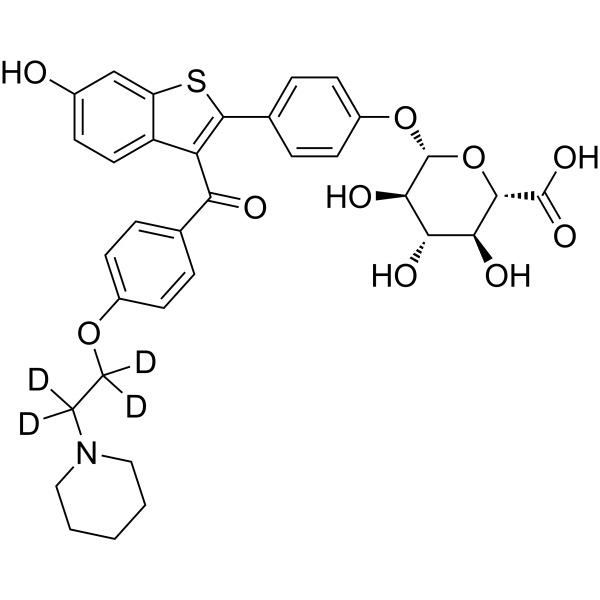
Raloxifene 4'-glucuronide-d4
Raloxifene 4'-glucuronide-d4 is deuterated labeled Raloxifene 4'-glucuronide (HY-135582). Raloxifene 4'-glucuronide is a primary metabolite of Raloxifene. Raloxifene 4'-glucuronide formation is mediated mostly by UGT1A10 and UGT1A8. Raloxifene 4'-glucuronide binds to estrogen receptor with an IC50 of 370 μM. . Raloxifene is a selective estrogen receptor modulator. Raloxifene activates TGFβ3 promoter as a full agonist at nanomolar concentrations, and inhibits the estrogen response element-containing vitellogenin promoter expression.
Nur für Forschungszwecke. Wir verkaufen nicht an Patienten.
- CAS. Nr.: 1279033-52-1
- Formel: C34H31D4NO10S
- Molecular Weight:653.73
-
Speicherung:
Please store the product under the recommended conditions in the Certificate of Analysis.

To place orders, for customer services and technical support, please contact: MedChemExpress USA
Tel: 609-228-6898 E-mail: [email protected] [email protected]


-
 Biologische Aktivität
-
Chemical Information
- Protokoll
- Reinheit & Dokumentation
- Verweise
-
 Help & FAQs




Biologische Aktivität
Beschreibung
In Vitro
Stable heavy isotopes of hydrogen, carbon, and other elements have been incorporated into drug molecules, largely as tracers for quantitation during the drug development process. Deuteration has gained attention because of its potential to affect the pharmacokinetic and metabolic profiles of drugs[1].
Expressed UGT1A8 catalyzes Raloxifene 4'-glucuronide with an apparent Km of 59 μM and a Vmax of 2.0 nmol/min/mg. Based on rates of Raloxifene glucuronidation and known extrahepatic expression, UGT1A8 and 1A10 appear to be primary contributors to Raloxifene glucuronidation in human jejunum microsomes. For human liver microsomes, the variability of Raloxifene 4'-glucuronide formation is 4-fold. Treatment of expressed UGTs with alamethicin results in minor increases in enzyme activity, whereas in human intestinal microsomes, maximal increases of 9-fold for the Raloxifene 4'-glucuronide are observed. Intrinsic clearance values in intestinal microsomes are 95 μl/min/mg for the Raloxifene 4'-glucuronide[3].
MedChemExpress (MCE) has not independently confirmed the accuracy of these methods. They are for reference only. Further protocols information, click here.
Anwendung
1. This compound can be used as a tracer
2. This compound can be used as an internal standard for quantitative analysis by NMR, GC-MS, or LC-MS.


Chemical Information
-
CAS. Nr. 1279033-52-1
-
Unlabeled CAS 182507-22-8
-
Molecular Weight 653.73
-
Formel C34H31D4NO10S
-
SMILES
O=C(C1=CC=C(C=C1)OC([2H])([2H])C([2H])([2H])N2CCCCC2)C3=C(C4=CC=C(C=C4)O[C@@H]5O[C@@H]([C@H]([C@@H]([C@H]5O)O)O)C(O)=O)SC6=CC(O)=CC=C63
-
Versand
Room temperature in continental US; may vary elsewhere.
-
Speicherung
Please store the product under the recommended conditions in the Certificate of Analysis.

Protokoll
-
RNA extraction experimental
By lysing cells, releasing RNA, and removing impurities such as proteins and DNA, high-purity RNA products are finally obtained. The commonly used traditional method is the guanidine isothiocyanate/phenol/chloroform method (Trizol), which is suitable for a variety of animal materials including animal tissues, microorganisms, cultured cells, etc., and most plant materials.
-
Research Protocol for Endocrine Diseases
Endocrine diseases often arise from disrupted hormone production, hormone signaling, or target-tissue responsiveness; for diabetes-focused endocrine disease models, insulin signaling regulates glucose uptake, hepatic glucose output, lipid metabolism, and β-cell compensation. Type 2 diabetes develops through interacting defects in insulin resistance, β-cell dysfunction, adipose inflammation, hepatic glucose overproduction, altered incretin signaling, and ectopic lipid metabolism. A major unresolved question is whether endocrine dysfunction is driven primarily by target-tissue insulin resistance, intrinsic β-cell failure, immune/inflammatory stress, or combined multi-organ failure that differs by disease stage.


Reinheit & Dokumentation
Verweise
[1]. Russak EM, et al. Impact of Deuterium Substitution on the Pharmacokinetics of Pharmaceuticals. Ann Pharmacother. 2019 Feb;53(2):211-216. [Content Brief]
[2]. Izgelov D, et al. The Effect of Piperine Pro-Nano Lipospheres on Direct Intestinal Phase II Metabolism: The Raloxifene Paradigm of Enhanced Oral Bioavailability. Mol Pharm. 2018 Apr 2;15(4):1548-1555. [Content Brief]
[3]. Kemp DC, et al. Characterization of raloxifene glucuronidation in vitro: contribution of intestinal metabolism to presystemic clearance. Drug Metab Dispos. 2002 Jun;30(6):694-700. [Content Brief]
[4]. Yang NN, et al. Estrogen and raloxifene stimulate transforming growth factor-beta 3 gene expression in rat bone: a potential mechanism for estrogen- or raloxifene-mediated bone maintenance. Endocrinology. 1996 May;137(5):2075-84. [Content Brief]

Calculators
Konzentration (Stammlösung) × Volumen (Stammlösung) = Konzentration (Ziellösung) × Volumen (Ziellösung)


Raloxifene 4'-glucuronide-d4 Related Classifications
HY-135582S Related Classifications
 Powered by Bioz