1. Search Result
Search Result
Results for "

dopamine receptors

" in MedChemExpress (MCE) Product Catalog:

911

Inhibitors & Agonists

6

Screening Libraries

1

Biochemical Assay Reagents

17

Peptides

39

Natural
Products

103

Isotope-Labeled Compounds

Cat. No. Product Name Target Research Areas Chemical Structure
  • HY-14542
    Ziprasidone
    3 Publications Verification

    CP-88059

    5-HT Receptor Dopamine Receptor Neurological Disease
    Ziprasidone (CP-88059), an orally active antipsychotic agent, is a combined 5-HT and dopamine receptor antagonist . Ziprasidone mesylate trihydrate has affinities for Rat D2 (Ki=4.8 nM), 5-HT2A (Ki=0.42 nM) and 5-HT1A (Ki=3.4 nM) .
    Ziprasidone
  • HY-75502
    Rotigotine
    3 Publications Verification

    N-0923; (-)-N 0437

    Dopamine Receptor Adrenergic Receptor 5-HT Receptor Neurological Disease Endocrinology
    Rotigotine is a potent dopamine receptor agonist with Ki values of 0.71 nM, 4-15 nM, and 83 nM for the dopamine D3 receptor and D2, D5, D4 receptors and dopamine D1 receptor. Rotigotine a partial agonist of the 5-HT1A receptor, and an antagonist of the α2B-adrenergic receptor. Rotigotine can be used for parkinson's disease (PD) research .
    Rotigotine
  • HY-17637

    ITI-007

    Dopamine Receptor 5-HT Receptor Neurological Disease Cancer
    Lumateperone (ITI-007) is an orally active 5-HT2A receptor antagonist (Ki = 0.54 nM), a partial agonist of presynaptic D2 receptors and an antagonist of postsynaptic D2 receptors (Ki = 32 nM), and a dopamine D1 receptor modulator. Lumateperone has anticancer activity and can also be used for the study of schizophrenia and bipolar depression .
    Lumateperone
  • HY-17407
    Ziprasidone hydrochloride monohydrate
    3 Publications Verification

    CP 88059 hydrochloride monohydrate

    5-HT Receptor Dopamine Receptor Neurological Disease
    Ziprasidone (CP-88059) hydrochloride monohydrate is an orally active combined 5-HT and dopamine receptor antagonist . Ziprasidone hydrochloride monohydrate has affinities for Rat D2 (Ki=4.8 nM), 5-HT2A (Ki=0.42 nM) and 5-HT1A (Ki=3.4 nM) .
    Ziprasidone hydrochloride monohydrate
  • HY-19733

    ITI-007 tosylate

    5-HT Receptor Dopamine Receptor Neurological Disease Cancer
    Lumateperone (ITI-007) tosylate is a 5-HT2A receptor antagonist (Ki = 0.54 nM), a partial agonist of presynaptic D2 receptors and an antagonist of postsynaptic D2 receptors (Ki = 32 nM), and a dopamine D1 receptor modulator. Lumateperone tosylate has anticancer activity and can also be used in studies of psychiatric disorders such as schizophrenia .
    Lumateperone tosylate
  • HY-110080

    Dopamine Receptor Neurological Disease
    Lisuride (maleate) is a potent agonist of dopamine with a probably direct action on dopaminergic receptors. Lisuride (maleate) is an ergot derivative. Lisuride (maleate) releases the premenstrual mastalgia without significant side effects .
    Lisuride maleate
  • HY-101348
    L-741626
    2 Publications Verification

    Dopamine Receptor Neurological Disease
    L-741626 is a selective D2 dopamine receptor antagonist, with the Ki values of 2.4, 100 and 220 nM for human D2, D3 and D4 receptors respectively .
    L-741626
  • HY-103413

    Dopamine Receptor Neurological Disease
    Eticlopride hydrochloride, a selective dopamine D2‐like receptor antagonist, exhibits high affinity for dopamine D2, α1-adrenergic, α2-adrenergic, 5HT1, 5HT2 receptors with Kis of 0.09, 112, 699, 6220, and 830 nM, respectively. Eticlopride hydrochloride is an antipsychotic agent .
    Eticlopride hydrochloride
  • HY-107663A

    Pro-Leu-Gly-NH2 TFA; Melanostatin TFA

    Dopamine Receptor Neurological Disease
    MIF-1 TFA (Melanostatin), an endogenous brain peptide, is a potent dopamine receptor allosteric modulator. MIF-1 TFA inhibits melanin formation. MIF-1 TFA blocks the effects of opioid receptor activation to modulate the analgesic effects. MIF-1 TFA accesses from the blood to the CNS by directly crossing the blood-brain barrier (BBB) .
    MIF-1 TFA
  • HY-101299B
    Dihydrexidine hydrochloride
    5 Publications Verification

    DAR-0100 hydrochloride

    Dopamine Receptor Neurological Disease
    Dihydrexidine hydrochloride (DAR-0100 hydrochloride) is a high potent, selective and full efficacy D1-like dopamine receptor (D1/D5) agonist, with an IC50 of 10 nM for D1 receptor. Dihydrexidine hydrochloride exhibits potent antiparkinsonian activity . Dihydrexidine hydrochloride can stimulate YAP phosphorylation .
    Dihydrexidine hydrochloride
  • HY-W014728
    N-Methyldopamine hydrochloride
    1 Publications Verification

    Dopamine Receptor Cardiovascular Disease Neurological Disease
    N-Methyldopamine hydrochloride is a precursor of adrenaline in the adrenal medulla. N-Methyldopamine hydrochloride is a modification of the dopamine (DA), and retains agonist activity at the DA1 receptor. N-Methyldopamine hydrochloride remains capable of universal surface coating and secondary reactions using the surface catechols. N-Methyldopamine hydrochloride can be used for heart failure research .
    N-Methyldopamine hydrochloride
  • HY-135608

    Sigma Receptor Neurological Disease
    BD-1008 is a nonselective σ receptor antagonist with Kis against σ1 receptor and σ2 receptor of 2 nM and 8 nM. The BD-1008 has an extremely low affinity for the D2 receptor (Ki = 1112 nM) and dopamine transporter (DAT) (Ki > 10,000 nM). BD-1008 significantly antagonizes dopamine release in the shell region of the nucleus accumbens via the σ₂ receptor. BD-1008 blocks the self-administration behavior of σ agonists.BD-1008 can be used for the study of addiction therapy that target the σ receptor .
    BD-1008
  • HY-108237

    (+)-PHNO; Dopazinol

    Dopamine Receptor Neurological Disease
    Naxagolide ((+)-PHNO; Dopazinol) is a potent dopamine D2 (Dopamine Receptor) agonist. Naxagolide has the potential for the research of parkinson's disease (PD) .
    Naxagolide
  • HY-147398

    Dopamine Receptor Neurological Disease
    Dopamine D4 receptor antagonist-1 is a selective DRD4 antagonists, with a Ki of 9.0 nM for Hd4.2. Dopamine D4 receptor antagonist-1 can be used in study of schizophrenia .
    Dopamine D4 receptor antagonist-1
  • HY-115553

    Dopamine Receptor Neurological Disease
    DETQ is a selective, allosteric and orally active dopamine D1 receptor (Dopamine Receptor) potentiator. In HEK293 cells expressing the human D1 receptor, DETQ increases cAMP with an EC50 of 5.8 nM and a Kb of 26 nM. DETQ shows ~30-fold less potent at rat and mouse D1 receptors and is inactive at the human D5 receptor .
    DETQ
  • HY-42849A
    Sultopride hydrochloride
    1 Publications Verification

    LIN-1418 hydrochloride

    Dopamine Receptor Neurological Disease
    Sultopride hydrochloride (LIN-1418 hydrochloride) is a selective antagonist of dopamine D2 receptor.
    Sultopride hydrochloride
  • HY-14325
    L-745870
    3 Publications Verification

    Dopamine Receptor Neurological Disease
    L-745870 is a potent, selective, brain-penetrant and orally active dopamine D4 receptor antagonist with a Ki of 0.43 nM. L-745870 shows weaker affinity for D2 (Ki of 960 nM) and D3 (Ki of 2300 nM) receptors, and exhibits moderate affinity for 5-HT2 receptors, sigma sites and α-adrenoceptors .
    L-745870
  • HY-14325B
    L-745870 hydrochloride
    3 Publications Verification

    Dopamine Receptor Neurological Disease
    L-745870 hydrochloride is a potent, selective, brain-penetrant and orally active dopamine D4 receptor antagonist with a Ki of 0.43 nM. L-745870 hydrochloride shows weaker affinity for D2 (Ki of 960 nM) and D3 (Ki of 2300 nM) receptors, and exhibits moderate affinity for 5-HT2 receptors, sigma sites and α-adrenoceptors .
    L-745870 hydrochloride
  • HY-N0927

    Tetrahydrocolumbamine; (S)-Tetrahydrocolumbamine

    Dopamine Receptor Others Neurological Disease
    (-)-Isocorypalmine (Tetrahydrocolumbamine; (S)-Tetrahydrocolumbamine) is a dopamine receptor ligand and modulator capable of crossing the blood-brain barrier. (-)-Isocorypalmine exhibits receptor selectivity, acting as a partial agonist of dopamine D1 and D5 receptors (coupled via Gs proteins), as well as an antagonist of D2, D3 and D4 receptors (by blocking Gi protein-mediated signaling). (-)-Isocorypalmine shows no significant binding to various non-dopamine receptors, ion channels and transporters. (-)-Isocorypalmine is metabolically stable in vivo, effectively inhibits spontaneous and cocaine-induced hyperlocomotion, sensitization and conditioned place preference in mice, and does not induce addictive place preference when administered alone. (-)-Isocorypalmine can be used in addiction research .
    (-)-Isocorypalmine
  • HY-W040146

    Propiopromazine hydrochloride

    Dopamine Receptor Neurological Disease
    Propionylpromazine hydrochloride (Propiopromazine hydrochloride), a dopamine receptor D2 (DRD2) antagonist, can be used in the research of Parkinson disease .
    Propionylpromazine hydrochloride
  • HY-111480

    Dopamine Receptor Neurological Disease
    Propionylpromazine is a dopamine receptor DRD2 antagonist. Propionylpromazine also is an effective tranquillizer. Propionylpromazine can be used in veterinary studies .
    Propionylpromazine
  • HY-103427

    Dopamine Receptor Neurological Disease
    NPEC-caged-dopamine is a caged version of dopamine. NPEC-caged-Dopamine was used by applying focal photolysis with UV light (360 nm) to releases dopamine, which leads to D1 receptor activation .
    NPEC-caged-dopamine
  • HY-159527

    Glovadalen

    Dopamine Receptor Neurological Disease
    Glovadalenum (Glovadalen) is an orally active, selective, blood-brain barrier permeable positive allosteric modulator of dopamine D1 receptor. Glovadalenum selectively enhances the efficacy of dopamine in activating dopamine D1 receptor. Glovadalenum can be used for the research of Parkinson's disease .
    Glovadalenum
  • HY-12237

    (±)-SKF-38393 hydrobromide

    Dopamine Receptor Neurological Disease
    SKF 38393 ((±)-SKF-38393) hydrobromide is a selective agonist of the dopamine D1 receptor (D1DR) with an IC50 of 110 nM .
    SKF 38393 hydrobromide
  • HY-101299A

    DAR-0100

    Dopamine Receptor YAP Neurological Disease
    Dihydrexidine (DAR-0100) is a high potent, selective and full efficacy D1-like dopamine receptor (D1/D5) agonist with an IC50 of 10 nM for D1 receptor. Dihydrexidine exhibits potent antiparkinsonian activity . Dihydrexidine can stimulate YAP phosphorylation .
    Dihydrexidine
  • HY-103407A

    Dopamine Receptor Neurological Disease Cancer
    PD 168568 dihydrochloride is a orally active and potent dopamine receptor D4 (DRD4) antagonist. PD 168568 dihydrochloride contains an isoindolinone and is selective for the D4 receptor versus D2 and D3, with Ki values of 8.8, 1842, and 2682 nM, respectively. PD 168568 dihydrochloride can be used for glioblastoma (GBM) research .
    PD 168568 dihydrochloride
  • HY-116020

    Dopamine Receptor Neurological Disease
    FAUC 365 is a highly dopamine D3 receptor-selective antagonist with Ki values of 0.5 nM, 340, 2600, and 3600 nM at D3, D4.4, D2short, and D2Long receptors, respectively. FAUC 365 can be used for the research of schizophrenia, and Parkinson's disease .
    FAUC 365
  • HY-107663

    Pro-Leu-Gly-NH2; Melanostatin

    Dopamine Receptor Neurological Disease
    MIF-1 (Melanostatin), an endogenous brain peptide, is a potent dopamine receptor allosteric modulator. MIF-1 inhibits melanin formation. MIF-1 blocks the effects of opioid receptor activation to modulate the analgesic effects. MIF-1 accesses from the blood to the CNS by directly crossing the blood-brain barrier (BBB) .
    MIF-1
  • HY-W648166

    Dopamine Receptor Neurological Disease
    Dopamine D2 receptor antagonist-3 (Example 17) is an orally active and selective dopamine D2 receptor antagonist with a pIC50 of 5.52. Dopamine D2 receptor antagonist-3 exhibits antipsychotic activity in the Apomorphine (HY-12723) induced agitation in rats. Dopamine D2 receptor antagonist-3 can be used for psychiatric and neurological disorders research .
    Dopamine D2 receptor antagonist-3
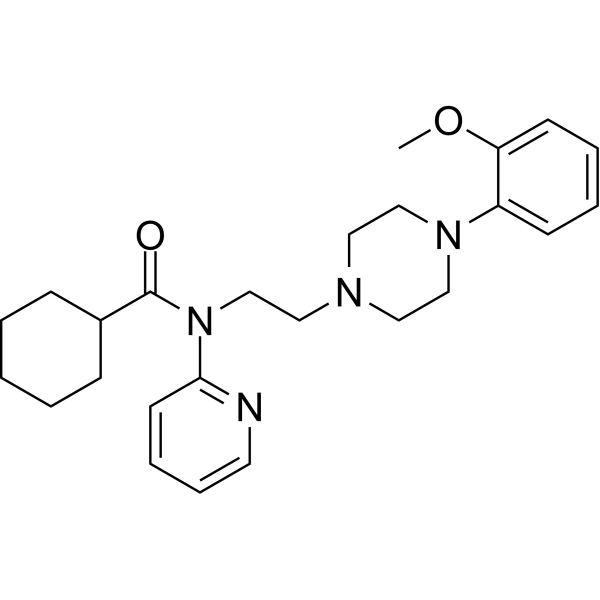
  • HY-42849

    LIN-1418

    Dopamine Receptor Neurological Disease
    Sultopride (LIN-1418) is a selective antagonist of dopamine D2 receptor.
    Sultopride
  • HY-144291

    Dopamine Receptor Neurological Disease
    LY3154885 is an orally active dopamine D1 receptor positive allosteric modulator (PAM). LY3154885 has an improved agent-agent interactions (DDI) risk profile .
    LY3154885
  • HY-129507

    DAB-452 fumarate

    Dopamine Receptor Neurological Disease
    Aplindore fumarate (DAB-452 fumarate) is a dopamine D2 receptor partial agonist. Aplindore fumarate could be used in studies of Parkinson's disease and schizophrenia .
    Aplindore fumarate
  • HY-A0125

    Dopamine Receptor Neurological Disease
    Alizapride is a potent antiemetic, acting as a dopamine receptor antagonist. Alizapride also used in human digestive disorders .
    Alizapride
  • HY-14326

    Dopamine Receptor Neurological Disease
    L-750667 is a selective dopamine D4 receptor antagonist ligand. 125I-labeled L-750667 can specifically bind to dopamine D4 receptors in the rat retina, with a Kd value of 0.06 nM. L-750667 is involved in the regulation of the light-sensitive cAMP pool .
    L-750667
  • HY-A0172

    Captodiamine

    5-HT Receptor Dopamine Receptor Sigma Receptor Neurological Disease
    Captodiame (Captodiamine) is a 5-HT2c receptor antagonist and sigma-1 and D3 dopamine receptor agonist. Captodiame shows antidepressant effect .
    Captodiame
  • HY-127120

    Dopamine Receptor Neurological Disease
    Timiperone has a strong affinity for cerebral dopamine D2 receptor. Timiperone has antipsychotic activity, and inhibits stereotyped behaviour. Timiperone can be used for research of schizophrenia .
    Timiperone
  • HY-12520

    Dopamine Receptor Neurological Disease Cancer
    SKF 38393 is a selective dopamine D1 receptor agonist. SKF 38393 activates the cAMP signaling pathway and promotes dopamine release in the developing rat striatum. SKF 38393 inhibits MCF-7 breast cancer cell proliferation (IC50=0.1 μM). SKF 38393 is promising for research of neurodevelopmental disorders, dopamine-related diseases (e.g., Parkinson’s, dopamine deficiency), and cancers .
    SKF 38393
  • HY-114576

    Nooglutyl; ONK-10

    iGluR Dopamine Receptor Neurological Disease
    Nooglutil (Nooglutyl; ONK-10) is a positive modulator of AMPA-type glutamate receptors (AMPARs). Nooglutil also regulates dopamine D2 receptor function to exert anxiolytic effects. Nooglutil is promising for research of neurodegenerative disorders (e.g., Alzheimer’s disease) .
    Nooglutil
  • HY-17637R

    ITI-007 (Standard)

    Dopamine Receptor 5-HT Receptor Reference Standards Neurological Disease Cancer
    Lumateperone (Standard) is the analytical standard of Lumateperone. This product is intended for research and analytical applications. Lumateperone (ITI-007) is an orally active 5-HT2A receptor antagonist (Ki = 0.54 nM), a partial agonist of presynaptic D2 receptors and an antagonist of postsynaptic D2 receptors (Ki = 32 nM), and a dopamine D1 receptor modulator. Lumateperone has anticancer activity and can also be used for the study of schizophrenia and bipolar depression .
    Lumateperone (Standard)
  • HY-14542C

    CP-88059 mesylate

    5-HT Receptor Dopamine Receptor Neurological Disease
    Ziprasidone (CP-88059) mesylate is an orally active combined 5-HT and dopamine receptor antagonist . Ziprasidone mesylate has affinities for Rat D2 (Ki=4.8 nM), 5-HT2A (Ki=0.42 nM) and 5-HT1A (Ki=3.4 nM) .
    Ziprasidone mesylate
  • HY-100966

    Sigma Receptor Neurological Disease
    BD-1008 dihydrobromide is a nonselective σ receptor antagonist with Kis against σ1 receptor and σ2 receptor of 2 nM and 8 nM. The BD-1008 dihydrobromide has an extremely low affinity for the D2 receptor (Ki = 1112 nM) and dopamine transporter (DAT) (Ki > 10,000 nM). BD-1008 dihydrobromide significantly antagonizes dopamine release in the shell region of the nucleus accumbens via the σ₂ receptor. BD-1008 dihydrobromide blocks the self-administration behavior of σ agonists.BD-1008 dihydrobromide can be used for the study of addiction therapy that target the σ receptor .
    BD-1008 dihydrobromide
  • HY-14542B

    CP-88059 mesylate trihydrate

    5-HT Receptor Dopamine Receptor Neurological Disease
    Ziprasidone (CP-88059) mesylate trihydrate is an orally active combined 5-HT and dopamine receptor antagonist . Ziprasidone mesylate trihydrate has affinities for Rat D2 (Ki=4.8 nM), 5-HT2A (Ki=0.42 nM) and 5-HT1A (Ki=3.4 nM) .
    Ziprasidone mesylate trihydrate
  • HY-14325R

    Dopamine Receptor Neurological Disease
    L-745870 (Standard) is the analytical standard of L-745870. This product is intended for research and analytical applications. L-745870 is a potent, selective, brain-penetrant and orally active dopamine D4 receptor antagonist with a Ki of 0.43 nM. L-745870 shows weaker affinity for D2 (Ki of 960 nM) and D3 (Ki of 2300 nM) receptors, and exhibits moderate affinity for 5-HT2 receptors, sigma sites and α-adrenoceptors .
    L-745870 (Standard)
  • HY-P2687

    Urodilatin (human)

    Natriuretic Peptide Receptor (NPR) Cardiovascular Disease
    Ularitide (Urodilatin), natriuretic peptide, is a vasodilator. Ularitide binds to and activates renal receptors. Ularitide also regulates renal dopamine metabolism Ularitide can be used in the research of heart failure .
    Ularitide
  • HY-103405A

    Dopamine Receptor Neurological Disease
    NGD 94-1 (dimaleate) is a potent and selective dopamine D4 receptor antagonist. NGD 94-1 (dimaleate) shows high affinity for the cloned human D4.2 receptor (Ki = 3.6 nM). NGD 94-1 (dimaleate) modulates the cognitive functions of the frontostriatal system and regulates dopaminergic transmission in Phencyclidine (PCP)-induced monkeys. NGD 94-1 (dimaleate) can be used for neurological disease research [1][2].
    NGD 94-1 dimaleate
  • HY-W752502

    Dopamine Receptor Vasopressin Receptor Adrenergic Receptor Cardiovascular Disease
    Docarpamine is an orally active dopamine prodrug that can be hydroxylated in the small intestine and liver to form active dopamine. Docarpamine mainly activates D1-like receptors in peripheral blood vessels to lower blood pressure and heart rate in a state of spontaneous hypertension. Docarpamine exerts a pressor and tachycardic effect by activating D1-like receptors, vasopressin V1 receptors, and α-adrenergic receptors in normal blood pressure conditions. Docarpamine can be used for research on renal vascular dilation and diuresis .
    Docarpamine
  • HY-106605

    LY 120363

    Dopamine Receptor 5-HT Receptor Neurological Disease
    Flumezapine (LY 120363) is a potent and balanced antagonist of the dopamine D2 receptor and the 5-hydroxytryptamine receptor (5-HT receptor). Flumezapine does not alter the increase in serum cortisol caused by κ-opioid receptor agonists. Flumezapine inhibits the conditioned avoidance response in rats and has a low risk of extrapyramidal side effects. Flumezapine can be used in antipsychotic research .
    Flumezapine
  • HY-115953

    Dopamine Receptor Neurological Disease
    Dopamine D3 receptor ligand is a potent, selective and high affinity ligand for Dopamine D3 receptor with 89-fold selective for D3 over D2 (D3 Ki= 8 nM, D2 Ki= 715 nM) .
    Dopamine D3 receptor ligand-1
  • HY-75502R

    N-0923 (Standard); (-)-N 0437 (Standard)

    Reference Standards Dopamine Receptor Adrenergic Receptor 5-HT Receptor Neurological Disease Endocrinology
    Rotigotine (Standard) is the analytical standard of Rotigotine. This product is intended for research and analytical applications. Rotigotine is a potent dopamine receptor agonist with Ki values of 0.71 nM, 4-15 nM, and 83 nM for the dopamine D3 receptor and D2, D5, D4 receptors and dopamine D1 receptor. Rotigotine a partial agonist of the 5-HT1A receptor, and an antagonist of the α2B-adrenergic receptor. Rotigotine can be used for parkinson's disease (PD) research .
    Rotigotine (Standard)
  • HY-116495

    PNU-96391

    Dopamine Receptor Neurological Disease
    (-)-OSU6162 (PNU-96391) is a presynaptic dopamine receptor antagonist .
    (-)-OSU6162

Inquiry Online

Your information is safe with us. * Required Fields.

Salutation


Country or Region *

Applicant Name *


Organization Name *

Department *


Email Address *


Product Name *

Cat. No.


Requested quantity *

Phone Number *


Remarks

Inquiry Online

Inquiry Information

Product Name:
Cat. No.:
Quantity:
MCE Japan Authorized Agent:

