



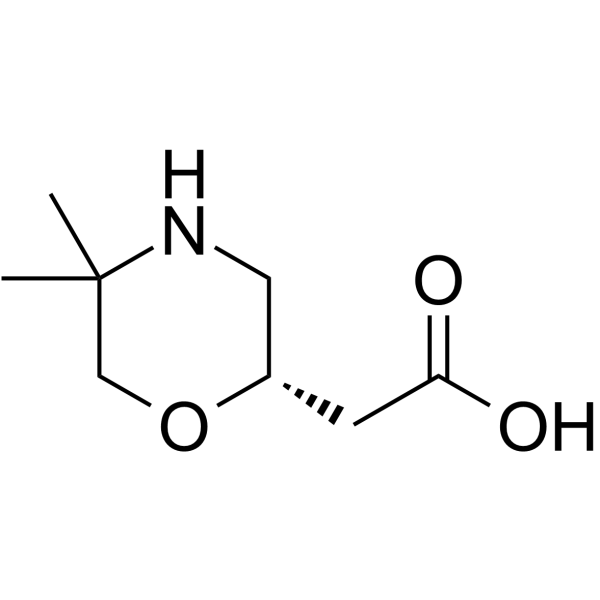
SCH 50911

Based on 1 Customer Validation
SCH 50911 is a selective, orally active, blood-brain barrier permeable GABA-B receptor (GABA-B Receptor) antagonist with an IC50 of 1.1 μM in rats. SCH 50911 blocks baclofen-induced antitussive effects, regulates neuronal firing and GABA release. SCH 50911 promotes spontaneous seizures during withdrawal in ethanol-dependent rats, alters reward-related neurotransmission, and reduces or suppresses lever responding and self-administration behaviors of alcohol and sucrose in rats. SCH 50911 is applicable to research related to ethanol withdrawal syndrome, absence epilepsy and alcohol use disorder.
Nos produits utilisent uniquement pour la recherche. Nous ne vendons pas aux patients.
- Pureté : 99.62%
- CAS No.: 733717-87-8
- Formule: C8H15NO3
- Masse moléculaire:173.21
-
Stockage:Powder -20°C, 3 years , 4°C, 2 years ; In solvent -80°C, 6 months , -20°C, 1 month

To place orders, for customer services and technical support, please contact: MedChemExpress USA
Tel: 609-228-6898 E-mail: [email protected] [email protected]


-
 Activité biologique
-
Chemical Information
-
Solvant et solubilité
- Pureté et documentation
- Références
-
 Help & FAQs




Activité biologique
Description
IC50 & Target
|
GABA(B) 1.1 μM (IC50) |
In Vitro
SCH 50911 (1.1-2.2 μM) potently inhibits GABA binding to GABA-B receptors in rat brain with an IC50 of 1.1 μM, and shows no binding affinity for most tested non-GABA-B receptors aside from weak activity in a nonspecific muscarinic binding assay[1].
MedChemExpress (MCE) has not independently confirmed the accuracy of these methods. They are for reference only.
In Vivo
Sch 50911 suppresses multiple forms of absence seizures in lethargic (lh/lh) mutant mice[3].
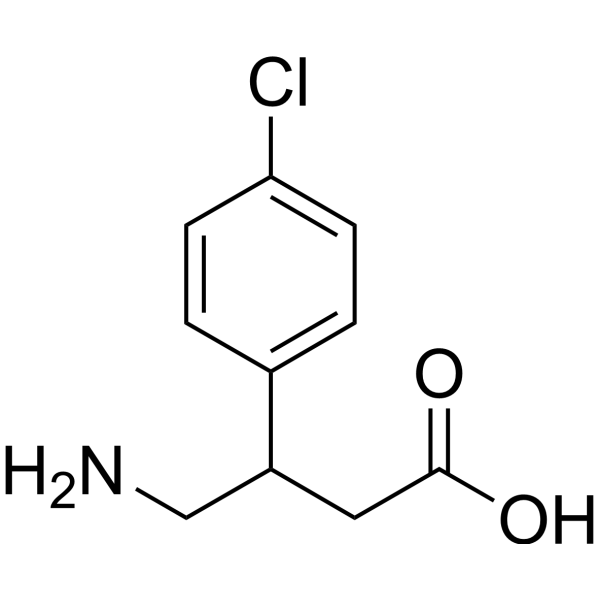
Sch 50911 (systemic) crosses the blood-brain barrier and blocks Baclofen (HY-B0007)-induced central antitussive and respiratory depressant effects in Felis catus and Cavia porcellus[3].
SCH 50911 (25-100 mg/kg; i.p.; single dose; 30 minutes before test session) reduces operant alcohol self-administration in male sP rats, with statistically significant ~35% and ~65% reductions in alcohol lever-responses at 50 and 100 mg/kg, respectively, and marked interindividual response variability[4].
SCH 50911 (100 mg/kg; i.p.; single dose; 30 minutes before test session) produces a statistically significant ~70% reduction in operant sucrose self-administration in male sP rats, with marked interindividual response variability[4].
MedChemExpress (MCE) has not independently confirmed the accuracy of these methods. They are for reference only.
-
Animal Model:Wistar rats (male, 275-300g, ethanol-dependent via Majchrowicz method)[2]
-
Dosage:100 mg/kg; 170 mg/kg; 300 mg/kg
-
Administration:i.p.; single acute dose
-
Result:Produced seizure scores significantly higher than saline-treated controls.
Induced repeated tonic-clonic seizures (score 6) in 4 out of 9 rats at 300 mg/kg.
Caused a significant, dose-dependent increase in seizure score.
-
Animal Model:Sardinian alcohol-preferring (sP) rats (male, 55 days old, 95th to 97th generations, trained to lever-respond for oral alcohol under fixed ratio 4 schedule)[4]
-
Dosage:25 mg/kg; 50 mg/kg; 100 mg/kg
-
Administration:i.p.; single dose; 30 minutes before 30-minute test session
-
Result:Produced a statistically significant ~35% reduction in alcohol lever-responses at 50 mg/kg.
Produced a statistically significant ~65% reduction in alcohol lever-responses at 100 mg/kg.
Produced a statistically significant reduction in the amount of self-administered alcohol at 100 mg/kg.
Induced virtually complete suppression of alcohol lever-responses in 1/16, 3/16, and 10/16 rats at 25, 50, and 100 mg/kg, respectively.
Produced a statistically significant ~45% reduction in alcohol lever-responses at 100 mg/kg (replication experiment).
Induced virtually complete suppression of alcohol lever-responses in 0/16, 5/16, and 8/16 rats at 25, 50, and 100 mg/kg, respectively.
Revealed four response variability subgroups in combined data (n=32 rats): 10/32 rats showed dose-related reduction with multiple doses; 6/32 rats showed reduction only at 100 mg/kg; 10/32 rats showed V-shaped response pattern; 6/32 rats showed no effect from any dose.
-
Animal Model:Sardinian alcohol-preferring (sP) rats (male, 55 days old, 95th to 97th generations, trained to lever-respond for sucrose solution under fixed ratio 4 schedule)[4]
-
Dosage:25 mg/kg; 50 mg/kg; 100 mg/kg
-
Administration:i.p.; single dose; 30 minutes before 30-minute test session
-
Result:Produced a statistically significant ~70% reduction in sucrose lever-responses at 100 mg/kg.
Produced a statistically significant reduction in the amount of self-administered sucrose solution at 100 mg/kg.
Induced virtually complete suppression of sucrose lever-responses in 0/16, 1/16, and 10/16 rats at 25, 50, and 100 mg/kg, respectively.
Revealed four response variability subgroups (n=16 rats): 6/16 rats showed dose-related reduction with multiple doses; 4/16 rats showed reduction only at 100 mg/kg; 4/16 rats showed V-shaped response pattern; 2/16 rats showed no effect from any dose.


Chemical Information
-
CAS No. 733717-87-8
-
Appearance Solid
-
Masse moléculaire 173.21
-
Formule C8H15NO3
-
Color White to light yellow
-
SMILES
O=C(O)C[C@H]1CNC(C)(C)CO1
-
Livraison
Room temperature in continental US; may vary elsewhere.
-
Stockage
Powder -20°C 3 years 4°C 2 years In solvent -80°C 6 months -20°C 1 month


Solvant et solubilité
In Vitro:
H2O : 12.5 mg/mL (72.17 mM; ultrasonic and warming and heat to 60°C)
Please refer to the solubility information to select the appropriate solvent. Once prepared, please aliquot and store the solution to prevent product inactivation from repeated freeze-thaw cycles.
Storage method and period of stock solution: -80°C, 6 months; -20°C, 1 month. When stored at -80°C, please use it within 6 months. When stored at -20°C, please use it within 1 month.
* Note: If you choose water as the stock solution, please dilute it to the working solution, then filter and sterilize it with a 0.22 μm filter before use.
Please refer to the solubility information to select the appropriate solvent. Once prepared, please aliquot and store the solution to prevent product inactivation from repeated freeze-thaw cycles.
Storage method and period of stock solution: -80°C, 6 months; -20°C, 1 month. When stored at -80°C, please use it within 6 months. When stored at -20°C, please use it within 1 month.
* Note: If you choose water as the stock solution, please dilute it to the working solution, then filter and sterilize it with a 0.22 μm filter before use.
Concentration (start) × Volume (start) = Concentration (final) × Volume (final)


Pureté et documentation
-
Fiche technique (277 KB)
-
SDS (254 KB)
- English - EN (254 KB)
- Français - FR (254 KB)
- Deutsch - DE (254 KB)
- Norwegian - NO (254 KB)
- Español - ES (254 KB)
- Swedish - SV (254 KB)
- Italian - IT (254 KB)
- Korean - KR (254 KB)
- Portuguese - PT (254 KB)
-
Instruction de manipulation (2659 KB)
Références
[1].
Bolser DC, et al. The pharmacology of SCH 50911: a novel, orally-active GABA-beta receptor antagonist. J Pharmacol Exp Ther. 1995 Sep;274(3):1393-8. PMID: 7562513.
[Content Brief]
[2]. Carai MA, et al. Proconvulsive effect of the GABA(B) receptor antagonist, SCH 50911, in rats undergoing ethanol withdrawal syndrome. Eur J Pharmacol. 2002;445(3):195-199. [Content Brief]
[3]. Ong J, et al. The morpholino-acetic acid analogue Sch 50911 is a selective GABA(B) receptor antagonist in rat neocortical slices. Eur J Pharmacol. 1998;362(1):35-41. [Content Brief]
[4]. Maccioni P, et al. Blockade of the GABAB receptor suppressed alcohol self-administration in rats: an effect similar to that produced by GABAB receptor activation. Behav Pharmacol. 2022;33(1):51-60. [Content Brief]


Complete Stock Solution Preparation Table
Please refer to the solubility information to select the appropriate solvent. Once prepared, please aliquot and store the solution to prevent product inactivation from repeated freeze-thaw cycles.
Storage method and period of stock solution: -80°C, 6 months; -20°C, 1 month. When stored at -80°C, please use it within 6 months. When stored at -20°C, please use it within 1 month.
| Optional Solvent | Concentration Solvent Mass | 1 mg | 5 mg | 10 mg | 25 mg |
|---|---|---|---|---|---|
| H2O | 1 mM | 5.7733 mL | 28.8667 mL | 57.7334 mL | 144.3335 mL |
| 5 mM | 1.1547 mL | 5.7733 mL | 11.5467 mL | 28.8667 mL | |
| 10 mM | 0.5773 mL | 2.8867 mL | 5.7733 mL | 14.4333 mL | |
| 15 mM | 0.3849 mL | 1.9244 mL | 3.8489 mL | 9.6222 mL | |
| 20 mM | 0.2887 mL | 1.4433 mL | 2.8867 mL | 7.2167 mL | |
| 25 mM | 0.2309 mL | 1.1547 mL | 2.3093 mL | 5.7733 mL | |
| 30 mM | 0.1924 mL | 0.9622 mL | 1.9244 mL | 4.8111 mL | |
| 40 mM | 0.1443 mL | 0.7217 mL | 1.4433 mL | 3.6083 mL | |
| 50 mM | 0.1155 mL | 0.5773 mL | 1.1547 mL | 2.8867 mL | |
| 60 mM | 0.0962 mL | 0.4811 mL | 0.9622 mL | 2.4056 mL |
* Note: If you choose water as the stock solution, please dilute it to the working solution, then filter and sterilize it with a 0.22 μm filter before use.


SCH 50911 Related Classifications
HY-12783A Related Classifications
 Powered by Bioz