



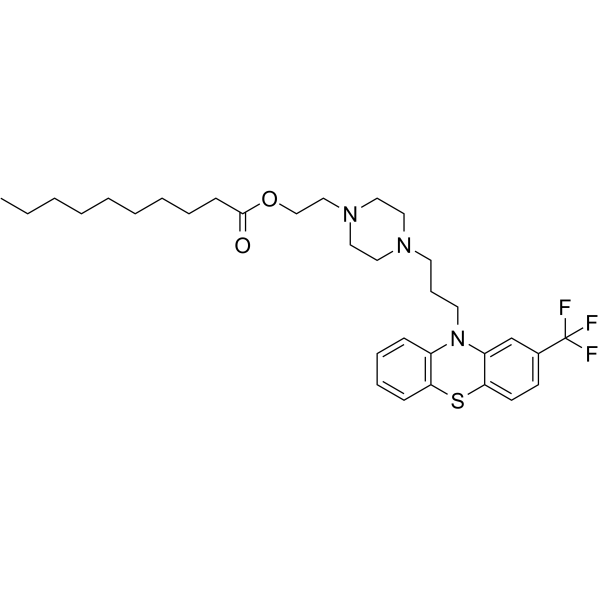
Fluphenazine decanoate

Based on 1 Customer Validation
Fluphenazine decanoate is a CNS-penetrant dopamine D2 receptor inhibitor, is a long-acting phenothiazine neuroleptic. Fluphenazine can be used for schizophrenia research.
For research use only. We do not sell to patients.
- Purity : 98.75%
- CAS No.: 5002-47-1
- Formula: C32H44F3N3O2S
- Molecular Weight:591.77
-
Storage:Pure form -20°C, 3 years , 4°C, 2 years ; In solvent -80°C, 6 months , -20°C, 1 month

To place orders, for customer services and technical support, please contact: MedChemExpress USA
Tel: 609-228-6898 E-mail: [email protected] [email protected]


-
 Biological Activity
-
Chemical Information
-
Solvent & Solubility
- Purity & Documentation
- References
-
 Help & FAQs



All Dopamine Receptor Isoforms
More

Biological Activity
Description
IC50 & Target
|
D2 Receptor |
In Vitro
Fluphenazine decanoate shows activity against T. gondii in human fibroblast cell cultures with an IC50 value of 1.7 mM[1].
MedChemExpress (MCE) has not independently confirmed the accuracy of these methods. They are for reference only. .
In Vivo
Fluphenazine decanoate (25 mg/kg; i.m.; 6 times every 3 weeks; 24 weeks) induces mouth movements in the rat, serves as a pharmacological model of human tardive dyskinesia[3].
Fluphenazine decanoate (1, 2, 3 mg/kg/d; s.c.; 60 d) shows antifertility effects and induces hyperprolactinemia concomitant with gonadotropin suppression in adult male rat[4].
MedChemExpress (MCE) has not independently confirmed the accuracy of these methods. They are for reference only.
-
Animal Model:Cebus apella monkey[2]
-
Dosage:0.22 mg/kg and followed by 0.33 mg/kg
-
Administration:Intramuscular injection; 8 times per 3 weeks; 0.22 mg/kg for 63 weeks and 0.33 mg/kg for 6 weeks
-
Result:Decreased the aggressiveness composite behavioral variables (CBV).
Resulted stereotypic behavior induced by agonist and decreased prolactin response to AMPH.
-
Animal Model:Male Sprague-Dawley rats (250 g)[3]
-
Dosage:25 mg/kg
-
Administration:Intramuscular injection into the hind limb; 24 weeks
-
Result:Resulted in spontaneous vacuous chewing mouth movements and jaw tremor.
-
Animal Model:Adult male rats[4]
-
Dosage:1, 2, 3 mg/kg/d
-
Administration:Subcutaneous injection between 10:00-12:00 h; 60 days
-
Result:Increased serum prolactin level and suppressed serum LH and FSH levels at day 60.
Increased hypothalamic tyrosine hydroxylase levels, enhanced chromatin decondensation, and resulted DNA denaturation.


Chemical Information
-
CAS No. 5002-47-1
-
Appearance <30°C Solid,>32°C Liquid
-
Molecular Weight 591.77
-
Formula C32H44F3N3O2S
-
Color Light yellow to yellow
-
SMILES
CCCCCCCCCC(OCCN1CCN(CCCN2C3=C(C=CC=C3)SC4=CC=C(C(F)(F)F)C=C24)CC1)=O
-
Shipping
Room temperature in continental US; may vary elsewhere.
-
Storage
Pure form -20°C 3 years 4°C 2 years In solvent -80°C 6 months -20°C 1 month


Solvent & Solubility
In Vitro:
DMSO : 125 mg/mL (211.23 mM; Need ultrasonic; Hygroscopic DMSO has a significant impact on the solubility of product, please use newly opened DMSO)
Ethanol : 50 mg/mL (84.49 mM; Need ultrasonic)
Please refer to the solubility information to select the appropriate solvent. Once prepared, please aliquot and store the solution to prevent product inactivation from repeated freeze-thaw cycles.
Storage method and period of stock solution: -80°C, 6 months; -20°C, 1 month. When stored at -80°C, please use it within 6 months. When stored at -20°C, please use it within 1 month.
Please refer to the solubility information to select the appropriate solvent. Once prepared, please aliquot and store the solution to prevent product inactivation from repeated freeze-thaw cycles.
Storage method and period of stock solution: -80°C, 6 months; -20°C, 1 month. When stored at -80°C, please use it within 6 months. When stored at -20°C, please use it within 1 month.
Concentration (start) × Volume (start) = Concentration (final) × Volume (final)
In Vivo:
Select the appropriate dissolution method based on your experimental animal and administration route.
- For the following dissolution methods, please ensure to first prepare a clear stock solution using an In Vitro approach and then sequentially add co-solvents:
- To ensure reliable experimental results, the clarified stock solution can be appropriately stored based on storage conditions. As for the working solution for In Vivo experiments, it is recommended to prepare freshly and use it on the same day.
- The percentages shown for the solvents indicate their volumetric ratio in the final prepared solution. If precipitation or phase separation occurs during preparation, heat and/or sonication can be used to aid dissolution.
Add each solvent one by one: 10% DMSO 40% PEG300 5% Tween-80 45% Saline
Solubility: ≥ 1.08 mg/mL (1.83 mM); Clear solution
This protocol yields a clear solution of ≥ 1.08 mg/mL (saturation unknown).
Taking 1 mL working solution as an example, add 100 μL DMSO stock solution (10.8 mg/mL) to 400 μL PEG300, and mix evenly; then add 50 μL Tween-80 and mix evenly; then add 450 μL Saline to adjust the volume to 1 mL.
Preparation of Saline: Dissolve 0.9 g sodium chloride in ddH₂O and dilute to 100 mL to obtain a clear Saline solution.
Add each solvent one by one: 10% DMSO 90% (20% SBE-β-CD in Saline)
Solubility: ≥ 1.08 mg/mL (1.83 mM); Clear solution
This protocol yields a clear solution of ≥ 1.08 mg/mL (saturation unknown).
Taking 1 mL working solution as an example, add 100 μL DMSO stock solution (10.8 mg/mL) to 900 μL 20% SBE-β-CD in Saline, and mix evenly.
Preparation of 20% SBE-β-CD in Saline (4°C, storage for one week): 2 g SBE-β-CD powder is dissolved in 10 mL Saline, completely dissolve until clear.
In Vivo Dissolution Calculator
Please enter the basic information of animal experiments:
-
-
-
-
Recommended: Prepare an additional quantity of animals to account for potential losses during experiments.
Please enter your animal formula composition:
-
%DMSO +
Recommended: Keep the proportion of DMSO in working solution below 2% if your animal is weak.
-
%+
-
+%Tween-80 + +
-
%Saline +
The co-solvents required include: DMSO, . All of co-solvents are available by MedChemExpress (MCE). , Tween 80. All of co-solvents are available by MedChemExpress (MCE).
Working solution concentration: 0.22 mg/mL
Method for preparing stock solution: mg drug dissolved in μL DMSO. Stock solution concentration: mg/mL.
1. Take μL DMSO stock solution;
2. Add μL .
μL , mix evenly;
3. Then add μL Tween 80, mix evenly;
4. Then add μL
Please ensure that the stock solution in the first step is dissolved to a clear state, and add co-solvents in sequence. You can use ultrasonic heating (ultrasonic cleaner, recommended frequency 20-40 kHz), vortexing, etc. to assist dissolution.


Purity & Documentation
-
Data Sheet (273 KB)
-
SDS (644 KB)
- English - EN (644 KB)
- Français - FR (644 KB)
- Deutsch - DE (644 KB)
- Norwegian - NO (644 KB)
- Español - ES (644 KB)
- Swedish - SV (644 KB)
- Italian - IT (644 KB)
- Korean - KR (644 KB)
- Portuguese - PT (644 KB)
-
Handling Instructions (2659 KB)
References
[1]. Goodwin DG, et al. Evaluation of five antischizophrenic agents against Toxoplasma gondii in human cell cultures. J Parasitol. 2011 Feb;97(1):148-51. [Content Brief]
[2]. Lifshitz K, et al. Effects of dopamine agonists on Cebus apella monkeys with previous long-term exposure to fluphenazine. Biol Psychiatry. 1997 Mar 15;41(6):657-67. [Content Brief]
[3]. Stoessl AJ, et al. Chronic neuroleptic-induced mouth movements in the rat: suppression by CCK and selective dopamine D1 and D2 receptor antagonists. Psychopharmacology (Berl). 1989;98(3):372-9. [Content Brief]
[4]. Gill-Sharma MK, et al. Antifertility effects of fluphenazine in adult male rats. J Endocrinol Invest. 2003 Apr;26(4):316-26. [Content Brief]


Complete Stock Solution Preparation Table
Please refer to the solubility information to select the appropriate solvent. Once prepared, please aliquot and store the solution to prevent product inactivation from repeated freeze-thaw cycles.
Storage method and period of stock solution: -80°C, 6 months; -20°C, 1 month. When stored at -80°C, please use it within 6 months. When stored at -20°C, please use it within 1 month.
| Optional Solvent | Concentration Solvent Mass | 1 mg | 5 mg | 10 mg | 25 mg |
|---|---|---|---|---|---|
| Ethanol / DMSO | 1 mM | 1.6898 mL | 8.4492 mL | 16.8985 mL | 42.2461 mL |
| 5 mM | 0.3380 mL | 1.6898 mL | 3.3797 mL | 8.4492 mL | |
| 10 mM | 0.1690 mL | 0.8449 mL | 1.6898 mL | 4.2246 mL | |
| 15 mM | 0.1127 mL | 0.5633 mL | 1.1266 mL | 2.8164 mL | |
| 20 mM | 0.0845 mL | 0.4225 mL | 0.8449 mL | 2.1123 mL | |
| 25 mM | 0.0676 mL | 0.3380 mL | 0.6759 mL | 1.6898 mL | |
| 30 mM | 0.0563 mL | 0.2816 mL | 0.5633 mL | 1.4082 mL | |
| 40 mM | 0.0422 mL | 0.2112 mL | 0.4225 mL | 1.0562 mL | |
| 50 mM | 0.0338 mL | 0.1690 mL | 0.3380 mL | 0.8449 mL | |
| 60 mM | 0.0282 mL | 0.1408 mL | 0.2816 mL | 0.7041 mL | |
| 80 mM | 0.0211 mL | 0.1056 mL | 0.2112 mL | 0.5281 mL | |
| DMSO | 100 mM | 0.0169 mL | 0.0845 mL | 0.1690 mL | 0.4225 mL |


Fluphenazine decanoate Related Classifications
HY-B1904 Related Classifications
 Powered by Bioz
Keywords
- Fluphenazine decanoate
- 5002-47-1
- Dopamine Receptor
- long-acting
- phenothiazine
- neuroleptic
- schizophrenia
- dopamine-D2
- reproductive
- T. gondii
- hypothalamic tyrosine hydroxylase levels
- human tardive dyskinesia
- gonadotropin suppression
- antifertility
- hyperprolactinemia
- mouth movements
- vacuous chewing mouth movement
- jaw tremor
- serum prolactin
- Inhibitor
- inhibitor
- inhibit