



Metoclopramide hydrochloride
Based on 3 publication(s) in Google Scholar
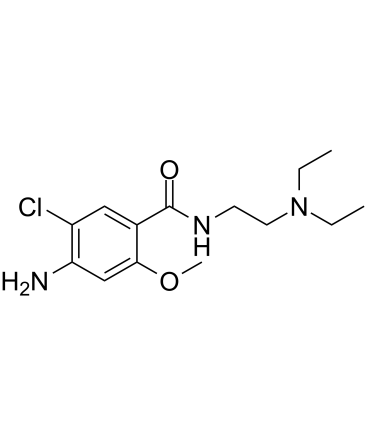
Metoclopramide hydrochloride is a potent and orally active antagonist of 5-HT3 and dopamine D2 receptor, with IC50s of 308 nM and 483 nM, respectively. Metoclopramide hydrochloride can be used for the research of nausea and vomiting, gastro-oesophageal reflux, and gastroparesis.
For research use only. We do not sell to patients.
- CAS No.: 7232-21-5
- Formula: C14H23Cl2N3O2
- Molecular Weight:336.26
-
Storage:
4°C, sealed storage, away from moisture
* In solvent : -80°C, 6 months; -20°C, 1 month (sealed storage, away from moisture)


To place orders, for customer services and technical support, please contact: MedChemExpress USA
Tel: 609-228-6898 E-mail: [email protected] [email protected]


-
 Biological Activity
-
Chemical Information
- Purity & Documentation
- References
-
 Help & FAQs


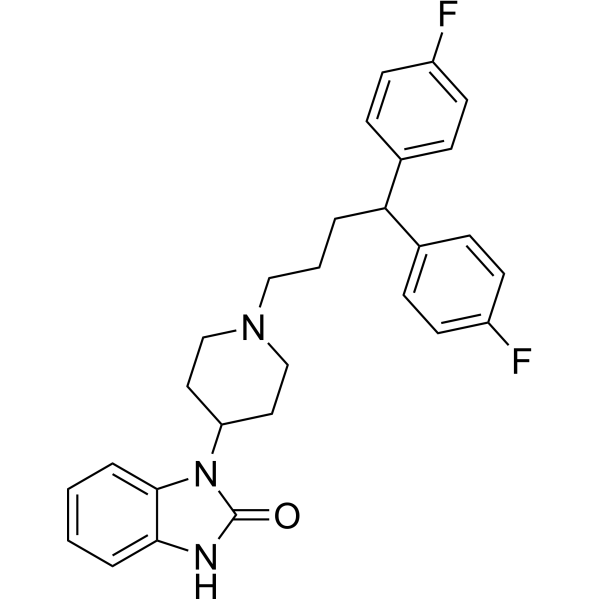


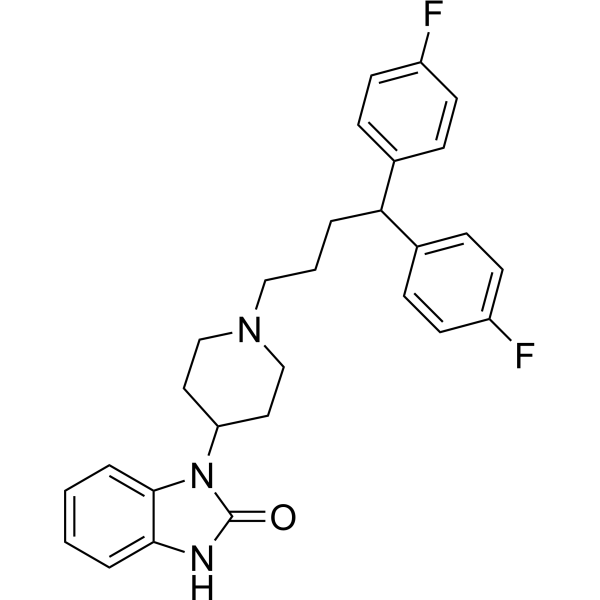
Publications Citing Use of MedChemExpress (MCE) Metoclopramide hydrochloride
MoreAll 5-HT Receptor Isoforms
MoreAll Dopamine Receptor Isoforms
More

Biological Activity
Description
IC50 & Target
[1]|
5-HT3 Receptor 308 nM (IC50) |
D2 Receptor 483 nM (IC50) |
Cellular Effect
|
Cell Line

|
Type | Value | Description | References |
|---|---|---|---|---|
| HEK293 | IC50 |
94.8 μM
Compound: Methoclopramide
|
Inhibition of 4-(4-(dimethylamino)styryl)-N-methylpyridinium uptake at human OCT1 expressed in HEK293 cells by confocal microscopy
Inhibition of 4-(4-(dimethylamino)styryl)-N-methylpyridinium uptake at human OCT1 expressed in HEK293 cells by confocal microscopy
|
[PMID: 18788725] |
| NHDF | IC50 |
>50 μM
Compound: 43
|
Cytotoxicity against NHDF assessed as reduction in cell viability after 72 hrs by MTT assay
Cytotoxicity against NHDF assessed as reduction in cell viability after 72 hrs by MTT assay
|
[PMID: 28671460] |
In Vitro
Metoclopramide (0.01-10 μM) hydrochloride stimulates aldosterone release in isolated perfused rat zona glomerulosa cells[3].
Metoclopramide hydrochloride results in prokinesis by four mechanisms: inhibition of presynaptic D2 receptors and stimulation of presynaptic excitatory 5-HT4 receptors, thereby allowing acetylcholine (ACh) release from intrinsic cholinergic motor neurons; inhibition of D2 postsynaptic receptors; and antagonism of the presynaptic inhibition of muscarinic receptors, leading to further augmentation of ACh release[2].
MedChemExpress (MCE) has not independently confirmed the accuracy of these methods. They are for reference only.
In Vivo
Metoclopramide (5-40 mg/kg; i.p.) hydrochloride induces catalepsy and antagonizes Apomorphine induced cage climbing behaviour in mice[5].
Metoclopramide (1.25-2.5 mg/kg; i.p.) hydrochloride induces stereotyped cage climbing behaviour in mice[5].
MedChemExpress (MCE) has not independently confirmed the accuracy of these methods. They are for reference only.
-
Animal Model:Adult, virgin female mice of the Swiss EPM-1 strain[4]
-
Dosage:6.7 µg/g
-
Administration:S.c. daily for 50 days
-
Result:Increased the number but also stimulated the metabolic activity of lactotrophs.


Chemical Information
-
CAS No. 7232-21-5
-
Appearance Solid
-
Molecular Weight 336.26
-
Formula C14H23Cl2N3O2
-
Color White to off-white
-
SMILES
O=C(NCCN(CC)CC)C1=CC(Cl)=C(N)C=C1OC.Cl
-
Shipping
Room temperature in continental US; may vary elsewhere.
-
Storage
4°C, sealed storage, away from moisture
* In solvent : -80°C, 6 months; -20°C, 1 month (sealed storage, away from moisture)


Publications (3)
-
Journal Impact Factor
-
Most Recent
-
-
ACS Omega
Computational Approaches to Identify Molecules Binding to Mycobacterium tuberculosis KasA. [Abstract]2020 Nov 15;5(46):29935-29942. PMID: 33251429 -
Eur J Drug Metab Pharmacokinet
Evaluation of an Ussing Chamber System Equipped with Rat Intestinal Tissues to Predict Intestinal Absorption and Metabolism in Humans. [Abstract]2022 Sep;47(5):639-652. PMID: 35733077


Purity & Documentation
-
Data Sheet (273 KB)
-
SDS (392 KB)
- English - EN (392 KB)
- Français - FR (392 KB)
- Deutsch - DE (392 KB)
- Norwegian - NO (392 KB)
- Español - ES (392 KB)
- Swedish - SV (392 KB)
- Italian - IT (392 KB)
- Korean - KR (392 KB)
- Portuguese - PT (392 KB)
-
Handling Instructions (2659 KB)
References
[1]. Hirokawa Y, et, al. Synthesis and structure-activity relationships of 4-amino-5-chloro-N-(1,4-dialkylhexahydro-1,4-diazepin-6-yl)-2-methoxybenzamide derivatives, novel and potent serotonin 5-HT3 and dopamine D2 receptors dual antagonist. Chem Pharm Bull (Tokyo). 2002 Jul;50(7):941-59. [Content Brief]
[2]. Rao AS, et, al. Review article: metoclopramide and tardive dyskinesia. Aliment Pharmacol Ther. 2010 Jan;31(1):11-9. [Content Brief]
[3]. Edwards CR, et, al. In vivo and in vitro studies on the effect of metoclopramide on aldosterone secretion. Clin Endocrinol (Oxf). 1980 Jul;13(1):45-50. [Content Brief]
[4]. Bhosale KB, et, al. Dose-dependent response of central dopaminergic systems to metoclopramide in mice. Indian J Exp Biol. 1997 Jun;35(6):618-22. [Content Brief]
[5]. Gomes RCT, et, al. Effects of metoclopramide on the mouse anterior pituitary during the estrous cycle. Clinics (Sao Paulo). 2011;66(6):1101-4. [Content Brief]

Calculators
Concentration (start) × Volume (start) = Concentration (final) × Volume (final)


Metoclopramide hydrochloride Related Classifications
HY-17382B Related Classifications
 Powered by Bioz