



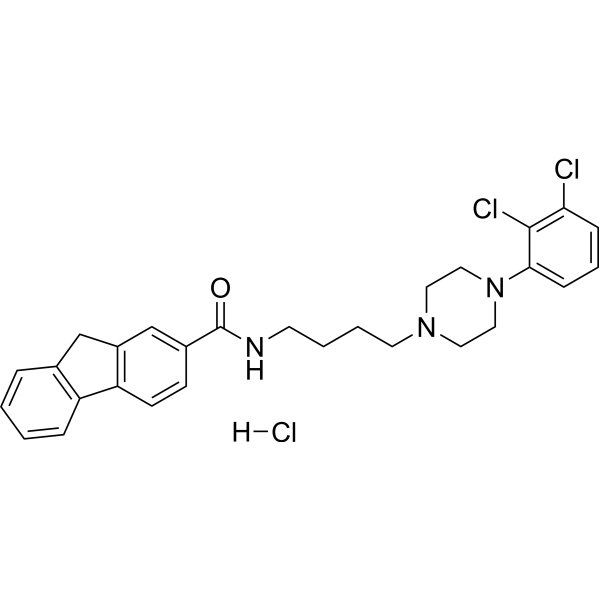
NGB 2904 hydrochloride
NGB 2904 hydrochloride is a potent, selective, orally active and brain-penetrated antagonist of dopamine D3 receptor, with a Ki of 1.4 nM. NGB 2904 hydrochloride shows selectivity for D3 over D2, 5-HT2, α1, D4, D1 and D5 receptors (Kis=217, 223, 642, >5000, >10000 and >10000 nM, respectively). NGB 2904 hydrochloride antagonizes Quinpirole-stimulated mitogenesis.
For research use only. We do not sell to patients.
- CAS No.: 189061-11-8
- Formula: C28H30Cl3N3O
- Molecular Weight:530.92
-
Storage:
Please store the product under the recommended conditions in the Certificate of Analysis.

To place orders, for customer services and technical support, please contact: MedChemExpress USA
Tel: 609-228-6898 E-mail: [email protected] [email protected]


-
 Biological Activity
-
Chemical Information
- Purity & Documentation
- References
-
 Help & FAQs


All Dopamine Receptor Isoforms
More

Biological Activity
Description
IC50 & Target
[1]|
D3 Receptor 1.4 (Ki) |
In Vitro
NGB 2904 antagonizes Quinpirole (100 nM)-stimulated mitogenesis, with an IC50 of 5.0 nM[1].
MedChemExpress (MCE) has not independently confirmed the accuracy of these methods. They are for reference only.
In Vivo
NGB 2904 (0.026 μg-1 mg/kg; a single s.c. or once daily for 7 d) stimulates spontaneous locomotion in wild-type mice[3].
MedChemExpress (MCE) has not independently confirmed the accuracy of these methods. They are for reference only.


Chemical Information
-
CAS No. 189061-11-8
-
Molecular Weight 530.92
-
Formula C28H30Cl3N3O
-
SMILES
O=C(C1=CC(CC2=C3C=CC=C2)=C3C=C1)NCCCCN4CCN(C5=CC=CC(Cl)=C5Cl)CC4.[H]Cl
-
Shipping
Room temperature in continental US; may vary elsewhere.
-
Storage
Please store the product under the recommended conditions in the Certificate of Analysis.


Purity & Documentation
References
[1]. Yuan J, et, al. NGB 2904 and NGB 2849: two highly selective dopamine D3 receptor antagonists. Bioorg Med Chem Lett. 1998 Oct 6;8(19):2715-8. [Content Brief]
[2]. Xi ZX, et, al. The novel dopamine D3 receptor antagonist NGB 2904 inhibits cocaine's rewarding effects and cocaine-induced reinstatement of drug-seeking behavior in rats. Neuropsychopharmacology. 2006 Jul;31(7):1393-405. [Content Brief]
[3]. Pritchard LM, et, al. The dopamine D3 receptor antagonist NGB 2904 increases spontaneous and amphetamine-stimulated locomotion. Pharmacol Biochem Behav. 2007 Apr;86(4):718-26. [Content Brief]

Calculators
Concentration (start) × Volume (start) = Concentration (final) × Volume (final)


NGB 2904 hydrochloride Related Classifications
HY-12697A Related Classifications
 Powered by Bioz