



ML417
Based on 2 publication(s) in Google Scholar
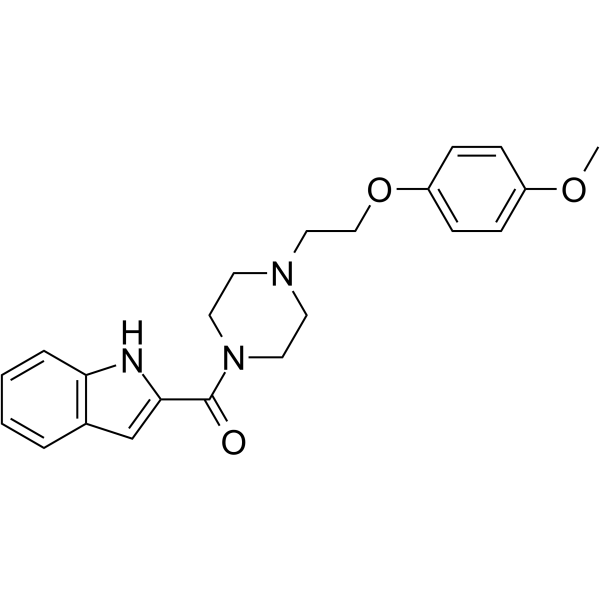
ML417 is a selective and brain penetrant D3 dopamine receptor (D3R) agonist, with an EC50 of 38 nM. ML417 potently promotes D3R-mediated β-arrestin translocation, G protein mediated signaling, and pERK phosphorylation with minimal effects on other GPCR-mediated signaling. ML417 exhibits neuroprotection against toxin-induced neurodegeneration of dopaminergic neurons.
For research use only. We do not sell to patients.
- Purity : 99.39%
- CAS No.: 1386162-69-1
- Formula: C22H25N3O3
- Molecular Weight:379.45
-
Storage:Powder -20°C, 3 years , 4°C, 2 years ; In solvent -80°C, 2 years , -20°C, 1 year

To place orders, for customer services and technical support, please contact: MedChemExpress USA
Tel: 609-228-6898 E-mail: [email protected] [email protected]


-
 Biological Activity
-
Chemical Information
-
Solvent & Solubility
- Protocols
- Purity & Documentation
- References
-
 Help & FAQs


Publications Citing Use of MedChemExpress (MCE) ML417
MoreAll Dopamine Receptor Isoforms
More

Biological Activity
Description
IC50 & Target
HY-P7488|
D3 Receptor 38 nM (EC50) |
Cellular Effect
|
Cell Line

|
Type | Value | Description | References |
|---|---|---|---|---|
| HEK293 | EC50 |
0.18 nM
Compound: 20; ML417
|
Agonist activity at RLuc8-fused Go-coupled human D3R expressed in HEK293 cells untagged beta1 and mVenus-tagged gamma2 measured after 5 mins in presence of coelenterazine H by BRET assay
Agonist activity at RLuc8-fused Go-coupled human D3R expressed in HEK293 cells untagged beta1 and mVenus-tagged gamma2 measured after 5 mins in presence of coelenterazine H by BRET assay
|
[PMID: 32342685] |
| HEK293 | EC50 |
1.2 nM
Compound: 20; ML417
|
Agonist activity at RLuc8-fused human D3R expressed in HEK293 cells co-expressing N-terminal Venus-tagged beta-arrestin2 and GRK3 assessed as induction of beta-arrestin2 recruitment measured after 5 mins in presence of coelenterazine H by BRET assay
Agonist activity at RLuc8-fused human D3R expressed in HEK293 cells co-expressing N-terminal Venus-tagged beta-arrestin2 and GRK3 assessed as induction of beta-arrestin2 recruitment measured after 5 mins in presence of coelenterazine H by BRET assay
|
[PMID: 32342685] |
| HEK293 | EC50 |
17 nM
Compound: 20; ML417
|
Agonist activity at RLuc8-fused human D3R Y198A mutant expressed in HEK293 cells co-expressing N-terminal Venus-tagged beta-arrestin2 and GRK3 assessed as induction of beta-arrestin2 recruitment measured after 5 mins in presence of coelenterazine H by BRE
Agonist activity at RLuc8-fused human D3R Y198A mutant expressed in HEK293 cells co-expressing N-terminal Venus-tagged beta-arrestin2 and GRK3 assessed as induction of beta-arrestin2 recruitment measured after 5 mins in presence of coelenterazine H by BRE
|
[PMID: 32342685] |
| HEK293 | EC50 |
520 nM
Compound: 20; ML417
|
Agonist activity at RLuc8-fused human D3R Y365A mutant expressed in HEK293 cells co-expressing N-terminal Venus-tagged beta-arrestin2 and GRK3 assessed as induction of beta-arrestin2 recruitment measured after 5 mins in presence of coelenterazine H by BRE
Agonist activity at RLuc8-fused human D3R Y365A mutant expressed in HEK293 cells co-expressing N-terminal Venus-tagged beta-arrestin2 and GRK3 assessed as induction of beta-arrestin2 recruitment measured after 5 mins in presence of coelenterazine H by BRE
|
[PMID: 32342685] |
| HEK293 | EC50 |
86 nM
Compound: 20; ML417
|
Agonist activity at human D3R expressed in HEK293 cells assessed as inhibition of forskolin-stimulated cAMP production measured after 5 mins in presence of beta-adrenergic blocker propranolol and coelenterazine H by CAMYEL BRET assay
Agonist activity at human D3R expressed in HEK293 cells assessed as inhibition of forskolin-stimulated cAMP production measured after 5 mins in presence of beta-adrenergic blocker propranolol and coelenterazine H by CAMYEL BRET assay
|
[PMID: 32342685] |
In Vitro
ML417 exhibits a Ki for the D3R of 1.24 µM. ML417 is a full and potent agonist for multiple signaling pathways associated with D3R activation[1].
ML417 potently inhibits cAMP accumulation with an EC50 of 86 nM and an efficacy identical to that of dopamine. ML417 exhibits submicromolar affinity for only three of the targets, the β1-adrenergic, 5-HT2B serotoninergic, and σ-1 receptors. ML417 stimulates β-arrestin recruitment to the D3R-WT with an EC50 of 1.4 nM[1].
ML417 protects (0.005-5 μM; 24 hours) D3R-expressing dopaminergic neurons from 6-OHDA induced cell death[1].
MedChemExpress (MCE) has not independently confirmed the accuracy of these methods. They are for reference only.
In Vivo
MedChemExpress (MCE) has not independently confirmed the accuracy of these methods. They are for reference only.
-
Animal Model:6-8 week old male C57BL/6 mice[1]
-
Dosage:20 mg/kg
-
Administration:I.p. (Pharmacokinetic Analysis)
-
Result:Brain penetrant and exhibits a plasma half-life of 3.44 hours and a brain half-life of 4.23 hours. Displayed a plasma Tmax of 0.5 hours and Cmax of 6500 ng/ml, and a brain Tmax of 0.25 hours and Cmax of 28000 ng/ml.


Chemical Information
-
CAS No. 1386162-69-1
-
Appearance Solid
-
Molecular Weight 379.45
-
Formula C22H25N3O3
-
Color Off-white to light yellow
-
SMILES
O=C(C(N1)=CC2=C1C=CC=C2)N3CCN(CCOC4=CC=C(OC)C=C4)CC3
-
Shipping
Room temperature in continental US; may vary elsewhere.
-
Storage
Powder -20°C 3 years 4°C 2 years In solvent -80°C 2 years -20°C 1 year


Publications (2)
-
Journal Impact Factor
-
Most Recent
-
-
bioRxiv
2025 Aug 12:2025.08.08.668522. PMID: 40832361


Solvent & Solubility
In Vitro:
DMSO : 50 mg/mL (131.77 mM; Need ultrasonic; Hygroscopic DMSO has a significant impact on the solubility of product, please use newly opened DMSO)
Please refer to the solubility information to select the appropriate solvent. Once prepared, please aliquot and store the solution to prevent product inactivation from repeated freeze-thaw cycles.
Storage method and period of stock solution: -80°C, 2 years; -20°C, 1 year. When stored at -80°C, please use it within 2 years. When stored at -20°C, please use it within 1 year.
Please refer to the solubility information to select the appropriate solvent. Once prepared, please aliquot and store the solution to prevent product inactivation from repeated freeze-thaw cycles.
Storage method and period of stock solution: -80°C, 2 years; -20°C, 1 year. When stored at -80°C, please use it within 2 years. When stored at -20°C, please use it within 1 year.
Concentration (start) × Volume (start) = Concentration (final) × Volume (final)
In Vivo:
Select the appropriate dissolution method based on your experimental animal and administration route.
- For the following dissolution methods, please ensure to first prepare a clear stock solution using an In Vitro approach and then sequentially add co-solvents:
- To ensure reliable experimental results, the clarified stock solution can be appropriately stored based on storage conditions. As for the working solution for In Vivo experiments, it is recommended to prepare freshly and use it on the same day.
- The percentages shown for the solvents indicate their volumetric ratio in the final prepared solution. If precipitation or phase separation occurs during preparation, heat and/or sonication can be used to aid dissolution.
In Vivo Dissolution Calculator
Please enter the basic information of animal experiments:
-
-
-
-
Recommended: Prepare an additional quantity of animals to account for potential losses during experiments.
Please enter your animal formula composition:
-
%DMSO +
Recommended: Keep the proportion of DMSO in working solution below 2% if your animal is weak.
-
%+
-
+%Tween-80 + +
-
%Saline +
The co-solvents required include: DMSO, . All of co-solvents are available by MedChemExpress (MCE). , Tween 80. All of co-solvents are available by MedChemExpress (MCE).
Working solution concentration: 0.22 mg/mL
Method for preparing stock solution: mg drug dissolved in μL DMSO. Stock solution concentration: mg/mL.
1. Take μL DMSO stock solution;
2. Add μL .
μL , mix evenly;
3. Then add μL Tween 80, mix evenly;
4. Then add μL
Please ensure that the stock solution in the first step is dissolved to a clear state, and add co-solvents in sequence. You can use ultrasonic heating (ultrasonic cleaner, recommended frequency 20-40 kHz), vortexing, etc. to assist dissolution.


Purity & Documentation
-
Data Sheet (273 KB)
-
SDS (251 KB)
- English - EN (251 KB)
- Français - FR (251 KB)
- Deutsch - DE (251 KB)
- Norwegian - NO (251 KB)
- Español - ES (251 KB)
- Swedish - SV (251 KB)
- Italian - IT (251 KB)
- Korean - KR (251 KB)
- Portuguese - PT (251 KB)
-
Handling Instructions (2659 KB)
References


Complete Stock Solution Preparation Table
Please refer to the solubility information to select the appropriate solvent. Once prepared, please aliquot and store the solution to prevent product inactivation from repeated freeze-thaw cycles.
Storage method and period of stock solution: -80°C, 2 years; -20°C, 1 year. When stored at -80°C, please use it within 2 years. When stored at -20°C, please use it within 1 year.
| Optional Solvent | Concentration Solvent Mass | 1 mg | 5 mg | 10 mg | 25 mg |
|---|---|---|---|---|---|
| DMSO | 1 mM | 2.6354 mL | 13.1770 mL | 26.3539 mL | 65.8848 mL |
| 5 mM | 0.5271 mL | 2.6354 mL | 5.2708 mL | 13.1770 mL | |
| 10 mM | 0.2635 mL | 1.3177 mL | 2.6354 mL | 6.5885 mL | |
| 15 mM | 0.1757 mL | 0.8785 mL | 1.7569 mL | 4.3923 mL | |
| 20 mM | 0.1318 mL | 0.6588 mL | 1.3177 mL | 3.2942 mL | |
| 25 mM | 0.1054 mL | 0.5271 mL | 1.0542 mL | 2.6354 mL | |
| 30 mM | 0.0878 mL | 0.4392 mL | 0.8785 mL | 2.1962 mL | |
| 40 mM | 0.0659 mL | 0.3294 mL | 0.6588 mL | 1.6471 mL | |
| 50 mM | 0.0527 mL | 0.2635 mL | 0.5271 mL | 1.3177 mL | |
| 60 mM | 0.0439 mL | 0.2196 mL | 0.4392 mL | 1.0981 mL | |
| 80 mM | 0.0329 mL | 0.1647 mL | 0.3294 mL | 0.8236 mL | |
| 100 mM | 0.0264 mL | 0.1318 mL | 0.2635 mL | 0.6588 mL |


ML417 Related Classifications
HY-136390 Related Classifications
 Powered by Bioz