



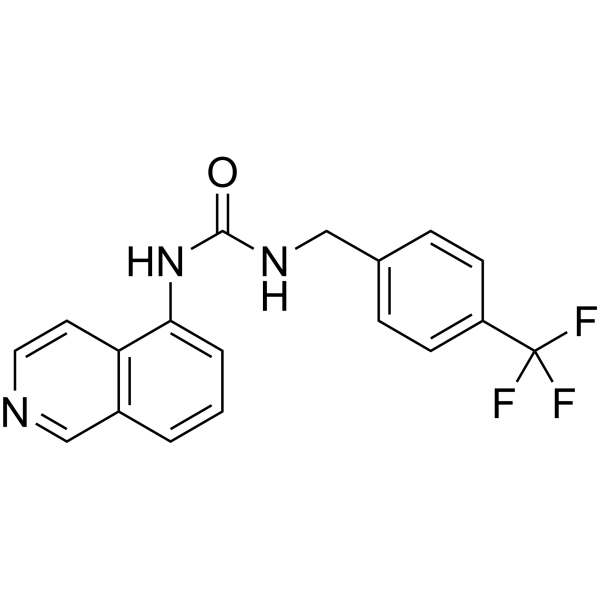
A-425619

Based on 1 Customer Validation
A-425619 is an orally active and selective transient receptor potential type V1 (TRPV1) antagonist. A-425619 blocks Capsaicin (HY-10448)- and N-arachidonoyl-dopamine (NADA)-induced Ca2+ influx in dorsal root ganglia and trigeminal ganglia. A-425619 relieves pathophysiological pain associated with inflammation and tissue injury in rats. A-425619 can be used for the study of pain related to inflammation and tissue injury.
For research use only. We do not sell to patients.
- Purity : 99.96%
- CAS No.: 581809-67-8
- Formula: C18H14F3N3O
- Molecular Weight:345.32
-
Storage:Powder -20°C, 3 years , 4°C, 2 years ; In solvent -80°C, 6 months , -20°C, 1 month

To place orders, for customer services and technical support, please contact: MedChemExpress USA
Tel: 609-228-6898 E-mail: [email protected] [email protected]


-
 Biological Activity
-
Chemical Information
-
Solvent & Solubility
- Protocols
- Purity & Documentation
- References
-
 Help & FAQs


All Calcium Channel Isoforms
More

Biological Activity
Description
Cellular Effect
|
Cell Line

|
Type | Value | Description | References |
|---|---|---|---|---|
| HEK293 | IC50 |
2 nM
Compound: 7
|
Antagonist activity at human TRPV1 expressed in HEK293 cells assessed as blockade of acid-induced receptor activation by FLIPR assay
Antagonist activity at human TRPV1 expressed in HEK293 cells assessed as blockade of acid-induced receptor activation by FLIPR assay
|
[PMID: 17489570] |
| HEK293 | IC50 |
3 nM
Compound: 7i
|
Antagonistic activity towards human vanilloid receptor subtype 1 expressed in HEK293 cell membrane, as inhibition of agonist-induced intracellular [Ca2+] levels.
Antagonistic activity towards human vanilloid receptor subtype 1 expressed in HEK293 cell membrane, as inhibition of agonist-induced intracellular [Ca2+] levels.
|
[PMID: 15149643] |
| HEK293 | IC50 |
5 nM
Compound: 7
|
Antagonist activity at human TRPV1 expressed in HEK293 cells assessed as blockade of capsaicin-induced receptor activation by FLIPR assay
Antagonist activity at human TRPV1 expressed in HEK293 cells assessed as blockade of capsaicin-induced receptor activation by FLIPR assay
|
[PMID: 17489570] |
| HEK293 | IC50 |
9 nM
Compound: 7
|
Antagonist activity at rat TRPV1 expressed in HEK293 cells assessed as blockade of capsaicin-induced receptor activation by FLIPR assay
Antagonist activity at rat TRPV1 expressed in HEK293 cells assessed as blockade of capsaicin-induced receptor activation by FLIPR assay
|
[PMID: 17489570] |
In Vitro
A-425619 (10 μM) blocks 500 nM Capsaicin (HY-10448)-induced Ca2+ influx in dorsal root ganglia (IC50 = 78 nM) and trigeminal ganglia (IC50 = 115 nM), and inhibits 3 μM N-arachidonoyl-dopamine (NADA)-induced Ca2+ influx in dorsal root ganglia (IC50 = 36 nM) and trigeminal ganglia (IC50 = 37 nM)[1].
A-425619 (100 nM) can completely inhibit TRPV1-mediated acid-activated currents in dorsal root ganglia and trigeminal ganglion neurons[1].
A-425619 (0.01-1 μM) can significantly block 300 nM Capsaicin- and 3 μM NADA-evoked calcitonin gene-related peptide (CGRP) release in dorsal root ganglia[1].
A-425619 (3-100 nM) potently blocks the activation of native TRPV1 channels in rat dorsal root ganglion neurons(IC50 = 9 nM)[2].
MedChemExpress (MCE) has not independently confirmed the accuracy of these methods. They are for reference only. Further protocols information, click here.
In Vivo
A-425619 (3.5-35 mg/kg (10-100 μmol/kg), i.p., 30 min before testing, single dose or 3.5-103 mg/kg (10-300 μmol/kg), p.o., 60 min before testing, single dose) dose-dependently relieves CFA-induced chronic inflammatory thermal hyperalgesia in rats[3].
A-425619 (103 μg/rats (300 nmol/rats), intraplantar into inflamed paw, 30 min before testing, single dose) reduces CFA-induced thermal hyperalgesia in rats[3].
A-425619 (3.5-35 mg/kg (10-100 μmol/kg), i.p., 90 min after Carrageenan (HY-125474), single dose) dose-dependently relieves Carrageenan-induced acute inflammatory thermal hyperalgesia in rats[3].
A-425619 (35 mg/kg (100 μmol/kg), p.o., twice daily for 5 days) maintains efficacy in relieving skin incision-induced mechanical allodynia in rats[3].
A-425619 (35-103 mg/kg (100-300 μmol/kg), i.p., 30 min before testing, single dose) reduces MIA-induced osteoarthritic pain in rats[3].
A-425619 (35 mg/kg (100 μmol/kg), i.p., 30 min before testing, single dose) reduces mechanical allodynia in L5/L6 spinal nerve ligation model and in sciatic nerve ligation model of neuropathic pain in rats[3].
MedChemExpress (MCE) has not independently confirmed the accuracy of these methods. They are for reference only.
-
Animal Model:Capsaicin-induced mechanical hyperalgesia model in rats: 2 μg/10 μL of capsaicin solution was subcutaneously injected into the plantar aspect of the right hind paw of rats[3]
-
Dosage:10.3-103 μg/rats (30-300 nmol/rats)
-
Administration:intraplantar 15 min before Capsaicin for a single dose
-
Result:Showed dose-dependent blocking effects on capsaicin-induced mechanical hyperalgesia.
Showed no effect on the paw withdrawal threshold of the capsaicin-injected paw when 300 nmol/rat was injected into the contralateral paw.
-
Animal Model:Capsaicin-induced mechanical hyperalgesia model in rats: 2 μg/10 μL of capsaicin solution was subcutaneously injected into the plantar aspect of the right hind paw of rats[3]
-
Dosage:10.3-35 mg/kg (30-100 μmol/kg)
-
Administration:p.o. 60 min before Capsaicin for a single dose
-
Result:Showed dose-dependent preventive effects on capsaicin-induced mechanical hyperalgesia.
Achieved full efficacy at 35 mg/kg (100 μmol/kg), with an ED50 of 45 μmol/kg.
Significantly increased the paw withdrawal threshold compared with vehicle-treated rats that received Capsaicin.
-
Animal Model:Complete Freund’s adjuvant (CFA)-induced chronic inflammatory pain model in rats: 150 μL of 50% CFA solution was injected into the plantar surface of the right hind paw of rats[3]
-
Dosage:3.5-35 mg/kg (10-100 μmol/kg) or 3.5-103 mg/kg (10-300 μmol/kg)
-
Administration:i.p. 30 min before testing for a single dose or p.o. 60 min before testing for a single dose
-
Result:Relieved CFA-induced thermal hyperalgesia, with an ED50 of 51 μmol/kg administered intraperitoneally.
Relieved CFA-induced thermal hyperalgesia, with an ED50 of 40 μmol/kg administered orally.
-
Animal Model:Complete Freund’s adjuvant (CFA)-induced chronic inflammatory pain model in rats: 150 μL of 50% CFA solution was injected into the plantar surface of the right hind paw of rats[3]
-
Dosage:103 mg/rats (300 nmol/rats)
-
Administration:intraplantar into inflamed paw 30 min before testing for a single dose
-
Result:Produced a 56.2% reduction in CFA-induced thermal hyperalgesia.
-
Animal Model:Carrageenan-induced acute inflammatory pain model in rats: 100 μL of 1% λ-carrageenan solution was injected into the plantar surface of the right hind paw of rats[3]
-
Dosage:3.5-35 mg/kg (10-100 μmol/kg)
-
Administration:i.p. 90 min after Carrageenan (HY-125474) for a single dose
-
Result:Relieved carrageenan-induced thermal hyperalgesia, with an ED50 of 50 μmol/kg.
-
Animal Model:Skin incision postoperative pain model in rats: a 1-cm longitudinal incision was made on the plantar surface (starting 0.5 cm from the proximal edge of the heel and extending toward the toes), the plantaris muscle was elevated and incised longitudinally (with origin and insertion intact), the skin was closed with two 5-0 nylon sutures[3]
-
Dosage:35 mg/kg (100 μmol/kg)
-
Administration:p.o. twice daily for 5 days
-
Result:Produced a 42.6% reduction in mechanical allodynia when tested at 24 hours after surgery (day 2), and still exerted a 37.6% analgesic effect on day 5 after surgery.
-
Animal Model:Monoiodoacetate (MIA)-induced osteoarthritic pain model in rats: under light halothane anesthesia, a single intra-articular injection of 3 mg MIA (dissolved in 0.05 ml sterile isotonic saline) was administered into the knee joint cavity of rats[3]
-
Dosage:35-103 mg/kg (100-300 μmol/kg)
-
Administration:i.p. 30 min before testing for a single dose
-
Result:Reduced MIA-induced increase in weight-bearing difference between the injured and non-injured hind limbs.
-
Animal Model:Spinal nerve (L5/L6) ligation neuropathic pain model in rats: a 1.5-cm incision was made dorsal to the lumbosacral plexus, the left L5 and L6 spinal nerves were isolated and tightly ligated with 3-0 silk threads[3]
-
Dosage:35 mg/kg (100 μmol/kg)
-
Administration:i.p. 30 min before testing for a single dose
-
Result:Reduced mechanical allodynia induced by spinal nerve injury.


Chemical Information
-
CAS No. 581809-67-8
-
Appearance Solid
-
Molecular Weight 345.32
-
Formula C18H14F3N3O
-
Color White to off-white
-
SMILES
FC(F)(F)C(C=C1)=CC=C1CNC(NC2=CC=CC3=C2C=CN=C3)=O
-
Shipping
Room temperature in continental US; may vary elsewhere.
-
Storage
Powder -20°C 3 years 4°C 2 years In solvent -80°C 6 months -20°C 1 month


Solvent & Solubility
In Vitro:
DMSO : 100 mg/mL (289.59 mM; Need ultrasonic; Hygroscopic DMSO has a significant impact on the solubility of product, please use newly opened DMSO)
Please refer to the solubility information to select the appropriate solvent. Once prepared, please aliquot and store the solution to prevent product inactivation from repeated freeze-thaw cycles.
Storage method and period of stock solution: -80°C, 6 months; -20°C, 1 month. When stored at -80°C, please use it within 6 months. When stored at -20°C, please use it within 1 month.
Please refer to the solubility information to select the appropriate solvent. Once prepared, please aliquot and store the solution to prevent product inactivation from repeated freeze-thaw cycles.
Storage method and period of stock solution: -80°C, 6 months; -20°C, 1 month. When stored at -80°C, please use it within 6 months. When stored at -20°C, please use it within 1 month.
Concentration (start) × Volume (start) = Concentration (final) × Volume (final)

Protocols
-
Ca2+ Staining Technique
Ca2+ staining is an experimental technique that utilizes specific fluorescent probes (such as Fluo-4 AM, Fura-2, etc.) to qualitatively or quantitatively detect dynamic changes in intracellular Ca2+ concentrations; this is achieved by monitoring the changes in fluorescent signals generated when these probes bind to free intracellular calcium ions. The underlying principle relies primarily on the presence of chelating groups within the probe's molecular structure that possess high affinity for calcium ions.
-
Research Protocol for Inflammation-related Diseases
The NLRP3 inflammasome is a cytosolic innate immune signaling platform that integrates priming signals and danger-signal activation to promote caspase-1 activation, maturation of IL-1β and IL-18, and gasdermin D-mediated pyroptotic cell death. The core experimental logic is to determine whether inflammatory disease phenotypes are driven by increased NLRP3 expression, ASC-containing inflammasome assembly, caspase-1 cleavage, GSDMD cleavage, and extracellular release of IL-1β/IL-18 rather than by nonspecific cell injury alone. The pathway is strongly linked to inflammation-related disease phenotypes because monosodium urate crystals activate NALP3/NLRP3 inflammasome signaling in gout-like crystal inflammation, cholesterol crystals activate NLRP3 inflammasomes in atherogenesis models, and DSS-induced intestinal inflammation has been reported to involve NLRP3 inflammasome activity. However, experimental colitis studies also show context-dependent protective effects of NLRP3 inflammasome co


Purity & Documentation
-
Data Sheet (282 KB)
-
SDS (393 KB)
- English - EN (393 KB)
- Français - FR (393 KB)
- Deutsch - DE (393 KB)
- Norwegian - NO (393 KB)
- Español - ES (393 KB)
- Swedish - SV (393 KB)
- Italian - IT (393 KB)
- Korean - KR (393 KB)
- Portuguese - PT (393 KB)
-
Handling Instructions (2659 KB)
References
[1]. McDonald HA, et al. Characterization of A-425619 at native TRPV1 receptors: a comparison between dorsal root ganglia and trigeminal ganglia. Eur J Pharmacol. 2008 Oct 31;596(1-3):62-9. [Content Brief]
[2]. El Kouhen R, et al. A-425619 [1-isoquinolin-5-yl-3-(4-trifluoromethyl-benzyl)-urea], a novel and selective transient receptor potential type V1 receptor antagonist, blocks channel activation by vanilloids, heat, and acid. J Pharmacol Exp Ther. 2005 Jul;314(1):400-9. [Content Brief]
[3]. Honore P, et al. A-425619 [1-isoquinolin-5-yl-3-(4-trifluoromethyl-benzyl)-urea], a novel transient receptor potential type V1 receptor antagonist, relieves pathophysiological pain associated with inflammation and tissue injury in rats. J Pharmacol Exp Ther. 2005 Jul;314(1):410-21. [Content Brief]


Complete Stock Solution Preparation Table
Please refer to the solubility information to select the appropriate solvent. Once prepared, please aliquot and store the solution to prevent product inactivation from repeated freeze-thaw cycles.
Storage method and period of stock solution: -80°C, 6 months; -20°C, 1 month. When stored at -80°C, please use it within 6 months. When stored at -20°C, please use it within 1 month.
| Optional Solvent | Concentration Solvent Mass | 1 mg | 5 mg | 10 mg | 25 mg |
|---|---|---|---|---|---|
| DMSO | 1 mM | 2.8959 mL | 14.4793 mL | 28.9586 mL | 72.3966 mL |
| 5 mM | 0.5792 mL | 2.8959 mL | 5.7917 mL | 14.4793 mL | |
| 10 mM | 0.2896 mL | 1.4479 mL | 2.8959 mL | 7.2397 mL | |
| 15 mM | 0.1931 mL | 0.9653 mL | 1.9306 mL | 4.8264 mL | |
| 20 mM | 0.1448 mL | 0.7240 mL | 1.4479 mL | 3.6198 mL | |
| 25 mM | 0.1158 mL | 0.5792 mL | 1.1583 mL | 2.8959 mL | |
| 30 mM | 0.0965 mL | 0.4826 mL | 0.9653 mL | 2.4132 mL | |
| 40 mM | 0.0724 mL | 0.3620 mL | 0.7240 mL | 1.8099 mL | |
| 50 mM | 0.0579 mL | 0.2896 mL | 0.5792 mL | 1.4479 mL | |
| 60 mM | 0.0483 mL | 0.2413 mL | 0.4826 mL | 1.2066 mL | |
| 80 mM | 0.0362 mL | 0.1810 mL | 0.3620 mL | 0.9050 mL | |
| 100 mM | 0.0290 mL | 0.1448 mL | 0.2896 mL | 0.7240 mL |


A-425619 Related Classifications
HY-110292 Related Classifications
 Powered by Bioz