



TRPM4
TRPM4 (transient receptor potential melastatin 4) is a Ca2+-activated, voltage-dependent, nonselective monovalent cation channel that converts intracellular Ca2+ signals into membrane depolarization and thereby regulates Ca2+ entry through other Ca2+-permeable pathways[1][2]. Mechanistically, TRPM4 activity is strongly controlled by phosphatidylinositol 4,5-bisphosphate (PIP2), which enhances channel Ca2+ sensitivity, shifts voltage dependence, and counteracts channel desensitization, linking TRPM4 to phospholipase C-associated signaling processes[1]. Through its effects on membrane potential and Ca2+ homeostasis, TRPM4 participates in physiological functions including electrical signaling, immune responses, insulin secretion, and cardiovascular regulation[2][3]. In disease contexts, altered TRPM4 function has been associated with cardiac conduction disorders and other pathophysiological conditions in which dysregulated cellular excitability contributes to disease progression[2]. Compared with the closely related isoform TRPM5, TRPM4 shares the characteristic of being a Ca2+-activated monovalent cation channel but differs in tissue distribution and physiological roles, making isoform-specific interpretation important in experimental studies[3][4]. For experimental applications, pharmacological inhibition of TRPM4 has become a useful strategy for investigating channel-dependent signaling and electrophysiological mechanisms, and several small-molecule inhibitors have been evaluated for their ability to modulate TRPM4 activity in vitro and in vivo[5].
References:
- [1]. Nilius B, et al. The Ca2+-activated cation channel TRPM4 is regulated by phosphatidylinositol 4,5-biphosphate. EMBO J. 2006 Feb 8;25(3):467-78. [Content Brief]
- [2]. Morinaga T, et al. Role of Membrane Cholesterol Levels in Activation of Lyn upon Cell Detachment. Int J Mol Sci. 2018 Jun 19;19(6):1811. [Content Brief]
- [3]. Dienes C, et al. Pharmacological Modulation and (Patho)Physiological Roles of TRPM4 Channel-Part 2: TRPM4 in Health and Disease. Pharmaceuticals (Basel). 2021 Dec 28;15(1):40. [Content Brief]
- [4]. Database: Guide to pharmacology.
- [5]. Arullampalam P, et al. Species-Specific Effects of Cation Channel TRPM4 Small-Molecule Inhibitors. Front Pharmacol. 2021 Jul 12;12:712354. [Content Brief]
All Product Categories
-
TRPM4 Related Products (4)
Related Products (4)

-
9-Phenanthrol
 0 Images9-Phenanthrol (9-Hydroxyphenanthrene) is a selective TRPM4 inhibitor with an IC50 of 17 μM. 9-Phenanthrol has no inhibitory activity on TRPM5, TRPC6, and CFTR. 9-Phenanthrol can be used for the research of ischemia-reperfusion injury.
-
TRPM4-IN-2
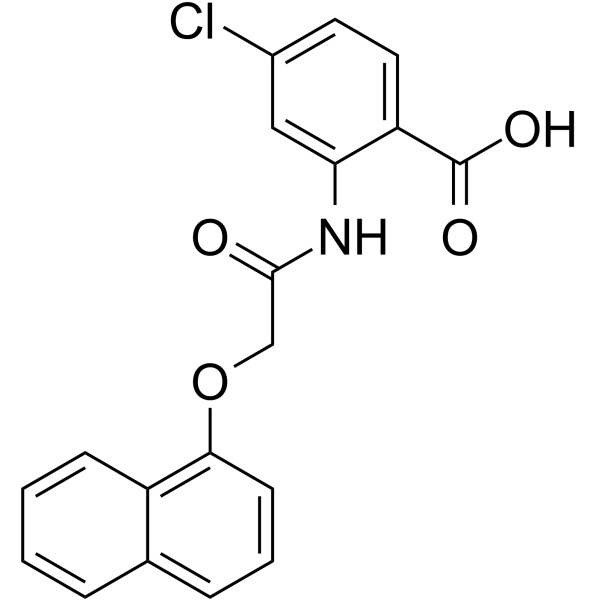 0 ImagesSynonyms: NBATRPM4-IN-2 (NBA) is a potent transient receptor potential melastatin 4 (TRPM4) inhibitor with an IC50 value of 0.16 μM. TRPM4-IN-2 can be used for researching prostate cancer and colorectal cancer.
-
ErSO-TFPy
 0 ImagesSynonyms: TEQ103; Sera2ErSO-TFPy (TEQ103) is an ERα+ tumor cell inhibitor with low nanomolar cytotoxic activity against ERα+ breast cancer cells. ErSO-TFPy activates the sodium channel TRPM4, causes an imbalance of intracellular calcium and sodium ions. ErSO-TFPy dysregulates calcium homeostasis in ERα+ tumor cells, triggers the anticipatory unfolded protein response, and induces rapid immune cell-independent necrotic cell death. ErSO-TFPy can be used for the research of estrogen receptor alpha positive breast cancer.
-
TRPM4-IN-4
 0 ImagesCat. No.: HY-183268TRPM4-IN-4 (Compound 118) is a selective TRPM4 inhibitor with an IC50 value of 0.339 μM against hTRPM4. TRPM4-IN-4 inhibits hTRPM4 and mTRPM4. TRPM4-IN-4 can be used for the research of colorectal cancer.



