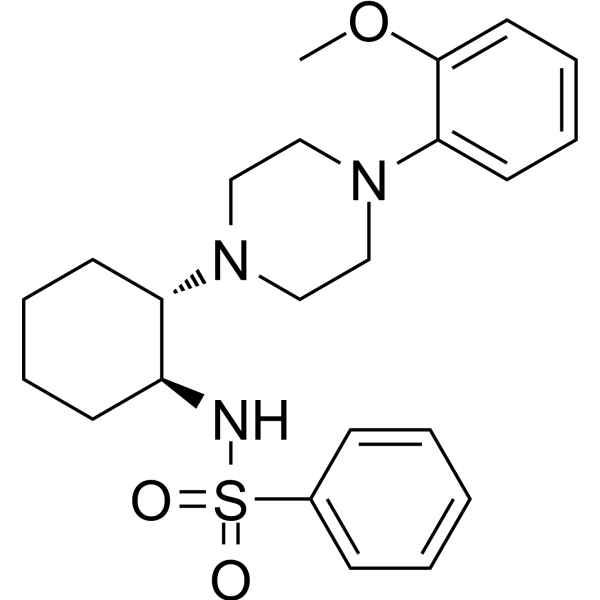
TRPML1
TRPML1 (MCOLN1) is a late endosome-lysosome nonselective cation channel that releases Ca2+, Zn2+, and Fe2+ to regulate endocytosis, exocytosis, lysosomal biogenesis, lysosome reformation, and autophagy[1]. Mechanistically, TRPML1 links lysosomal Ca2+ to autophagosome biogenesis by activating the CaMKKβ-AMPK-ULK1-VPS34 pathway and promoting PI3P-dependent recruitment of phagophore proteins[2]. In disease models, TRPML1 loss causes mucolipidosis type IV, while TRPML1 activation improves α-synuclein aggregate clearance, rescues Alzheimer-related endosomal-autophagic-lysosomal defects, and reverses VacA-disrupted endolysosomal trafficking during Helicobacter pylori infection[2][3][4][5]. Compared with related isoforms, TRPML3 acts as a PI3P effector in phagophores, whereas TRPML1 primarily controls late endolysosomal Ca2+ signaling and can form MCOLN1-MCOLN3 heteromers for autophagosome-lysosome fusion[6][7]. For experimental applications, ML-SA1 and ML1-SA1 activate TRPML1-dependent lysosomal Ca2+ signaling, whereas ML-SI3 and EDME-related antagonists support loss-of-function studies of autophagy, TFEB translocation, migration, invasion, and disease-relevant lysosomal trafficking[3][4][8][9].
References:
- [1]. Qi J, et al. MCOLN1/TRPML1 in the lysosome: a promising target for autophagy modulation in diverse diseases. Autophagy. 2024 Aug;20(8):1712-1722. [Content Brief]
- [2]. Scotto Rosato A, et al. TRPML1 links lysosomal calcium to autophagosome biogenesis through the activation of the CaMKKβ/VPS34 pathway. Nat Commun. 2019 Dec 10;10(1):5630. [Content Brief]
- [3]. Pollmanns MR, et al. Activated Endolysosomal Cation Channel TRPML1 Facilitates Maturation of α-Synuclein-Containing Autophagosomes. Front Cell Neurosci. 2022 Jul 6;16:861202. [Content Brief]
- [4]. Somogyi A, et al. The synthetic TRPML1 agonist ML-SA1 rescues Alzheimer-related alterations of the endosomal-autophagic-lysosomal system. J Cell Sci. 2023 Mar 15;136(6):jcs259875. [Content Brief]
- [5]. Capurro MI, et al. VacA generates a protective intracellular reservoir for Helicobacter pylori that is eliminated by activation of the lysosomal calcium channel TRPML1. Nat Microbiol. 2019 Aug;4(8):1411-1423. [Content Brief]
- [6]. Kim SW, et al. The intracellular Ca2+ channel TRPML3 is a PI3P effector that regulates autophagosome biogenesis. Proc Natl Acad Sci U S A. 2022 Oct 25;119(43):e2200085119. [Content Brief]
- [7]. Kwon J, et al. MCOLN1/TRPML1-MCOLN3/TRPML3 heteromer and its coupling to Ca2+ sensor SYT5 regulates autophagosome-lysosome fusion in a PtdIns4P-dependent manner. Autophagy. 2025 Nov;21(11):2456-2472. [Content Brief]
- [8]. Siow WX, et al. Lysosomal TRPML1 regulates mitochondrial function in hepatocellular carcinoma cells. J Cell Sci. 2022 Mar 15;135(6):jcs259455. [Content Brief]
- [9]. Rühl P, et al. Estradiol analogs attenuate autophagy, cell migration and invasion by direct and selective inhibition of TRPML1, independent of estrogen receptors. Sci Rep. 2021 Apr 15;11(1):8313. [Content Brief]
All Product Categories
-
TRPML1 Related Products (4)
Related Products (4)

-
ML-SI3
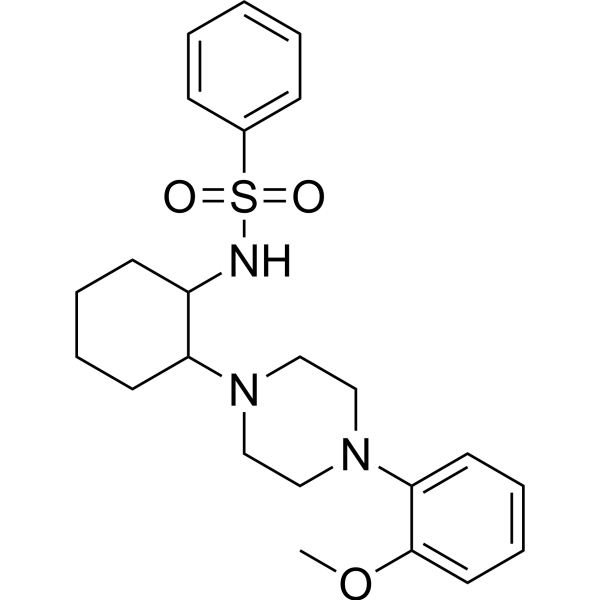 0 ImagesSynonyms: ML-SI3 (cis/trans mix)ML-SI3 is a mixture of cis/trans ML-SI3 (HY-139426A), which is a TRPML1/2 channel inhibitor with IC50s of 4.7 μM and 1.7 μM, respectively. ML-SI3 also inhibits lysosomal calcium efflux and blocks downstream TRPML1-mediated autophagy. The cis/trans ML-SI3 (HY-139426A) components of ML-SI3 are TRPML2 activators with EC50s of 3.3 μM and 9.4 μM, respectively.
-
(1R,2R)-ML-SI3
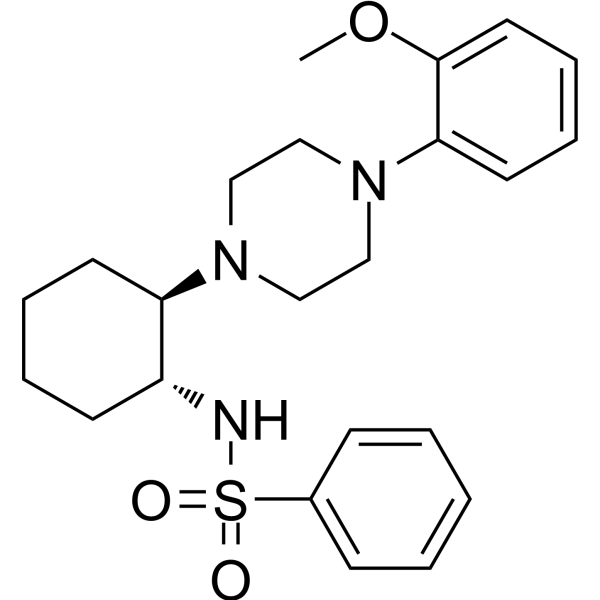 0 ImagesSynonyms: (-)-trans-ML-SI3
-
(rel)-ML-SI3
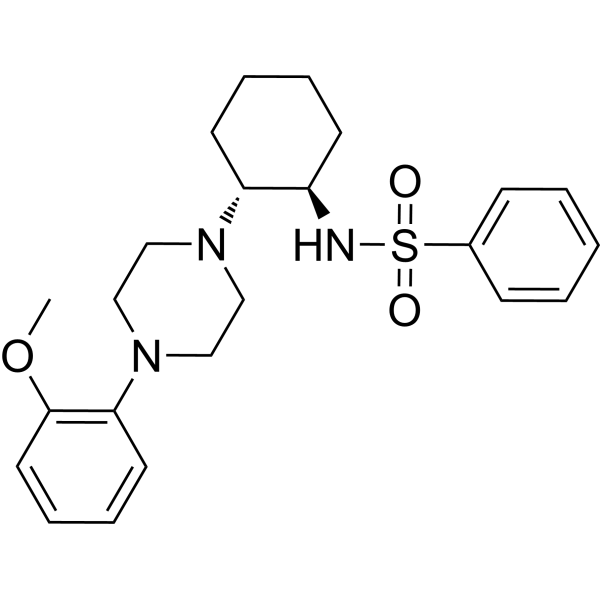 0 ImagesSynonyms: trans-ML-SI3