



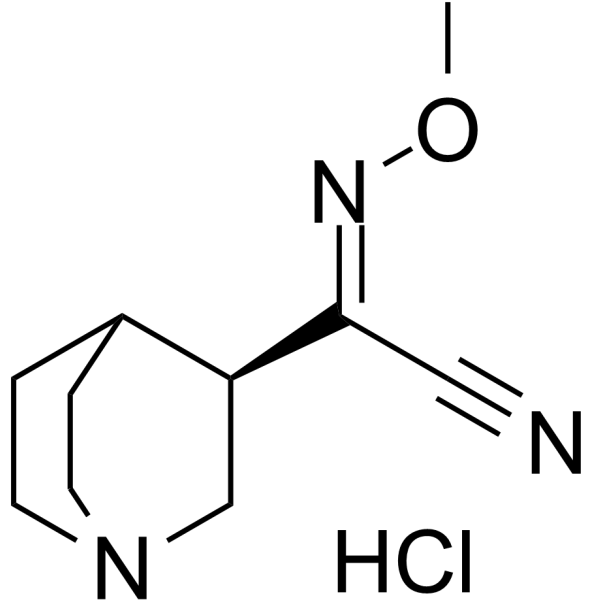
Sabcomeline hydrochloride

Based on 1 Customer Validation
Sabcomeline (SB-202026; Memric) hydrochloride is a muscarinic receptor agonist capable of crossing the blood-brain barrier. Sabcomeline hydrochloride exhibits affinity for all hM1 to hM5 subtypes (pKi=6.72-7.23), and shows near-full agonism at the hM3 receptor, inducing extracellular acidification. Sabcomeline hydrochloride alters the binding kinetics of dopamine D2 receptors through neural network regulation. Sabcomeline hydrochloride also causes minimal cardiovascular changes, effectively reverses spatial memory deficits in rodents and induces conditioned taste aversion. Sabcomeline hydrochloride is an important tool compound in studies of Alzheimer's disease and related neurodegenerative diseases.
For research use only. We do not sell to patients.
- Purity : 99.81%
- CAS No.: 159912-58-0
- Formula: C10H16ClN3O
- Molecular Weight:229.71
-
Storage:
4°C, stored under nitrogen, away from moisture
* In solvent : -80°C, 6 months; -20°C, 1 month (stored under nitrogen, away from moisture)

To place orders, for customer services and technical support, please contact: MedChemExpress USA
Tel: 609-228-6898 E-mail: [email protected] [email protected]


-
 Biological Activity
-
Chemical Information
-
Solvent & Solubility
- Protocols
- Purity & Documentation
- References
-
 Help & FAQs


All Dopamine Receptor Isoforms
More

Biological Activity
Description
IC50 & Target
|
mAChR1 6.72 (pKi) |
mAChR3 7.03 (pKi) |
mAChR4 7.23 (pKi) |
mAChR5 7.14 (pKi) |
In Vitro
Compared with Carbamoylcholine (HY-B1208), Sabcomeline hydrochloride exhibits the lowest potency (≈20%) at the hM1 and hM5 subtypes; moderate potency at the hM4 (≈38%) and hM2 (≈57%) subtypes; and the highest partial agonist potency (≈70%) at the hM3 subtype[1].
MedChemExpress (MCE) has not independently confirmed the accuracy of these methods. They are for reference only.
In Vivo
Sabcomeline hydrochloride (0.03-0.1 mg/kg; i.p.; single dose 15 minutes prior to testing) significantly reverses 20-s delay-induced T-maze choice accuracy deficits in male Hooded Lister rats, with cholinergic side effects appearing at higher doses of 0.3 mg/kg and above[3].
Sabcomeline hydrochloride (0.3-1.0 mg/kg; i.p.; single dose 15 minutes after saccharin exposure) induces significant conditioned taste aversion in male Hooded Lister rats at a minimum effective dose of 0.3 mg/kg, with 60% inhibition of saccharin intake observed at 1.0 mg/kg[3].
MedChemExpress (MCE) has not independently confirmed the accuracy of these methods. They are for reference only.
-
Animal Model:ddY mice (male, 8-9 weeks old)[2]
-
Dosage:0.01-3 mg/kg (i.v.); 0.3 mg/kg (i.p.)
-
Administration:i.v.; i.p. (single dose 30 minutes before tracer injection)
-
Result:Inhibited specific [3H]NMPB binding in cerebral cortex, striatum, and hippocampus with an estimated IC50 of ~0.2 mg/kg.
Reached maximum muscarinic acetylcholine (mACh) receptor occupancy 1 hour after intravenous injection of 0.3 mg/kg, with binding availability returning to control levels by 3-4 hours.
Dose-dependently inhibited specific [3H]QNB binding in the heart.
Decreased the forward rate constant (k3) of [3H]NMSP binding in the striatum by approximately 15%.
Decreased both the forward rate constant (k3) and reverse rate constant (k4) of [3H]raclopride binding in the striatum.
Increased the [3H]raclopride binding potential (BP=k3/k4) in the striatum by approximately 20%.
-
Animal Model:ddY mice (male, 8-9 weeks old)[2]
-
Dosage:0.01-3 mg/kg
-
Administration:i.v.
-
Result:Showed a strong correlation between mACh receptor occupancy values measured 30 minutes and 60 minutes after tracer injection in the cerebral cortex, hippocampus, and striatum.
-
Animal Model:Hooded Lister rats (male)[3]
-
Dosage:0.03 mg/kg; 0.1 mg/kg; 0.3 mg/kg; 1.0 mg/kg
-
Administration:i.p.; single dose 15 minutes after saccharin exposure
-
Result:Induced significant conditioned taste aversion at minimum effective dose of 0.3 mg/kg (P < 0.05).
Inhibited saccharin consumption by 60% compared to vehicle controls at 1.0 mg/kg, with slight diarrhoea observed.
Failed to produce significant reduction in saccharin intake at 0.03 mg/kg and 0.1 mg/kg.


Chemical Information
-
CAS No. 159912-58-0
-
Appearance Solid
-
Molecular Weight 229.71
-
Formula C10H16ClN3O
-
Color White to off-white
-
SMILES
CO/N=C([C@@H]1C2CCN(CC2)C1)\C#N.Cl
-
Synonyms
SB-202026 hydrochloride; Memric hydrochloride
-
Shipping
Room temperature in continental US; may vary elsewhere.
-
Storage
4°C, stored under nitrogen, away from moisture
* In solvent : -80°C, 6 months; -20°C, 1 month (stored under nitrogen, away from moisture)


Solvent & Solubility
In Vitro:
H2O : 125 mg/mL (544.16 mM; Need ultrasonic)
Please refer to the solubility information to select the appropriate solvent. Once prepared, please aliquot and store the solution to prevent product inactivation from repeated freeze-thaw cycles.
Storage method and period of stock solution: -80°C, 6 months; -20°C, 1 month (stored under nitrogen, away from moisture). When stored at -80°C, please use it within 6 months. When stored at -20°C, please use it within 1 month.
* Note: If you choose water as the stock solution, please dilute it to the working solution, then filter and sterilize it with a 0.22 μm filter before use.
Please refer to the solubility information to select the appropriate solvent. Once prepared, please aliquot and store the solution to prevent product inactivation from repeated freeze-thaw cycles.
Storage method and period of stock solution: -80°C, 6 months; -20°C, 1 month (stored under nitrogen, away from moisture). When stored at -80°C, please use it within 6 months. When stored at -20°C, please use it within 1 month.
* Note: If you choose water as the stock solution, please dilute it to the working solution, then filter and sterilize it with a 0.22 μm filter before use.
Concentration (start) × Volume (start) = Concentration (final) × Volume (final)


Purity & Documentation
-
Data Sheet (281 KB)
-
SDS (254 KB)
- English - EN (254 KB)
- Français - FR (254 KB)
- Deutsch - DE (254 KB)
- Norwegian - NO (254 KB)
- Español - ES (254 KB)
- Swedish - SV (254 KB)
- Italian - IT (254 KB)
- Korean - KR (254 KB)
- Portuguese - PT (254 KB)
-
Handling Instructions (2659 KB)
References
[2]. Hosoi R, et al. Effect of sabcomeline on muscarinic and dopamine receptor binding in intact mouse brain. Ann Nucl Med. 2003;17(2):123-130. [Content Brief]
[3]. Hatcher JP, et al. Sabcomeline (SB-202026), a functionally selective M1 receptor partial agonist, reverses delay-induced deficits in the T-maze. Psychopharmacology (Berl). 1998;138(3-4):275-282. [Content Brief]


Complete Stock Solution Preparation Table
Please refer to the solubility information to select the appropriate solvent. Once prepared, please aliquot and store the solution to prevent product inactivation from repeated freeze-thaw cycles.
Storage method and period of stock solution: -80°C, 6 months; -20°C, 1 month (stored under nitrogen, away from moisture). When stored at -80°C, please use it within 6 months. When stored at -20°C, please use it within 1 month.
| Optional Solvent | Concentration Solvent Mass | 1 mg | 5 mg | 10 mg | 25 mg |
|---|---|---|---|---|---|
| H2O | 1 mM | 4.3533 mL | 21.7666 mL | 43.5331 mL | 108.8329 mL |
| 5 mM | 0.8707 mL | 4.3533 mL | 8.7066 mL | 21.7666 mL | |
| 10 mM | 0.4353 mL | 2.1767 mL | 4.3533 mL | 10.8833 mL | |
| 15 mM | 0.2902 mL | 1.4511 mL | 2.9022 mL | 7.2555 mL | |
| 20 mM | 0.2177 mL | 1.0883 mL | 2.1767 mL | 5.4416 mL | |
| 25 mM | 0.1741 mL | 0.8707 mL | 1.7413 mL | 4.3533 mL | |
| 30 mM | 0.1451 mL | 0.7256 mL | 1.4511 mL | 3.6278 mL | |
| 40 mM | 0.1088 mL | 0.5442 mL | 1.0883 mL | 2.7208 mL | |
| 50 mM | 0.0871 mL | 0.4353 mL | 0.8707 mL | 2.1767 mL | |
| 60 mM | 0.0726 mL | 0.3628 mL | 0.7256 mL | 1.8139 mL | |
| 80 mM | 0.0544 mL | 0.2721 mL | 0.5442 mL | 1.3604 mL | |
| 100 mM | 0.0435 mL | 0.2177 mL | 0.4353 mL | 1.0883 mL |
* Note: If you choose water as the stock solution, please dilute it to the working solution, then filter and sterilize it with a 0.22 μm filter before use.


Sabcomeline hydrochloride Related Classifications
HY-106432A Related Classifications
 Powered by Bioz