



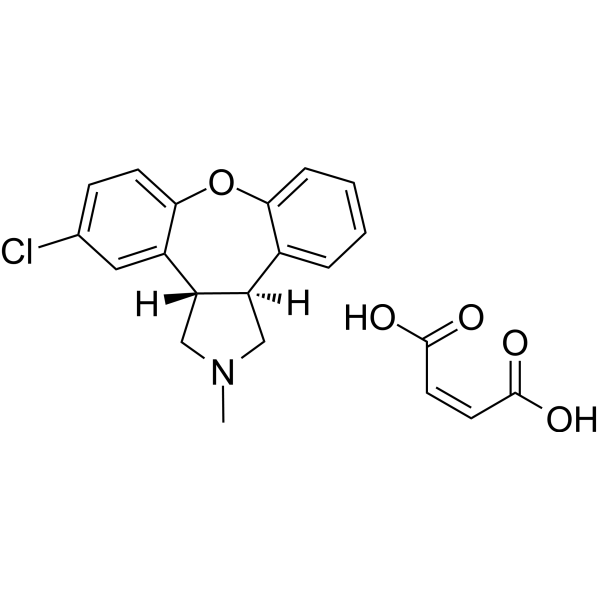
Asenapine maleate
Based on 4 publication(s) in Google Scholar
Asenapine (Org 5222) maleate, a brain-penetrant atypical antipsychotic, is an antagonist of serotonin receptors (pKi: 8.4-10.5), adrenoceptors (pKi: 8.9-9.5), dopamine receptors (pKi: 8.9-9.4) and histamine receptors (pKi: 8.2-9.0). Asenapine maleate can be used in the research of schizophrenia and bipolar disorder.
For research use only. We do not sell to patients.
- Purity : 99.95%
- CAS No.: 85650-56-2
- Formula: C21H20ClNO5
- Molecular Weight:401.84
-
Storage:
4°C, sealed storage, away from moisture
* In solvent : -80°C, 6 months; -20°C, 1 month (sealed storage, away from moisture)

To place orders, for customer services and technical support, please contact: MedChemExpress USA
Tel: 609-228-6898 E-mail: [email protected] [email protected]


-
 Biological Activity
-
Chemical Information
-
Solvent & Solubility
- Protocol
- Purity & Documentation
- References
-
 Help & FAQs




Publications Citing Use of MedChemExpress (MCE) Asenapine maleate
MoreAll 5-HT Receptor Isoforms
More

Biological Activity
Description
IC50 & Target
[1]|
5-HT1A Receptor |
sPLA2 2.5 nM (Ki) |
5-HT2A Receptor 0.06 nM (Ki) |
5-HT2C Receptor 0.03 nM (Ki) |
5-HT7 Receptor 0.13 nM (Ki) |
D2 Receptor 1.3 nM (Ki) |
D3 Receptor 0.42 nM (Ki) |
D4 Receptor 1.1 nM (Ki) |
In Vitro
Relative to its D2 receptor affinity, asenapine has a higher affinity for 5-HT2C, 5-HT2A, 5-HT2B, 5-HT7, 5-HT6, α2B and D3 receptors, suggesting stronger engagement of these targets at therapeutic doses. Asenapine behaves as a potent antagonist (pKB) at 5-HT1A (7.4), 5-HT1B (8.1), 5-HT2A (9.0), 5-HT2B (9.3), 5-HT2C (9.0), 5-HT6 (8.0), 5-HT7 (8.5), D2 (9.1), D3 (9.1), α2A (7.3), α2B (8.3), α2C (6.8) and H1 (8.4) receptors[2].
MedChemExpress (MCE) has not independently confirmed the accuracy of these methods. They are for reference only.
In Vivo
MedChemExpress (MCE) has not independently confirmed the accuracy of these methods. They are for reference only.


Chemical Information
-
CAS No. 85650-56-2
-
Appearance Solid
-
Molecular Weight 401.84
-
Formula C21H20ClNO5
-
Color White to off-white
-
SMILES
CN1C[C@]2([H])C3=CC=CC=C3OC4=CC=C(Cl)C=C4[C@]2(C1)[H].O=C(O)/C=C\C(O)=O
-
Synonyms
Org 5222 maleate
-
Shipping
Room temperature in continental US; may vary elsewhere.
-
Storage
4°C, sealed storage, away from moisture
* In solvent : -80°C, 6 months; -20°C, 1 month (sealed storage, away from moisture)


Publications (4)
-
Journal Impact Factor
-
Most Recent
-
-
Int J Biol Macromol
Structural and expression analysis of the dopamine receptors reveals their crucial roles in regulating the insulin signaling pathway in oysters. [Abstract]2023 Aug 30:247:125703. PMID: 37414315 -
Insect Biochem Mol Biol
Molecular and pharmacological characterization of the dopamine receptors in the oriental fruit fly, Bactrocera dorsalis. [Abstract]2025 May:180:104312. PMID: 40245998 -
Biomed Pharmacother
Identification of the atypical antipsychotic Asenapine as a direct survivin inhibitor with anticancer properties and sensitizing effects to conventional therapies. [Abstract]2025 Jan:182:117756. PMID: 39693907


Solvent & Solubility
In Vitro:
DMSO : 25 mg/mL (62.21 mM; Need ultrasonic; Hygroscopic DMSO has a significant impact on the solubility of product, please use newly opened DMSO)
H2O : 6.25 mg/mL (15.55 mM; Need ultrasonic and warming)
Please refer to the solubility information to select the appropriate solvent. Once prepared, please aliquot and store the solution to prevent product inactivation from repeated freeze-thaw cycles.
Storage method and period of stock solution: -80°C, 6 months; -20°C, 1 month (sealed storage, away from moisture). When stored at -80°C, please use it within 6 months. When stored at -20°C, please use it within 1 month.
* Note: If you choose water as the stock solution, please dilute it to the working solution, then filter and sterilize it with a 0.22 μm filter before use.
Please refer to the solubility information to select the appropriate solvent. Once prepared, please aliquot and store the solution to prevent product inactivation from repeated freeze-thaw cycles.
Storage method and period of stock solution: -80°C, 6 months; -20°C, 1 month (sealed storage, away from moisture). When stored at -80°C, please use it within 6 months. When stored at -20°C, please use it within 1 month.
* Note: If you choose water as the stock solution, please dilute it to the working solution, then filter and sterilize it with a 0.22 μm filter before use.
Concentration (start) × Volume (start) = Concentration (final) × Volume (final)
In Vivo:
Select the appropriate dissolution method based on your experimental animal and administration route.
- For the following dissolution methods, please ensure to first prepare a clear stock solution using an In Vitro approach and then sequentially add co-solvents:
- To ensure reliable experimental results, the clarified stock solution can be appropriately stored based on storage conditions. As for the working solution for In Vivo experiments, it is recommended to prepare freshly and use it on the same day.
- The percentages shown for the solvents indicate their volumetric ratio in the final prepared solution. If precipitation or phase separation occurs during preparation, heat and/or sonication can be used to aid dissolution.
Add each solvent one by one: 10% DMSO 40% PEG300 5% Tween-80 45% Saline
Solubility: ≥ 2.5 mg/mL (6.22 mM); Clear solution
This protocol yields a clear solution of ≥ 2.5 mg/mL (saturation unknown).
Taking 1 mL working solution as an example, add 100 μL DMSO stock solution (25.0 mg/mL) to 400 μL PEG300, and mix evenly; then add 50 μL Tween-80 and mix evenly; then add 450 μL Saline to adjust the volume to 1 mL.
Preparation of Saline: Dissolve 0.9 g sodium chloride in ddH₂O and dilute to 100 mL to obtain a clear Saline solution.
Add each solvent one by one: 10% DMSO 90% (20% SBE-β-CD in Saline)
Solubility: ≥ 2.5 mg/mL (6.22 mM); Clear solution
This protocol yields a clear solution of ≥ 2.5 mg/mL (saturation unknown).
Taking 1 mL working solution as an example, add 100 μL DMSO stock solution (25.0 mg/mL) to 900 μL 20% SBE-β-CD in Saline, and mix evenly.
Preparation of 20% SBE-β-CD in Saline (4°C, storage for one week): 2 g SBE-β-CD powder is dissolved in 10 mL Saline, completely dissolve until clear.
For the following dissolution methods, please prepare the working solution directly:
It is recommended to prepare fresh solutions and use them promptly within a short period of time.
The percentages shown for the solvents indicate their volumetric ratio in the final prepared solution. If precipitation or phase separation occurs during preparation, heat and/or sonication can be used to aid dissolution.
Add each solvent one by one: PBS
Solubility: 1.2 mg/mL (2.99 mM); Clear solution; Need ultrasonic
In Vivo Dissolution Calculator
Please enter the basic information of animal experiments:
-
-
-
-
Recommended: Prepare an additional quantity of animals to account for potential losses during experiments.
Please enter your animal formula composition:
-
%DMSO +
Recommended: Keep the proportion of DMSO in working solution below 2% if your animal is weak.
-
%+
-
+%Tween-80 + +
-
%Saline +
The co-solvents required include: DMSO, . All of co-solvents are available by MedChemExpress (MCE). , Tween 80. All of co-solvents are available by MedChemExpress (MCE).
Working solution concentration: 0.22 mg/mL
Method for preparing stock solution: mg drug dissolved in μL DMSO. Stock solution concentration: mg/mL. * In solvent : -80°C, 6 months; -20°C, 1 month (sealed storage, away from moisture)
1. Take μL DMSO stock solution;
2. Add μL .
μL , mix evenly;
3. Then add μL Tween 80, mix evenly;
4. Then add μL
Please ensure that the stock solution in the first step is dissolved to a clear state, and add co-solvents in sequence. You can use ultrasonic heating (ultrasonic cleaner, recommended frequency 20-40 kHz), vortexing, etc. to assist dissolution.

Protocol
Rats: Asenapine maleate is suspended in 10% hydroxypropyl-β-cyclodextrin and administered in a volume of 1 mL/kg body weight . Rats are individually fear conditioned using electrical foot shock in a Skinner box. Animals are injected intraperitoneally (i.p.) with asenapine, clozapine, olanzapine, buspirone, or SB242084 at 30 min before freezing behaviour assessment[3].
Mice: Male ICR mice are repeatedly treated with 0.1 or 0.3mg/kg injections of asenapine and then tested in a battery of behavioural tests related to anxiety including the open-field test, elevated plus-maze (EPM), defensive marble burying and hyponeophagia tests[4].
MedChemExpress (MCE) has not independently confirmed the accuracy of these methods. They are for reference only.


Purity & Documentation
-
Data Sheet (280 KB)
-
SDS (564 KB)
- English - EN (564 KB)
- Français - FR (564 KB)
- Deutsch - DE (564 KB)
- Norwegian - NO (564 KB)
- Español - ES (564 KB)
- Swedish - SV (564 KB)
- Italian - IT (564 KB)
- Korean - KR (564 KB)
- Portuguese - PT (564 KB)
-
Handling Instructions (2659 KB)
References
[1]. Shahid M, et al. Asenapine: a novel psychopharmacologic agent with a unique human receptor signature. J Psychopharmacol. 2009 Jan;23(1):65-73. [Content Brief]
[2]. Olivia Frånberg, et al. Asenapine, a novel psychopharmacologic agent: preclinical evidence for clinical effects in schizophrenia. Psychopharmacology (Berl). 2008 Feb;196(3):417-29. [Content Brief]
[3]. Ohyama M,et al. Asenapine reduces anxiety-related behaviours in rat conditioned fear stress model. Acta Neuropsychiatr. 2016 Dec;28(6):327-336. [Content Brief]
[4]. Ene HM, et al. Effects of repeated asenapine in a battery of tests for anxiety-like behaviours in mice. Acta Neuropsychiatr. 2016 Apr;28(2):85-91. [Content Brief]
[5]. Stoner SC, et al. Asenapine: a clinical review of a second-generation antipsychotic. Clin Ther. 2012 May;34(5):1023-40. [Content Brief]


Complete Stock Solution Preparation Table
Please refer to the solubility information to select the appropriate solvent. Once prepared, please aliquot and store the solution to prevent product inactivation from repeated freeze-thaw cycles.
Storage method and period of stock solution: -80°C, 6 months; -20°C, 1 month (sealed storage, away from moisture). When stored at -80°C, please use it within 6 months. When stored at -20°C, please use it within 1 month.
| Optional Solvent | Concentration Solvent Mass | 1 mg | 5 mg | 10 mg | 25 mg |
|---|---|---|---|---|---|
| H2O / DMSO | 1 mM | 2.4886 mL | 12.4428 mL | 24.8855 mL | 62.2138 mL |
| 5 mM | 0.4977 mL | 2.4886 mL | 4.9771 mL | 12.4428 mL | |
| 10 mM | 0.2489 mL | 1.2443 mL | 2.4886 mL | 6.2214 mL | |
| 15 mM | 0.1659 mL | 0.8295 mL | 1.6590 mL | 4.1476 mL | |
| DMSO | 20 mM | 0.1244 mL | 0.6221 mL | 1.2443 mL | 3.1107 mL |
| 25 mM | 0.0995 mL | 0.4977 mL | 0.9954 mL | 2.4886 mL | |
| 30 mM | 0.0830 mL | 0.4148 mL | 0.8295 mL | 2.0738 mL | |
| 40 mM | 0.0622 mL | 0.3111 mL | 0.6221 mL | 1.5553 mL | |
| 50 mM | 0.0498 mL | 0.2489 mL | 0.4977 mL | 1.2443 mL | |
| 60 mM | 0.0415 mL | 0.2074 mL | 0.4148 mL | 1.0369 mL |
* Note: If you choose water as the stock solution, please dilute it to the working solution, then filter and sterilize it with a 0.22 μm filter before use.


Asenapine maleate Related Classifications
HY-11100 Related Classifications
 Powered by Bioz