



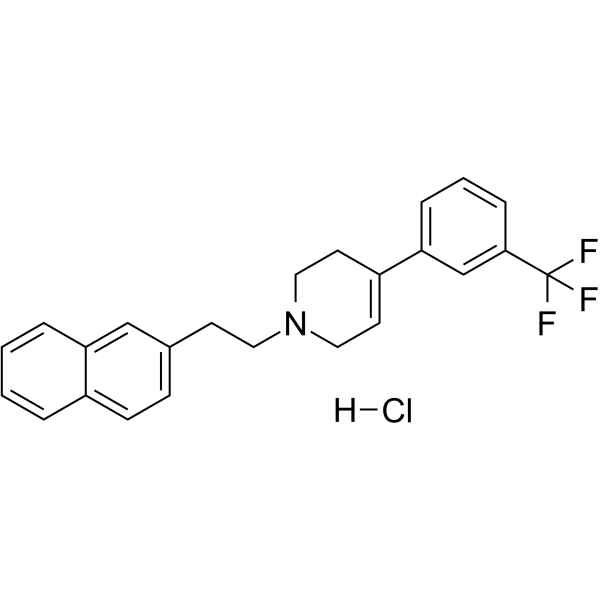
Xaliproden hydrochloride
Based on 1 publication(s) in Google Scholar
Xaliproden (SR57746) hydrochloride (SR57746A) is an orally active, highly selective 5-HT1A receptor agonist. Xaliproden hydrochloride activates pertussis toxin-sensitive G protein-coupled signaling cascades, as well as the PKC, ERK1/ERK2, Akt and p21 Ras/MEK-1 pathways. Xaliproden hydrochloride also downregulates the JNK/p66/c-Jun signaling pathway, induces phosphorylation of the shc adaptor protein, regulates extracellular dopamine and 5-HT levels, and induces [35S]GTPγS labeling in rat brain structures rich in 5-HT1A receptors. Xaliproden hydrochloride exerts neurotrophic, neuroprotective, renoprotective, anti-inflammatory, anti-apoptotic, anti-fibrotic and analgesic effects. Xaliproden hydrochloride also enhances NGF-induced neurite outgrowth, promotes motor neuron survival, attenuates renal tubular injury and inhibits chemotherapy-induced mechanical allodynia, without activating or altering NGF-induced TrkA receptor activation. Xaliproden hydrochloride can be used in the research of motor neuron disease, diabetic nephropathy, chemotherapy-induced peripheral neuropathy, amyotrophic lateral sclerosis, Alzheimer's disease, acute tonic nociceptive pain, inflammatory pain, depression and anxiety.
For research use only. We do not sell to patients.
- Purity : 98.40%
- CAS No.: 90494-79-4
- Formula: C24H23ClF3N
- Molecular Weight:417.89
-
Storage:
4°C, sealed storage, away from moisture
* In solvent : -80°C, 6 months; -20°C, 1 month (sealed storage, away from moisture)

To place orders, for customer services and technical support, please contact: MedChemExpress USA
Tel: 609-228-6898 E-mail: [email protected] [email protected]


-
 Biological Activity
-
Chemical Information
-
Solvent & Solubility
- Purity & Documentation
- References
-
 Help & FAQs




Publications Citing Use of MedChemExpress (MCE) Xaliproden hydrochloride
MoreAll 5-HT Receptor Isoforms
MoreAll Dopamine Receptor Isoforms
More

Biological Activity
Description
IC50 & Target
|
5-HT1A Receptor |
D2 Receptor |
In Vitro
Xaliproden hydrochloride (1-10 μM; 5-30 min) does not activate the TrkA receptor in rat pheochromocytoma PC12 cells[1].
Xaliproden hydrochloride (1 μM; 5 min-48 h) induces time-dependent tyrosine phosphorylation of the p66shc and p52shc isoforms in rat pheochromocytoma PC12 cells, with the phosphorylation of p66shc peaking at 5 min and that of p52shc peaking at 48 h[1].
Xaliproden hydrochloride (0.1-5 μM; 5-30 min) induces dose-dependent transient activation of ERK1/ERK2 MAP kinases in PC12 rat pheochromocytoma cells, with a 3-fold activation peak of ERK2 at 1 μM for 5 min, and the maximum activation level achieved at 5 μM for 5 min[1].
Activation of ERK1/ERK2 MAP kinases and phosphorylation of PKC isoforms induced by xaliproden hydrochloride (1 μM; 5-30 min) in PC12 rat pheochromocytoma cells depend on PKC activity, whereas 5-HT1A receptor antagonism or Gi/o protein inactivation inhibits PKC activation[1].
Xaliproden hydrochloride (1-10 μM; 24 h) protects human renal proximal tubular epithelial cells from high glucose-induced injury by inhibiting the JNK/p65/c-Jun signaling pathway and alleviating inflammation, apoptosis and fibrosis[2].
Xaliproden hydrochloride (10 μM) activates G proteins via native 5-HT1a receptors in the rat hippocampus, lateral septum, frontal cortex and entorhinal cortex, and this effect is completely blocked by the 5-HT1a receptor antagonist WAY100635 (HY-10349)[4].
MedChemExpress (MCE) has not independently confirmed the accuracy of these methods. They are for reference only.
-
Cell Line:PC12 rat pheochromocytoma cells
-
Concentration:1 μM (Xaliproden); 1 μM, 5 μM (chelerythrine chloride, pre-incubation); 10 μM (pindobind, pre-incubation); 50 ng/mL (pertussis toxin, pre-incubation)
-
Incubation Time:5 min (Xaliproden; following 1 h pre-incubation with chelerythrine chloride); 30 min (Xaliproden; following 1 h pre-incubation with pindobind or 2 h pre-incubation with pertussis toxin)
-
Result:Pre-incubation with 1 μM or 5 μM chelerythrine chloride blocked Xaliproden-induced ERK1/ERK2 activation.
Pre-incubation with GF109203X repressed Xaliproden-induced ERK1/ERK2 activation.
Induced phosphorylation of PKC isoforms α, βI, βII, γ, δ at 30 min, which was inhibited by pre-incubation with pindobind or pertussis toxin.
-
Cell Line:human renal proximal tubular epithelial cells (high glucose-stimulated)
-
Concentration:1 μM, 10 μM
-
Incubation Time:24 h (co-incubation with high glucose)
-
Result:Did not affect cell viability of high glucose-stimulated cells.
Significantly reduced phosphorylation of JNK, p65, and c-Jun.
Decreased protein expression of inflammatory cytokines IL-1β, IL-6, and TNF-α.
Reduced the number of TUNEL-positive apoptotic cells.
Lowered protein levels of cleaved caspase-3 and cleaved PARP.
Decreased expression of fibrotic proteins TGF-β, phospho-Smad2/3, and collagen 1.
Produced comparable reductions in p-JNK, p-p65, inflammatory proteins, TUNEL-positive cells, apoptotic proteins, p-c-Jun, and fibrotic proteins when co-treated with SP600125 as when used alone.
Produced comparable reductions in p-c-Jun and fibrotic proteins when co-treated with SR11302 as when used alone.
Showed no dose-dependent effect between 1 μM and 10 μM concentrations.
In Vivo
Xaliproden (0.3-1.5 mg/kg/day; oral administration; once daily; for 4 consecutive weeks) hydrochloride exerts renoprotective effects on db/db mice with diabetic nephropathy by significantly improving renal function, reducing proteinuria, alleviating renal tubular injury and fibrosis, as well as blocking inflammatory, apoptotic and fibrotic pathways via inhibition of the JNK/p65/c-Jun signaling axis[2].
Xaliproden (0.3-3 mg/kg; p.o.; single administration) hydrochloride significantly, persistently and dose-dependently inhibits Paclitaxel (HY-B0015)-induced mechanical allodynia[3].
Xaliproden (0.3-3 mg/kg; p.o.; single administration) hydrochloride exerts only a mild, transient 19% inhibition of vincristine (HY-N0488A)-induced mechanical allodynia at the single dose of 3 mg/kg, shows no effect at low doses, and does not alter the tibial nerve firing response in vincristine-treated mice[3].
Xaliproden (0.63-40 mg/kg; p.o.; single administration) hydrochloride produces a dose-dependent inhibitory effect on in vivo 5-HT1A receptor binding in the frontal cortex and hippocampus of mice, with ID50 values of 3.5 mg/kg and 3.3 mg/kg (p.o.), respectively[4].
Xaliproden (0.63-10 mg/kg; intraperitoneal injection; single administration) hydrochloride dose-dependently increases dopamine levels in the prefrontal cortex of rats (ED50=0.7 mg/kg, i.p.) and decreases 5-HT levels in the rat hippocampus (ED50=1.2 mg/kg, i.p.) via activation of the 5-HT1A receptor[4].
Xaliproden (0.63-10 mg/kg; intraperitoneal injection; single administration) hydrochloride exerts a dose-dependent, 5-HT1A receptor-mediated antinociceptive effect in the rat formalin pain test, and completely inhibits paw licking and lifting responses at 10 mg/kg (i.p.)[4].
MedChemExpress (MCE) has not independently confirmed the accuracy of these methods. They are for reference only.
-
Animal Model:BKS.Cg-Dock7m+/+ Leprdb (db/db) (6-week-old male, spontaneous genetic diabetic kidney disease model)[2]
-
Dosage:0.3 mg/kg/day; 1.5 mg/kg/day
-
Administration:p.o.; once daily; 4 weeks
-
Result:Significantly reduced serum blood urea nitrogen and creatinine levels relative to untreated DKD mice.
Significantly decreased urinary albumin-to-creatinine ratios relative to untreated DKD mice.
Significantly lowered fasting blood glucose and homeostatic model assessment of insulin resistance levels relative to untreated DKD mice.
Significantly reduced renal tubular injury scores and collagen deposition (renal fibrosis) compared to untreated DKD mice.
Significantly attenuated the phosphorylation of JNK, p65, and c-Jun in kidney tissues relative to untreated DKD mice.
Significantly decreased the expression of inflammatory markers (IL-1β, IL-6, TNF-α), apoptotic markers (cleaved caspase-3, cleaved PARP), and fibrotic markers (TGF-β, phospho-Smad2/3, collagen 1) in kidney tissues relative to untreated DKD mice.
Showed no dose-dependent effect between 0.3 mg/kg/day and 1.5 mg/kg/day doses.
Clinical Trial
| NCT Number | Sponsor | Condition | Start Date |
Phase

|
|---|---|---|---|---|
| NCT01329991 | Plexxikon| | 2011-05 | PHASE1 |


Chemical Information
-
CAS No. 90494-79-4
-
Appearance Solid
-
Molecular Weight 417.89
-
Formula C24H23ClF3N
-
Color White to off-white
-
SMILES
FC(C1=CC(C2=CCN(CCC3=CC=C4C=CC=CC4=C3)CC2)=CC=C1)(F)F.[H]Cl
-
Synonyms
SR57746A; SR57746 hydrochloride
-
Shipping
Room temperature in continental US; may vary elsewhere.
-
Storage
4°C, sealed storage, away from moisture
* In solvent : -80°C, 6 months; -20°C, 1 month (sealed storage, away from moisture)


Publications (1)
-
Journal Impact Factor
-
Most Recent
-
Biochem Pharmacol
Xaliproden improves diabetic kidney disease through JNK-mediated renal tubular protection. [Abstract]2026 Mar 22:117923. PMID: 41876014


Solvent & Solubility
In Vitro:
DMSO : 33.33 mg/mL (79.76 mM; Need ultrasonic; Hygroscopic DMSO has a significant impact on the solubility of product, please use newly opened DMSO)
Please refer to the solubility information to select the appropriate solvent. Once prepared, please aliquot and store the solution to prevent product inactivation from repeated freeze-thaw cycles.
Storage method and period of stock solution: -80°C, 6 months; -20°C, 1 month (sealed storage, away from moisture). When stored at -80°C, please use it within 6 months. When stored at -20°C, please use it within 1 month.
Please refer to the solubility information to select the appropriate solvent. Once prepared, please aliquot and store the solution to prevent product inactivation from repeated freeze-thaw cycles.
Storage method and period of stock solution: -80°C, 6 months; -20°C, 1 month (sealed storage, away from moisture). When stored at -80°C, please use it within 6 months. When stored at -20°C, please use it within 1 month.
Concentration (start) × Volume (start) = Concentration (final) × Volume (final)
In Vivo:
Select the appropriate dissolution method based on your experimental animal and administration route.
- For the following dissolution methods, please ensure to first prepare a clear stock solution using an In Vitro approach and then sequentially add co-solvents:
- To ensure reliable experimental results, the clarified stock solution can be appropriately stored based on storage conditions. As for the working solution for In Vivo experiments, it is recommended to prepare freshly and use it on the same day.
- The percentages shown for the solvents indicate their volumetric ratio in the final prepared solution. If precipitation or phase separation occurs during preparation, heat and/or sonication can be used to aid dissolution.
Add each solvent one by one: 10% DMSO 40% PEG300 5% Tween-80 45% Saline
Solubility: ≥ 2.5 mg/mL (5.98 mM); Clear solution
This protocol yields a clear solution of ≥ 2.5 mg/mL (saturation unknown).
Taking 1 mL working solution as an example, add 100 μL DMSO stock solution (25.0 mg/mL) to 400 μL PEG300, and mix evenly; then add 50 μL Tween-80 and mix evenly; then add 450 μL Saline to adjust the volume to 1 mL.
Preparation of Saline: Dissolve 0.9 g sodium chloride in ddH₂O and dilute to 100 mL to obtain a clear Saline solution.
Add each solvent one by one: 10% DMSO 90% (20% SBE-β-CD in Saline)
Solubility: ≥ 2.5 mg/mL (5.98 mM); Clear solution
This protocol yields a clear solution of ≥ 2.5 mg/mL (saturation unknown).
Taking 1 mL working solution as an example, add 100 μL DMSO stock solution (25.0 mg/mL) to 900 μL 20% SBE-β-CD in Saline, and mix evenly.
Preparation of 20% SBE-β-CD in Saline (4°C, storage for one week): 2 g SBE-β-CD powder is dissolved in 10 mL Saline, completely dissolve until clear.
In Vivo Dissolution Calculator
Please enter the basic information of animal experiments:
-
-
-
-
Recommended: Prepare an additional quantity of animals to account for potential losses during experiments.
Please enter your animal formula composition:
-
%DMSO +
Recommended: Keep the proportion of DMSO in working solution below 2% if your animal is weak.
-
%+
-
+%Tween-80 + +
-
%Saline +
The co-solvents required include: DMSO, . All of co-solvents are available by MedChemExpress (MCE). , Tween 80. All of co-solvents are available by MedChemExpress (MCE).
Working solution concentration: 0.22 mg/mL
Method for preparing stock solution: mg drug dissolved in μL DMSO. Stock solution concentration: mg/mL. * In solvent : -80°C, 6 months; -20°C, 1 month (sealed storage, away from moisture)
1. Take μL DMSO stock solution;
2. Add μL .
μL , mix evenly;
3. Then add μL Tween 80, mix evenly;
4. Then add μL
Please ensure that the stock solution in the first step is dissolved to a clear state, and add co-solvents in sequence. You can use ultrasonic heating (ultrasonic cleaner, recommended frequency 20-40 kHz), vortexing, etc. to assist dissolution.


Purity & Documentation
-
Data Sheet (283 KB)
-
SDS (393 KB)
- English - EN (393 KB)
- Français - FR (393 KB)
- Deutsch - DE (393 KB)
- Norwegian - NO (393 KB)
- Español - ES (393 KB)
- Swedish - SV (393 KB)
- Italian - IT (393 KB)
- Korean - KR (393 KB)
- Portuguese - PT (393 KB)
-
Handling Instructions (2659 KB)
References
[1]. Appert-Collin A, et al. Xaliproden (SR57746A) induces 5-HT1A receptor-mediated MAP kinase activation in PC12 cells. Int J Immunopathol Pharmacol. 2005;18(2):233-244. [Content Brief]
[2]. Lee HJ, et al. Xaliproden improves diabetic kidney disease through JNK-mediated renal tubular protection. Biochem Pharmacol. Published online March 22, 2026. [Content Brief]
[3]. Andoh T, et al. Effects of xaliproden, a 5-HT₁A agonist, on mechanical allodynia caused by chemotherapeutic agents in mice. Eur J Pharmacol. 2013;721(1-3):231-236. [Content Brief]
[4]. Martel JC, et al. 5-HT1A receptors are involved in the effects of xaliproden on G-protein activation, neurotransmitter release and nociception. Br J Pharmacol. 2009;158(1):232-242. [Content Brief]


Complete Stock Solution Preparation Table
Please refer to the solubility information to select the appropriate solvent. Once prepared, please aliquot and store the solution to prevent product inactivation from repeated freeze-thaw cycles.
Storage method and period of stock solution: -80°C, 6 months; -20°C, 1 month (sealed storage, away from moisture). When stored at -80°C, please use it within 6 months. When stored at -20°C, please use it within 1 month.
| Optional Solvent | Concentration Solvent Mass | 1 mg | 5 mg | 10 mg | 25 mg |
|---|---|---|---|---|---|
| DMSO | 1 mM | 2.3930 mL | 11.9649 mL | 23.9297 mL | 59.8244 mL |
| 5 mM | 0.4786 mL | 2.3930 mL | 4.7859 mL | 11.9649 mL | |
| 10 mM | 0.2393 mL | 1.1965 mL | 2.3930 mL | 5.9824 mL | |
| 15 mM | 0.1595 mL | 0.7977 mL | 1.5953 mL | 3.9883 mL | |
| 20 mM | 0.1196 mL | 0.5982 mL | 1.1965 mL | 2.9912 mL | |
| 25 mM | 0.0957 mL | 0.4786 mL | 0.9572 mL | 2.3930 mL | |
| 30 mM | 0.0798 mL | 0.3988 mL | 0.7977 mL | 1.9941 mL | |
| 40 mM | 0.0598 mL | 0.2991 mL | 0.5982 mL | 1.4956 mL | |
| 50 mM | 0.0479 mL | 0.2393 mL | 0.4786 mL | 1.1965 mL | |
| 60 mM | 0.0399 mL | 0.1994 mL | 0.3988 mL | 0.9971 mL |


Xaliproden hydrochloride Related Classifications
HY-14604 Related Classifications
 Powered by Bioz
Keywords
- Xaliproden
- 90494-79-4
- SR57746A
- SR57746
- SR 57746
- SR-57746
- 5-HT Receptor
- Dopamine Receptor
- Trk Receptor
- PKC
- ERK
- Akt
- JNK
- human renal proximal tubular epithelial cells
- diabetic kidney disease
- glioma C6 cells
- db/db mice
- 5-HT1A receptor
- HeLa cells
- pmn mice
- motoneuron diseases
- amyotrophic lateral sclerosis
- PC12 rat pheochromocytoma cells
- Inhibitor
- inhibitor
- inhibit