



Haloperidol hydrochloride
Based on 22 publication(s) in Google Scholar
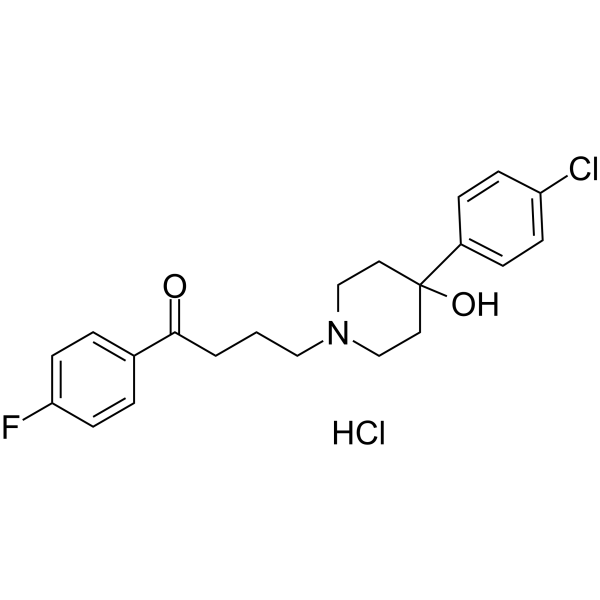
Haloperidol hydrochloride is a potent dopamine D2 receptor antagonist, widely used as an antipsychotic agent. Haloperidol hydrochloride can be used in the study of schizophrenia, tics in Tourette syndrome, mania in bipolar disorder, delirium, agitation, acute psychosis, and hallucinations from alcohol withdrawal.
For research use only. We do not sell to patients.
- Purity : 99.56%
- CAS No.: 1511-16-6
- Formula: C21H24Cl2FNO2
- Molecular Weight:412.33
-
Storage:
4°C, sealed storage, away from moisture
* In solvent : -80°C, 6 months; -20°C, 1 month (sealed storage, away from moisture)

To place orders, for customer services and technical support, please contact: MedChemExpress USA
Tel: 609-228-6898 E-mail: [email protected] [email protected]


-
 Biological Activity
-
Chemical Information
-
Solvent & Solubility
- Purity & Documentation
- References
-
 Help & FAQs


Publications Citing Use of MedChemExpress (MCE) Haloperidol hydrochloride
More- Cell. 2023 Nov 22;186(24):5347-5362.e24. [Abstract]
- Adv Sci (Weinh). 2025 Sep;12(33):e02276. [Abstract]
- Environ Sci Technol. 2023 Sep 26;57(38):14162-14172. [Abstract]
- Phytomedicine. 2025 Jun:141:156707. [Abstract]
- Acta Biomater. 2026 Jun:216:333-347. [Abstract]
- Br J Pharmacol. 2021 Sep;178(17):3570-3586. [Abstract]
- J Ethnopharmacol. 2021 Jun 12:273:113994. [Abstract]
- Oncogenesis. 2025 Aug 21;14(1):31. [Abstract]
- EMBO Rep. 2022 Feb 3;23(3):e53191. [Abstract]
- Cell Rep Methods. 2023 Oct 23;3(10):100599. [Abstract]
- Eur J Pharmacol. 2023 Dec 15:961:176174. [Abstract]
- Eur J Pharmacol. 2023 May 5:946:175647. [Abstract]
- ACS Omega. 2025 Oct 17;10(42):50208-50217. [Abstract]
- ACS Omega. 2020 Nov 15;5(46):29935-29942. [Abstract]
- BMC Endocr Disord. 2021 Nov 23;21(1):235. [Abstract]
- PLoS Negl Trop Dis. 2019 Aug 20;13(8):e0007681. [Abstract]
- Behav Brain Res. 2022 Mar 26:422:113759. [Abstract]
- Clin Exp Pharmacol Physiol. 2021 Mar;48(3):370-380. [Abstract]
- Eur J Integr Med. 2021, 101322.
- Clin Tradit Med Pharmacol. 2026 Jan 14.
- University of South Carolina. 2025.
- University of Zurich. 2025.
 Customer Validation & Images

-
WB
-
WB
-
Cell Proliferation/Viability Assay
-
Cell Imaging/Staining
-
WB
All Dopamine Receptor Isoforms
More

Biological Activity
Description
IC50 & Target
|
D2 Receptor |
In Vivo
Please do not refer to only one article to determine the experimental conditions. It is recommended to determine the optimal experimental conditions (animal strain, age, dosage, frequency and cycle, detection time and indicators, etc.) through preliminary experiments before the formal experiment.
Haloperidol can be used to create tardive dyskinesia models. In rats, the oral half-life of Haloperidol is 5.9 hours, with a Tmax of 0.9 hours, a Cmax of 6.8 ng/mL, and an oral bioavailability of 23.0%. When administered intravenously, the AUC0-∞ of Haloperidol is 188.4 ng·h/mL, and the t1/2 is 2.9 hours[3].
Administration: 1 mg/KG • i.p. • daily for 31 days
MedChemExpress (MCE) has not independently confirmed the accuracy of these methods. They are for reference only.


Chemical Information
-
CAS No. 1511-16-6
-
Appearance Solid
-
Molecular Weight 412.33
-
Formula C21H24Cl2FNO2
-
Color White to off-white
-
SMILES
ClC(C=C1)=CC=C1C2(O)CCN(CCCC(C3=CC=C(F)C=C3)=O)CC2.Cl
-
Shipping
Room temperature in continental US; may vary elsewhere.
-
Storage
4°C, sealed storage, away from moisture
* In solvent : -80°C, 6 months; -20°C, 1 month (sealed storage, away from moisture)


Publications (22)
-
Journal Impact Factor
-
Most Recent
-
Cell
2023 Nov 22;186(24):5347-5362.e24. PMID: 37963465 -
Adv Sci (Weinh)
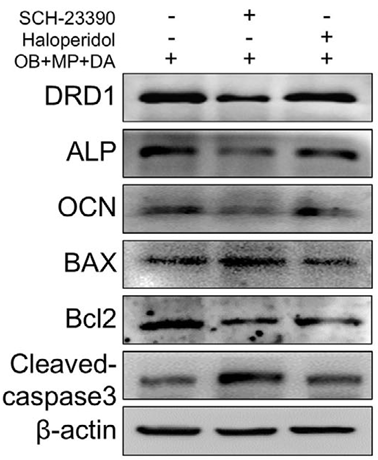
Dopamine D1 Receptor Contributes to Glucocorticoid-Associated Osteonecrosis of Femoral Head Protection Through the ATF3/CHOP Axis to Inhibit Osteoblastic Apoptosis. [Abstract]2025 Sep;12(33):e02276. PMID: 40583147
Haloperidol hydrochloride purchased from MedChemExpress. Usage Cited in: Adv Sci (Weinh). 2025 Sep;12(33):e02276. [Abstract]
Western blotting of DRD1, ALP, OCN, BAX, Bcl2, cleaved‐caspase3, and β‐actin in osteogenesis‐induced BMSCs treated with Haloperidol (1 µM), DA and then stimulated with MP.
-
Environ Sci Technol
2-Ethylhexyl Diphenyl Phosphate Causes Obesity in Zebrafish by Stimulating Overeating via Inhibition of Dopamine Receptor D2. [Abstract]2023 Sep 26;57(38):14162-14172. PMID: 37704188 -
Phytomedicine
Valproic acid promotes transcriptional activation of Drd2 by mediating histone acetylation to inhibit the mTOR-Pttg1 signaling axis and exerts anti-PitNETs activity. [Abstract]2025 Jun:141:156707. PMID: 40220407 -
Acta Biomater
Carrier-free spherical nucleic acids engineered by coordination-competition for programmable release and cancer immunotherapy. [Abstract]2026 Jun:216:333-347. PMID: 41962730 -
Br J Pharmacol
Exploiting D2 receptor β-arrestin2-biased signalling to suppress tumour growth of pituitary adenomas. [Abstract]2021 Sep;178(17):3570-3586. PMID: 33904172 -
J Ethnopharmacol
Total barley maiya alkaloids inhibit prolactin secretion by acting on dopamine D2 receptor and protein kinase A targets. [Abstract]2021 Jun 12:273:113994. PMID: 33711439 -
Oncogenesis
Peroxisomal lipid metabolism inhibits Pimozide-induced cancer cell death by regulating ATP homeostasis. [Abstract]2025 Aug 21;14(1):31. PMID: 40841534 -
EMBO Rep
ZFP207 sustains pluripotency by coordinating OCT4 stability, alternative splicing and RNA export. [Abstract]2022 Feb 3;23(3):e53191. PMID: 35037361 -
Cell Rep Methods
RECOVER identifies synergistic drug combinations in vitro through sequential model optimization. [Abstract]2023 Oct 23;3(10):100599. PMID: 37797618 -
Eur J Pharmacol
A novel dopamine D2 receptor-NR2B protein complex might contribute to morphine use disorders. [Abstract]2023 Dec 15:961:176174. PMID: 37939993 -
Eur J Pharmacol
Sigma-1 receptor agonist properties that mediate the fast-onset antidepressant effect of hypidone hydrochloride (YL-0919). [Abstract]2023 May 5:946:175647. PMID: 36898424 -
ACS Omega
2025 Oct 17;10(42):50208-50217. PMID: 41179162
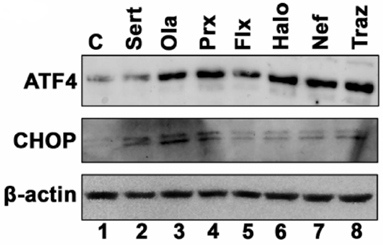
Haloperidol hydrochloride purchased from MedChemExpress. Usage Cited in: ACS Omega. 2025 Oct 17;10(42):50208-50217. [Abstract]
Haloperidol (Halo; 20 ng/mL; 24 h). ISR induction by various drugs. N2a cells were treated with the indicated drugs for 24 h. The cell extracts were analyzed by Western blot analysis with anti-ATF4, anti-CHOP, and anti-β actin antibodies.
-
ACS Omega
Computational Approaches to Identify Molecules Binding to Mycobacterium tuberculosis KasA. [Abstract]2020 Nov 15;5(46):29935-29942. PMID: 33251429 -
BMC Endocr Disord
The role of MAPK11/12/13/14 (p38 MAPK) protein in dopamine agonist-resistant prolactinomas. [Abstract]2021 Nov 23;21(1):235. PMID: 34814904 -
PLoS Negl Trop Dis
Identification of anti-flaviviral drugs with mosquitocidal and anti-Zika virus activity in Aedes aegypti. [Abstract]2019 Aug 20;13(8):e0007681. PMID: 31430351 -
Behav Brain Res
Activation of dopamine D2 receptors in the shell of nucleus accumbens triggers conditioned avoidance responses in rats. [Abstract]2022 Mar 26:422:113759. PMID: 35051488 -
Clin Exp Pharmacol Physiol
Dopamine receptor D2 inhibition alleviates diabetic hepatic stellate cells fibrosis by regulating the TGF-β1/Smads and NFκB pathways. [Abstract]2021 Mar;48(3):370-380. PMID: 33179312
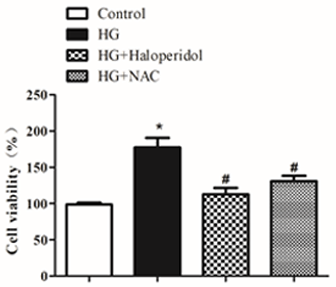
Haloperidol hydrochloride purchased from MedChemExpress. Usage Cited in: Clin Exp Pharmacol Physiol. 2021 Mar;48(3):370-380. [Abstract]
Haloperidol (10 μM; 48 h). Cell viability was measured by CCK-8 assay. The cells incubated with control medium were considered 100% viable.
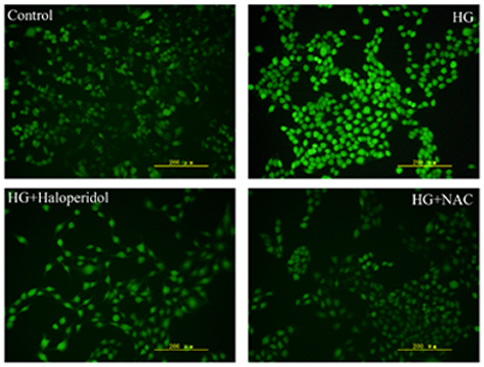
Haloperidol hydrochloride purchased from MedChemExpress. Usage Cited in: Clin Exp Pharmacol Physiol. 2021 Mar;48(3):370-380. [Abstract]
Haloperidol (10 μM; 48 h). ROS production in HSCs measured by staining with DCFH-DA and imaged by fluorescent microscopy.
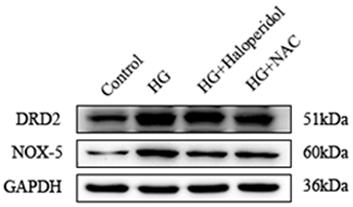
Haloperidol hydrochloride purchased from MedChemExpress. Usage Cited in: Clin Exp Pharmacol Physiol. 2021 Mar;48(3):370-380. [Abstract]
Haloperidol (10 μM; 48 h). Immunoblotting and optical density analysis of DRD2 and NOX-5, and the data were normalized to GAPDH.
-
-
-
-


Solvent & Solubility
In Vitro:
DMSO : 50 mg/mL (121.26 mM; ultrasonic and warming and heat to 60°C; Hygroscopic DMSO has a significant impact on the solubility of product, please use newly opened DMSO)
Please refer to the solubility information to select the appropriate solvent. Once prepared, please aliquot and store the solution to prevent product inactivation from repeated freeze-thaw cycles.
Storage method and period of stock solution: -80°C, 6 months; -20°C, 1 month (sealed storage, away from moisture). When stored at -80°C, please use it within 6 months. When stored at -20°C, please use it within 1 month.
Please refer to the solubility information to select the appropriate solvent. Once prepared, please aliquot and store the solution to prevent product inactivation from repeated freeze-thaw cycles.
Storage method and period of stock solution: -80°C, 6 months; -20°C, 1 month (sealed storage, away from moisture). When stored at -80°C, please use it within 6 months. When stored at -20°C, please use it within 1 month.
Concentration (start) × Volume (start) = Concentration (final) × Volume (final)
In Vivo:
Select the appropriate dissolution method based on your experimental animal and administration route.
- For the following dissolution methods, please ensure to first prepare a clear stock solution using an In Vitro approach and then sequentially add co-solvents:
- To ensure reliable experimental results, the clarified stock solution can be appropriately stored based on storage conditions. As for the working solution for In Vivo experiments, it is recommended to prepare freshly and use it on the same day.
- The percentages shown for the solvents indicate their volumetric ratio in the final prepared solution. If precipitation or phase separation occurs during preparation, heat and/or sonication can be used to aid dissolution.
Add each solvent one by one: 10% DMSO 40% PEG300 5% Tween-80 45% Saline
Solubility: ≥ 5 mg/mL (12.13 mM); Clear solution
This protocol yields a clear solution of ≥ 5 mg/mL (saturation unknown).
Taking 1 mL working solution as an example, add 100 μL DMSO stock solution (50.0 mg/mL) to 400 μL PEG300, and mix evenly; then add 50 μL Tween-80 and mix evenly; then add 450 μL Saline to adjust the volume to 1 mL.
Preparation of Saline: Dissolve 0.9 g sodium chloride in ddH₂O and dilute to 100 mL to obtain a clear Saline solution.
Add each solvent one by one: 10% DMSO 90% (20% SBE-β-CD in Saline)
Solubility: ≥ 5 mg/mL (12.13 mM); Clear solution
This protocol yields a clear solution of ≥ 5 mg/mL (saturation unknown).
Taking 1 mL working solution as an example, add 100 μL DMSO stock solution (50.0 mg/mL) to 900 μL 20% SBE-β-CD in Saline, and mix evenly.
Preparation of 20% SBE-β-CD in Saline (4°C, storage for one week): 2 g SBE-β-CD powder is dissolved in 10 mL Saline, completely dissolve until clear.
In Vivo Dissolution Calculator
Please enter the basic information of animal experiments:
-
-
-
-
Recommended: Prepare an additional quantity of animals to account for potential losses during experiments.
Please enter your animal formula composition:
-
%DMSO +
Recommended: Keep the proportion of DMSO in working solution below 2% if your animal is weak.
-
%+
-
+%Tween-80 + +
-
%Saline +
The co-solvents required include: DMSO, . All of co-solvents are available by MedChemExpress (MCE). , Tween 80. All of co-solvents are available by MedChemExpress (MCE).
Working solution concentration: 0.22 mg/mL
Method for preparing stock solution: mg drug dissolved in μL DMSO. Stock solution concentration: mg/mL. * In solvent : -80°C, 6 months; -20°C, 1 month (sealed storage, away from moisture)
1. Take μL DMSO stock solution;
2. Add μL .
μL , mix evenly;
3. Then add μL Tween 80, mix evenly;
4. Then add μL
Please ensure that the stock solution in the first step is dissolved to a clear state, and add co-solvents in sequence. You can use ultrasonic heating (ultrasonic cleaner, recommended frequency 20-40 kHz), vortexing, etc. to assist dissolution.


Purity & Documentation
-
Data Sheet (278 KB)
-
SDS (645 KB)
- English - EN (645 KB)
- Français - FR (645 KB)
- Deutsch - DE (645 KB)
- Norwegian - NO (645 KB)
- Español - ES (645 KB)
- Swedish - SV (645 KB)
- Italian - IT (645 KB)
- Korean - KR (645 KB)
- Portuguese - PT (645 KB)
-
Handling Instructions (2659 KB)
References


Complete Stock Solution Preparation Table
Please refer to the solubility information to select the appropriate solvent. Once prepared, please aliquot and store the solution to prevent product inactivation from repeated freeze-thaw cycles.
Storage method and period of stock solution: -80°C, 6 months; -20°C, 1 month (sealed storage, away from moisture). When stored at -80°C, please use it within 6 months. When stored at -20°C, please use it within 1 month.
| Optional Solvent | Concentration Solvent Mass | 1 mg | 5 mg | 10 mg | 25 mg |
|---|---|---|---|---|---|
| DMSO | 1 mM | 2.4252 mL | 12.1262 mL | 24.2524 mL | 60.6310 mL |
| 5 mM | 0.4850 mL | 2.4252 mL | 4.8505 mL | 12.1262 mL | |
| 10 mM | 0.2425 mL | 1.2126 mL | 2.4252 mL | 6.0631 mL | |
| 15 mM | 0.1617 mL | 0.8084 mL | 1.6168 mL | 4.0421 mL | |
| 20 mM | 0.1213 mL | 0.6063 mL | 1.2126 mL | 3.0316 mL | |
| 25 mM | 0.0970 mL | 0.4850 mL | 0.9701 mL | 2.4252 mL | |
| 30 mM | 0.0808 mL | 0.4042 mL | 0.8084 mL | 2.0210 mL | |
| 40 mM | 0.0606 mL | 0.3032 mL | 0.6063 mL | 1.5158 mL | |
| 50 mM | 0.0485 mL | 0.2425 mL | 0.4850 mL | 1.2126 mL | |
| 60 mM | 0.0404 mL | 0.2021 mL | 0.4042 mL | 1.0105 mL | |
| 80 mM | 0.0303 mL | 0.1516 mL | 0.3032 mL | 0.7579 mL | |
| 100 mM | 0.0243 mL | 0.1213 mL | 0.2425 mL | 0.6063 mL |


Haloperidol hydrochloride Related Classifications
HY-14538A Related Classifications
 Powered by Bioz