



L-745870
Based on 3 publication(s) in Google Scholar
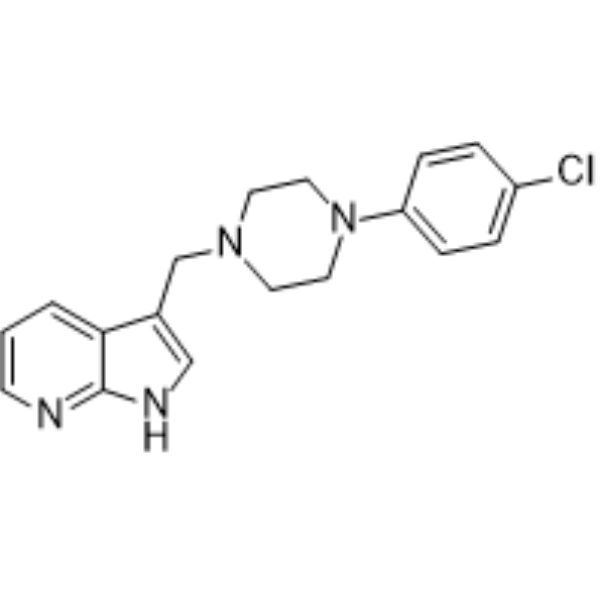
L-745870 is a potent, selective, brain-penetrant and orally active dopamine D4 receptor antagonist with a Ki of 0.43 nM. L-745870 shows weaker affinity for D2 (Ki of 960 nM) and D3 (Ki of 2300 nM) receptors, and exhibits moderate affinity for 5-HT2 receptors, sigma sites and α-adrenoceptors.
Nur für Forschungszwecke. Wir verkaufen nicht an Patienten.
- Reinheit : 99.50%
- CAS. Nr.: 158985-00-3
- Formel: C18H19ClN4
- Molecular Weight:326.82
-
Speicherung:
4°C, protect from light
* In solvent : -80°C, 6 months; -20°C, 1 month (protect from light)

To place orders, for customer services and technical support, please contact: MedChemExpress USA
Tel: 609-228-6898 E-mail: [email protected] [email protected]


-
 Biologische Aktivität
-
Chemical Information
-
Lösungsmittel & Löslichkeit
- Reinheit & Dokumentation
- Verweise
-
 Help & FAQs


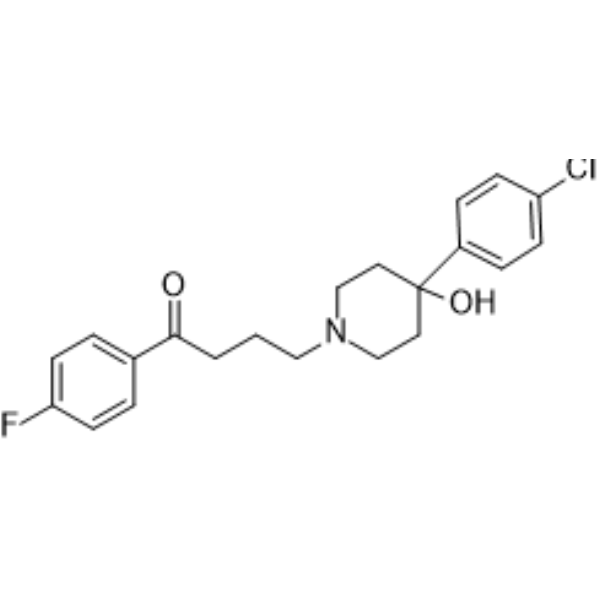
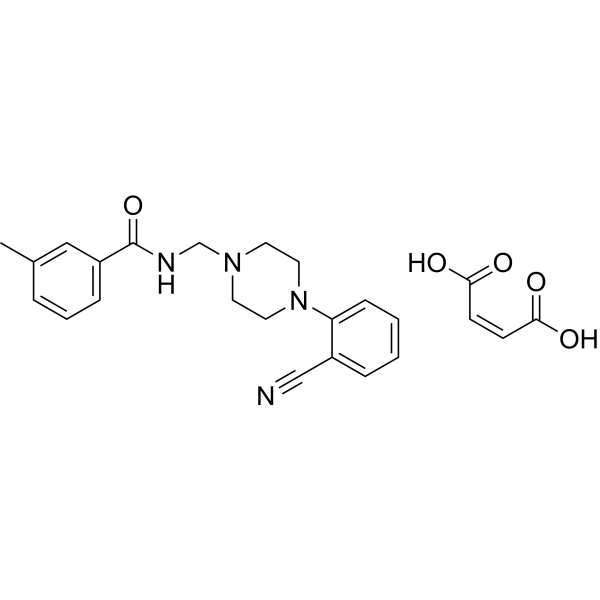
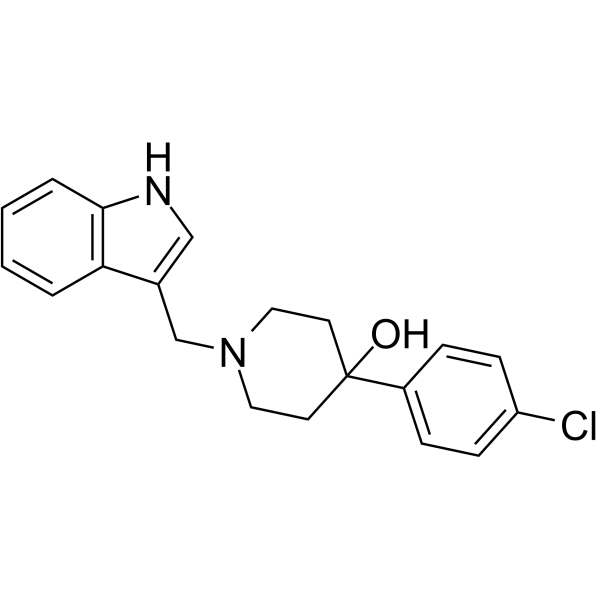
Publications Citing Use of MedChemExpress (MCE) L-745870
MoreAlle Dopamine Receptor Isoform-spezifische Produkte anzeigen
More

Biologische Aktivität
Beschreibung
IC50 & Target
[3]|
Human D4 Receptor 4.3 nM (Ki) |
D2 Receptor 960 nM (Ki) |
D3 Receptor 2300 nM (Ki) |
Cellular Effect
|
Cell Line

|
Type | Value | Description | References |
|---|---|---|---|---|
| CHO | EC50 |
27 nM
Compound: L-745870
|
Tested for the effective concentration against CHO 10001 cells in human D4.2 receptor established in mitogenesis assay
Tested for the effective concentration against CHO 10001 cells in human D4.2 receptor established in mitogenesis assay
|
[PMID: 11844688] |
In Vitro
L-745870 is capable of antagonizing the ability of D4 receptors to inhibit agonist-induced stimulation of [35S]-GTPgS binding; blocking the inhibition of forskolin-stimulated adenylate cyclase activity in transfected human embryonic kidney (HEK293) and Chinese hamster ovary (CHO) cells; blocking dopamine-induced inhibition of Ca2+ currents in transfected GH4C1 pituitary cells; inhibiting D4 activation of cloned G protein-coupled inwardly rectifying K+ channels; and antagonizing dopamine-induced stimulation of extracellular acidification in transfected cells[1].
MedChemExpress (MCE) has not independently confirmed the accuracy of these methods. They are for reference only.
In Vivo
Following oral administration to squirrel monkeys, L745870 (10 mg/kg p.o.) induces mild sedation and extrapyramidal motor symptoms, notably bradykinesia, became apparent at 30 mg/kg. Lower doses of L-745870 has no observable behavioural effects in monkeys[2].
MedChemExpress (MCE) has not independently confirmed the accuracy of these methods. They are for reference only.


Chemical Information
-
CAS. Nr. 158985-00-3
-
Appearance Solid
-
Molecular Weight 326.82
-
Formel C18H19ClN4
-
Color White to off-white
-
SMILES
ClC(C=C1)=CC=C1N(CC2)CCN2CC3=CNC4=NC=CC=C43
-
Versand
Room temperature in continental US; may vary elsewhere.
-
Speicherung
4°C, protect from light
* In solvent : -80°C, 6 months; -20°C, 1 month (protect from light)


Publications (3)
-
Journal Impact Factor
-
Most Recent
-
Br J Cancer
DRD4 promotes chemo-resistance and cancer stem cell-like phenotypes by mediating the activation of the Akt/β-catenin signaling axis in liver cancer. [Abstract]2024 Oct;131(7):1212-1223. PMID: 39174739 -
Psychopharmacology (Berl)
Contrasting effects of DOI and lisuride on impulsive decision-making in delay discounting task. [Abstract]2022 Nov;239(11):3551-3565. PMID: 36107207 -


Lösungsmittel & Löslichkeit
In Vitro:
DMSO : 25 mg/mL (76.49 mM; Need ultrasonic; Hygroscopic DMSO has a significant impact on the solubility of product, please use newly opened DMSO)
Please refer to the solubility information to select the appropriate solvent. Once prepared, please aliquot and store the solution to prevent product inactivation from repeated freeze-thaw cycles.
Storage method and period of stock solution: -80°C, 6 months; -20°C, 1 month (protect from light). When stored at -80°C, please use it within 6 months. When stored at -20°C, please use it within 1 month.
Please refer to the solubility information to select the appropriate solvent. Once prepared, please aliquot and store the solution to prevent product inactivation from repeated freeze-thaw cycles.
Storage method and period of stock solution: -80°C, 6 months; -20°C, 1 month (protect from light). When stored at -80°C, please use it within 6 months. When stored at -20°C, please use it within 1 month.
Konzentration (Stammlösung) × Volumen (Stammlösung) = Konzentration (Ziellösung) × Volumen (Ziellösung)
In Vivo:
Select the appropriate dissolution method based on your experimental animal and administration route.
- For the following dissolution methods, please ensure to first prepare a clear stock solution using an In Vitro approach and then sequentially add co-solvents:
- To ensure reliable experimental results, the clarified stock solution can be appropriately stored based on storage conditions. As for the working solution for In Vivo experiments, it is recommended to prepare freshly and use it on the same day.
- The percentages shown for the solvents indicate their volumetric ratio in the final prepared solution. If precipitation or phase separation occurs during preparation, heat and/or sonication can be used to aid dissolution.
Add each solvent one by one: 10% DMSO 40% PEG300 5% Tween-80 45% Saline
Solubility: ≥ 2.5 mg/mL (7.65 mM); Clear solution
This protocol yields a clear solution of ≥ 2.5 mg/mL (saturation unknown).
Taking 1 mL working solution as an example, add 100 μL DMSO stock solution (25.0 mg/mL) to 400 μL PEG300, and mix evenly; then add 50 μL Tween-80 and mix evenly; then add 450 μL Saline to adjust the volume to 1 mL.
Preparation of Saline: Dissolve 0.9 g sodium chloride in ddH₂O and dilute to 100 mL to obtain a clear Saline solution.
In Vivo Dissolution Calculator
Please enter the basic information of animal experiments:
-
-
-
-
Recommended: Prepare an additional quantity of animals to account for potential losses during experiments.
Please enter your animal formula composition:
-
%DMSO +
Recommended: Keep the proportion of DMSO in working solution below 2% if your animal is weak.
-
%+
-
+%Tween-80 + +
-
%Saline +
The co-solvents required include: DMSO, . All of co-solvents are available by MedChemExpress (MCE). , Tween 80. All of co-solvents are available by MedChemExpress (MCE).
Working solution concentration: 0.22 mg/mL
Method for preparing stock solution: mg drug dissolved in μL DMSO. Stock solution concentration: mg/mL. * In solvent : -80°C, 6 months; -20°C, 1 month (protect from light)
1. Take μL DMSO stock solution;
2. Add μL .
μL , mix evenly;
3. Then add μL Tween 80, mix evenly;
4. Then add μL
Please ensure that the stock solution in the first step is dissolved to a clear state, and add co-solvents in sequence. You can use ultrasonic heating (ultrasonic cleaner, recommended frequency 20-40 kHz), vortexing, etc. to assist dissolution.


Reinheit & Dokumentation
-
Data Sheet (275 KB)
-
SDS (393 KB)
- English - EN (393 KB)
- Français - FR (393 KB)
- Deutsch - DE (393 KB)
- Norwegian - NO (393 KB)
- Español - ES (393 KB)
- Swedish - SV (393 KB)
- Italian - IT (393 KB)
- Korean - KR (393 KB)
- Portuguese - PT (393 KB)
-
Handling Instructions (2659 KB)
Verweise
[1]. Bristow LJ, et al. Schizophrenia and L-745,870, a novel dopamine D4 receptor antagonist. Trends Pharmacol Sci. 1997 Jun;18(6):186-8. [Content Brief]
[2]. Patel S, et al. Biological profile of L-745,870, a selective antagonist with high affinity for the dopamine D4 receptor. J Pharmacol Exp Ther. 1997 Nov;283(2):636-47. [Content Brief]
[3]. Kulagowski JJ, et al. 3-((4-(4-Chlorophenyl)piperazin-1-yl)-methyl)-1H-pyrrolo-2,3-b-pyridine: an antagonist with high affinity and selectivity for the human dopamine D4 receptor. J Med Chem. 1996 May 10;39(10):1941-2. [Content Brief]


Complete Stock Solution Preparation Table
Please refer to the solubility information to select the appropriate solvent. Once prepared, please aliquot and store the solution to prevent product inactivation from repeated freeze-thaw cycles.
Storage method and period of stock solution: -80°C, 6 months; -20°C, 1 month (protect from light). When stored at -80°C, please use it within 6 months. When stored at -20°C, please use it within 1 month.
| Optional Solvent | Concentration Solvent Mass | 1 mg | 5 mg | 10 mg | 25 mg |
|---|---|---|---|---|---|
| DMSO | 1 mM | 3.0598 mL | 15.2989 mL | 30.5979 mL | 76.4947 mL |
| 5 mM | 0.6120 mL | 3.0598 mL | 6.1196 mL | 15.2989 mL | |
| 10 mM | 0.3060 mL | 1.5299 mL | 3.0598 mL | 7.6495 mL | |
| 15 mM | 0.2040 mL | 1.0199 mL | 2.0399 mL | 5.0996 mL | |
| 20 mM | 0.1530 mL | 0.7649 mL | 1.5299 mL | 3.8247 mL | |
| 25 mM | 0.1224 mL | 0.6120 mL | 1.2239 mL | 3.0598 mL | |
| 30 mM | 0.1020 mL | 0.5100 mL | 1.0199 mL | 2.5498 mL | |
| 40 mM | 0.0765 mL | 0.3825 mL | 0.7649 mL | 1.9124 mL | |
| 50 mM | 0.0612 mL | 0.3060 mL | 0.6120 mL | 1.5299 mL | |
| 60 mM | 0.0510 mL | 0.2550 mL | 0.5100 mL | 1.2749 mL |


L-745870 Related Classifications
HY-14325 Related Classifications
 Powered by Bioz