



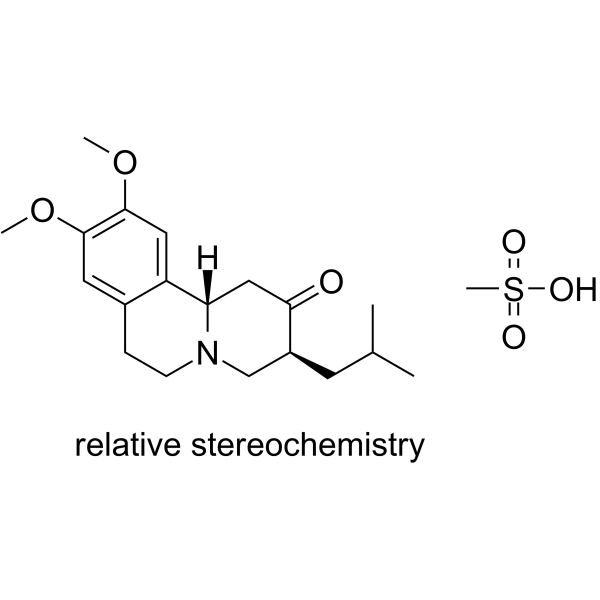
Tetrabenazine mesylate
Based on 1 publication(s) in Google Scholar
Tetrabenazine (Ro 1-9569) mesylate is a brain-penetrant and orally active VMAT2-selective ligand with human VMAT2 Ki 100 nM. Tetrabenazine mesylate binds VMAT2 to block monoamine uptake into synaptic vesicles, potentiates cytoplasmic monoamine degradation. Tetrabenazine mesylate weakly blocks dopamine D2 receptors, and increases dopamine turnover via elevated cerebrospinal fluid homovanillic acid. Tetrabenazine mesylate can be used for the research of Huntington’s disease, tardive dyskinesia, and Tourette’s syndrome.
For research use only. We do not sell to patients.
- CAS No.: 804-53-5
- Formula: C20H31NO6S
- Molecular Weight:413.53
-
Storage:
Please store the product under the recommended conditions in the Certificate of Analysis.

To place orders, for customer services and technical support, please contact: MedChemExpress USA
Tel: 609-228-6898 E-mail: [email protected] [email protected]


-
 Biological Activity
-
Chemical Information
- Purity & Documentation
- References
-
 Help & FAQs


Publications Citing Use of MedChemExpress (MCE) Tetrabenazine mesylate
MoreAll Dopamine Receptor Isoforms
More

Biological Activity
Description
IC50 & Target
|
D2 Receptor ~2.1 μM (Ki) |
In Vitro
Tetrabenazine mesylate reversibly inhibits human VMAT2 with a Ki of ~100 nM, reducing monoamine uptake into synaptic vesicles and depleting presynaptic monoamine stores[1].
Tetrabenazine mesylate inhibits dopamine D2 receptors in striatal membranes with a Ki of ~2.1 μM[1].
Tetrabenazine (0.3-10.0 μg/mL; 4 h) mesylate releases serotonin from rabbit blood platelets in vitro in a concentration-dependent manner[3].
Tetrabenazine (5-20 mg/L) mesylate is 60% bound to nondiffusible components of rabbit plasma[3].
MedChemExpress (MCE) has not independently confirmed the accuracy of these methods. They are for reference only.
In Vivo
Tetrabenazine (7 days) mesylate causes irreversible locomotor changes and substantia nigra pars compacta neuronal damage in healthy rats[1].
Tetrabenazine (50-150 mg/kg; i.v.; daily for 3-9 days) mesylate exhibits short-lived, central nervous system-selective Reserpine (HY-N0480)-like effects in rabbits[3].
MedChemExpress (MCE) has not independently confirmed the accuracy of these methods. They are for reference only.
-
Animal Model:New Zealand White male (~2 kg)[3]
-
Dosage:50 mg/kg; 150 mg/kg
-
Administration:i.v.; daily for 3, 7, 9 days
-
Result:Decreased brain serotonin to ~50% of normal within 1 hour, remained at this level for several hours, and returned to near normal by 18-24 hours.
Declined brain norepinephrine to ~15% of normal over 4 hours, and returned to ~70% of normal by 24 hours.
Did not measurably affect peripheral serotonin in blood platelets and small intestine, and norepinephrine in heart.
Caused <10% depletion of adrenal catecholamines at 4 hours and ~40% depletion at 24 hours.
Reduced plasma drug levels to <3 μg/mL by 6 hours, and made them undetectable by 24 hours.
Reached brain drug levels of ~45 μg/g within 10 minutes, declined to ~1.3 μg/g by 6 hours, and made them undetectable by 24 hours.
Failed to affect intestinal/platelet serotonin or heart norepinephrine, but caused 50% depletion of adrenal catecholamines by the end of infusion with single 150 mg/kg i.v. dose.
Showed no drug accumulation in plasma or tissues 24 hours after the last dose with repeated 50 mg/kg daily i.v. doses.
Clinical Trial
| NCT Number | Sponsor | Condition | Start Date |
Phase

|
|---|---|---|---|---|
| NCT01329991 | Plexxikon| | 2011-05 | PHASE1 |


Chemical Information
-
CAS No. 804-53-5
-
Molecular Weight 413.53
-
Formula C20H31NO6S
-
SMILES
CS(=O)(O)=O.O=C1[C@@H](CC(C)C)CN2CCC3=CC(OC)=C(OC)C=C3[C@]2([H])C1
-
Synonyms
Ro 1-9569 mesylate
-
Shipping
Room temperature in continental US; may vary elsewhere.
-
Storage
Please store the product under the recommended conditions in the Certificate of Analysis.


Publications (1)
-
Journal Impact Factor
-
Most Recent


Purity & Documentation
References
[1]. J C Shih, et al. Ketanserin and tetrabenazine abolish aggression in mice lacking monoamine oxidase A. Brain Res. 1999 Jul 24;835(2):104-12. [Content Brief]
[2]. Nobue Kitanaka, et al. Tetrabenazine, a vesicular monoamine transporter-2 inhibitor, attenuates morphine-induced hyperlocomotion in mice through alteration of dopamine and 5-hydroxytryptamine turnover in the cerebral cortex. Pharmacol Biochem Behav. 2018 Sep;172:9-16. doi: 10.1016/j.pbb.2018.07.002. Epub 2018 Jul 12. [Content Brief]
[3]. S J Podurgiel, et al. The vesicular monoamine transporter (VMAT-2) inhibitor tetrabenazine induces tremulous jaw movements in rodents: implications for pharmacological models of parkinsonian tremor. Neuroscience. 2013 Oct 10;250:507-19. doi: 10.1016/j.neuroscience.2013.07.008. Epub 2013 Jul 15. [Content Brief]

Calculators
Concentration (start) × Volume (start) = Concentration (final) × Volume (final)


Tetrabenazine mesylate Related Classifications
HY-B0590E Related Classifications
 Powered by Bioz