



Dopamine hydrochloride
Based on 33 publication(s) in Google Scholar
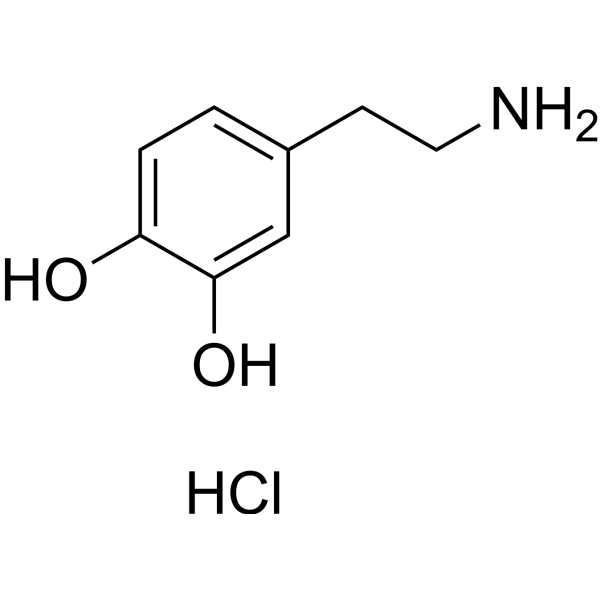
Dopamine hydrochloride (ASL279) is a catecholamine neurotransmitter that is produced in the substantia nigra, ventral tegmental area, and hypothalamus of the brain. Dopamine hydrochloride (ASL279) plays several important roles in the brain and body. Dopamine hydrochloride (ASL279) acts through D2 dopamine receptors to induce endocytosis of VEGFR2, which is critical for promoting angiogenesis.
Nur für Forschungszwecke. Wir verkaufen nicht an Patienten.
- Reinheit : 99.79%
- CAS. Nr.: 62-31-7
- Formel: C8H12ClNO2
- Molecular Weight:189.64
-
Speicherung:
Please store the product under the recommended conditions in the Certificate of Analysis.

To place orders, for customer services and technical support, please contact: MedChemExpress USA
Tel: 609-228-6898 E-mail: [email protected] [email protected]


-
 Biologische Aktivität
-
Chemical Information
-
Lösungsmittel & Löslichkeit
- Protokoll
- Reinheit & Dokumentation
- Verweise
-
 Help & FAQs


-
HY-B1473
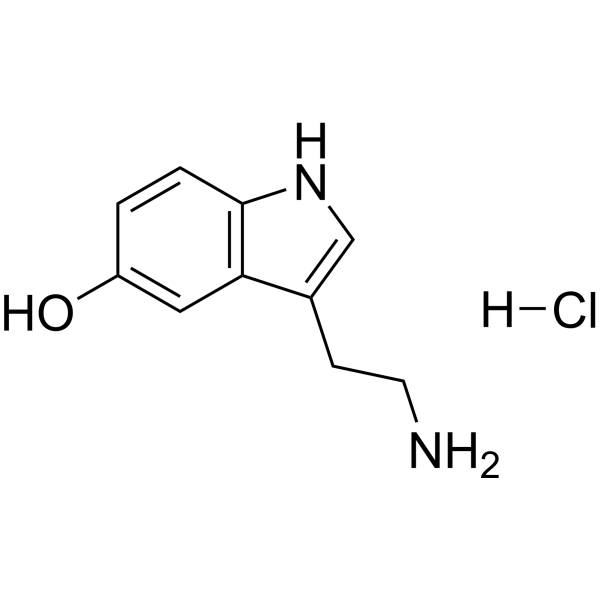
Serotonin hydrochloride -
HY-B1473A
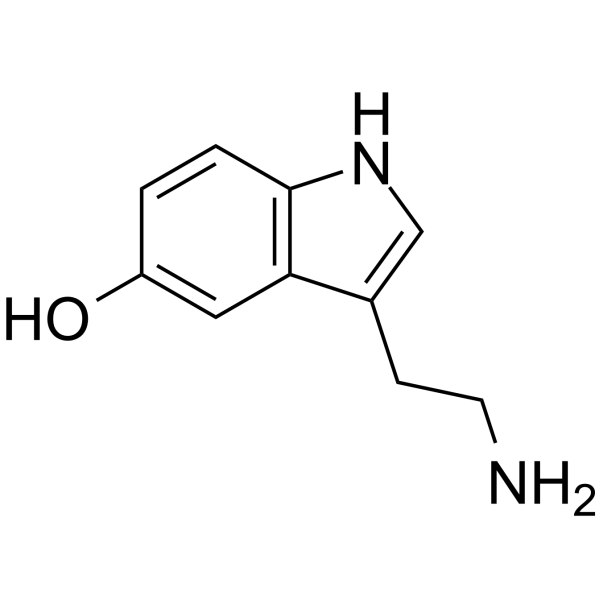
Serotonin5-HT Receptor Agonist -

HY-B0451AR
Dopamine hydrochloride (Standard)Catecholamine Neurotransmitter -
HY-N0304
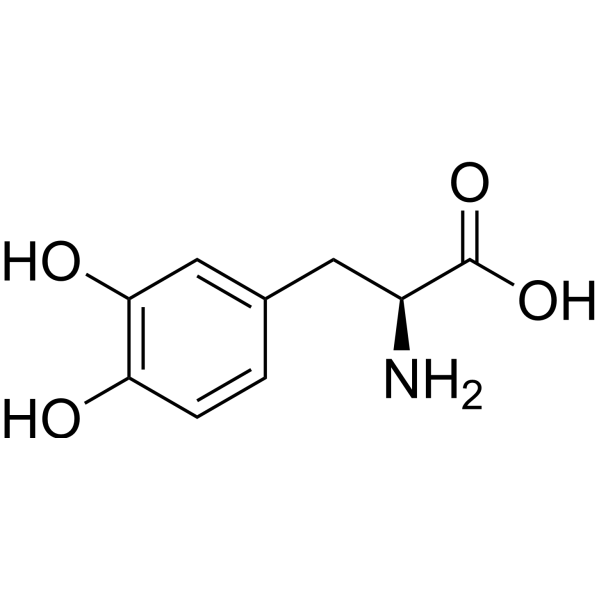
L-DOPADopamine Precursor -
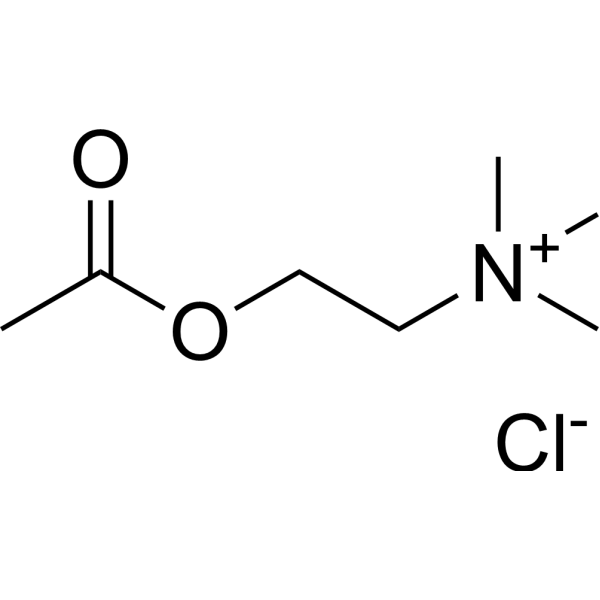
HY-B0282
Acetylcholine chlorideCholinergic Agonist -
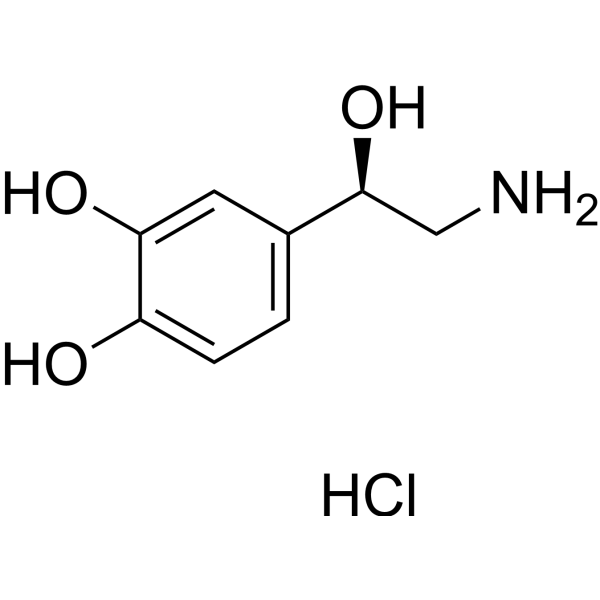
HY-13715A
Norepinephrine hydrochlorideAdrenergic Receptor Agonist -
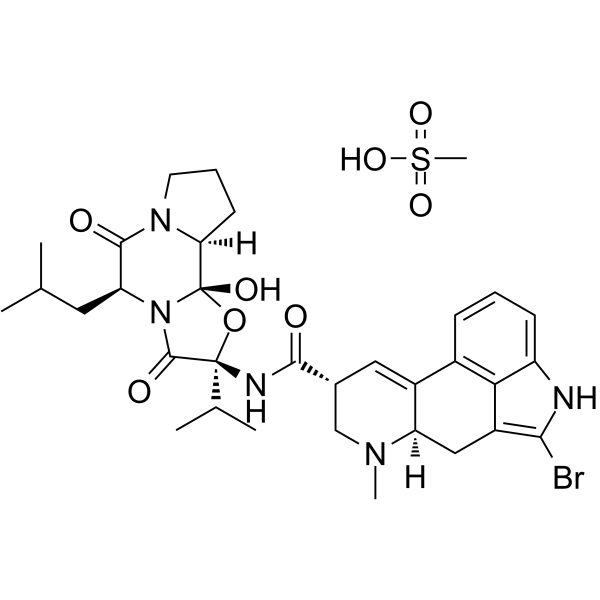
HY-12705A
Bromocriptine mesylate -

HY-B0451
DopamineCatecholamine Neurotransmitter -
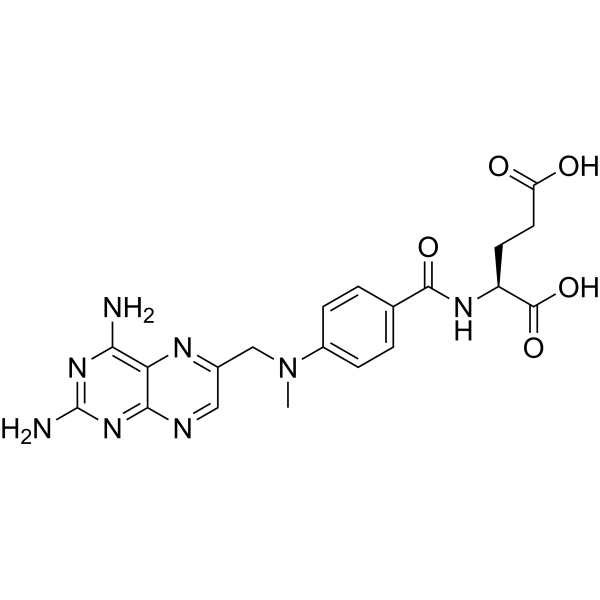
HY-14519
MethotrexateDihydrofolate Reductase Inhibitor -
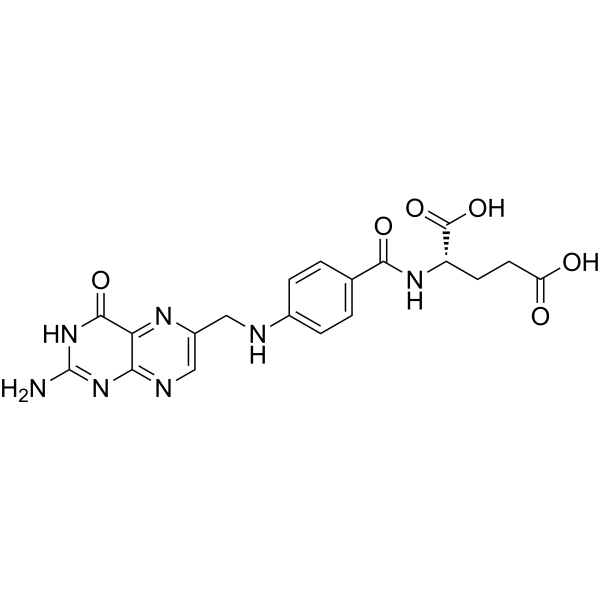
HY-16637
Folic acidB complex -

HY-B0710
Betaine -
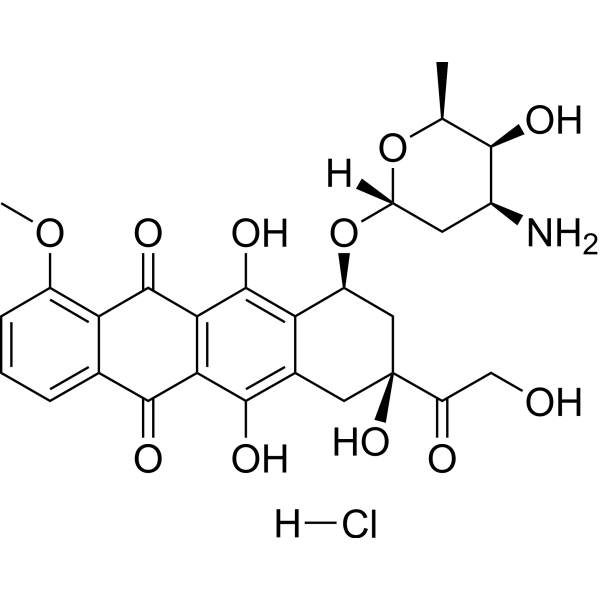
HY-15142
Doxorubicin hydrochlorideTopoisomerase Inhibitor
Publications Citing Use of MedChemExpress (MCE) Dopamine hydrochloride
More- Cell Res. 2026 Apr;36(4):286-299. [Abstract]
- Immunity. 2025 Sep 9;58(9):2320-2335.e9. [Abstract]
- Nat Commun. 2025 Jan 2;16(1):323. [Abstract]
- Nat Commun. 2024 Feb 6;15(1):1122. [Abstract]
- Exp Mol Med. 2026 Aug;58(8):2762-2780.
- J Clin Invest. 2026 Jan 15;136(5):e196944. [Abstract]
- Sci Adv. 2023 Jun 2;9(22):eadg3365. [Abstract]
- Int J Biol Macromol. 2026 May:362:152049. [Abstract]
- Int J Nanomedicine. 2024 Jul 3:19:6717-6730. [Abstract]
- Phytother Res. 2023 Aug;37(8):3296-3308. [Abstract]
- ACS Appl Mater Interfaces. 2025 Nov 26;17(47):64149-64167. [Abstract]
- Anal Chem. 2026 Jul 21;98(28):20926-20935. [Abstract]
- Anal Chem. 2026 Jun 16;98(23):16962-16970. [Abstract]
- Results Chem. 2026 Apr 21;26:103342.
- Eur J Pharmacol. 2026 Jul 10:1029:178996. [Abstract]
- Eur J Pharmacol. 2025 Jul 5:998:177498. [Abstract]
- Eur J Pharmacol. 2023 Dec 15:961:176174. [Abstract]
- Int J Mol Sci. 2022 Oct 17;23(20):12420. [Abstract]
- Microchem J. 2025 Dec 18;220:116650.
- Microorganisms. 2026 Jan 30;14(2):327. [Abstract]
- Structure. 2026 Jun 8.
- J Solid State Electrochem. 2025 Jan 17.
- J Biomed Mater Res B Appl Biomater. 2026 Jan;114(1):e70037. [Abstract]
- New J Chem. 03 Aug 2022.
- Biomed Chromatogr. 2026 Sep;40(9):e70551.
- bioRxiv. 2026 Jul 13.
- Elife. 2026 Jun 22:15:RP109081. [Abstract]
- SSRN. 2026 Jun 16.
- bioRxiv. 2026 Mar 7.
- bioRxiv. 2025 Oct 12.
- bioRxiv. 2025 Oct 22.
- bioRxiv. 2023 Oct 13.
- Biomed Pharmacother. 2019 Nov:119:109419. [Abstract]
 Customer Validation & Images

-
Histological Imaging/Staining
Alle Dopamine Receptor Isoform-spezifische Produkte anzeigen
MoreAlle Endogenous Metabolite Isoform-spezifische Produkte anzeigen
More

Biologische Aktivität
Beschreibung
IC50 & Target
|
Microbial Metabolite |
D2 Dopamine Receptor |
Cellular Effect
|
Cell Line

|
Type | Value | Description | References |
|---|---|---|---|---|
| CHO | EC50 |
209 nM
Compound: dopamine
|
Agonist activity at human dopamine D2 receptor expressed in CHO cells by [35S]GTPgammaS binding assay
Agonist activity at human dopamine D2 receptor expressed in CHO cells by [35S]GTPgammaS binding assay
|
[PMID: 20146482] |
| CHO | EC50 |
4.76 nM
Compound: dopamine
|
Agonist activity at human dopamine D3 receptor expressed in CHO cells by [35S]GTPgammaS binding assay
Agonist activity at human dopamine D3 receptor expressed in CHO cells by [35S]GTPgammaS binding assay
|
[PMID: 20146482] |
| CHO | EC50 |
227 nM
Compound: DA
|
Agonist activity at human cloned dopamine D2 receptor expressed in CHO cells by [35S]GTPgammaS binding assay
Agonist activity at human cloned dopamine D2 receptor expressed in CHO cells by [35S]GTPgammaS binding assay
|
[PMID: 22642365] |
| CHO | EC50 |
8.57 nM
Compound: DA
|
Agonist activity at human cloned dopamine D3 receptor expressed in CHO cells by [35S]GTPgammaS binding assay
Agonist activity at human cloned dopamine D3 receptor expressed in CHO cells by [35S]GTPgammaS binding assay
|
[PMID: 22642365] |
| CHO | EC50 |
240 nM
Compound: Dopamine
|
Agonist activity at human cloned dopamine D2 receptor expressed in CHO cells by [35S]GTP gammaS binding assay
Agonist activity at human cloned dopamine D2 receptor expressed in CHO cells by [35S]GTP gammaS binding assay
|
[PMID: 23275802] |
| CHO | EC50 |
5.8 nM
Compound: Dopamine
|
Agonist activity at human cloned dopamine D3 receptor expressed in CHO cells by [35S]GTP gammaS binding assay
Agonist activity at human cloned dopamine D3 receptor expressed in CHO cells by [35S]GTP gammaS binding assay
|
[PMID: 23275802] |
| CHO | EC50 |
227 nM
Compound: DA
|
Agonist activity at human dopamine D2L receptor expressed in CHO cells assessed as stimulation of [35S]GTPgammaS binding after 60 mins by scintillation counting analysis
Agonist activity at human dopamine D2L receptor expressed in CHO cells assessed as stimulation of [35S]GTPgammaS binding after 60 mins by scintillation counting analysis
|
[PMID: 23623679] |
| CHO | EC50 |
7.64 nM
Compound: DA
|
Agonist activity at human dopamine D3 receptor expressed in CHO cells assessed as stimulation of [35S]GTPgammaS binding after 60 mins by scintillation counting analysis
Agonist activity at human dopamine D3 receptor expressed in CHO cells assessed as stimulation of [35S]GTPgammaS binding after 60 mins by scintillation counting analysis
|
[PMID: 23623679] |
| CHO | EC50 |
36 nM
Compound: Dopamine
|
Agonist activity at human dopamine D2 receptor expressed in CHO cells assessed as increase of forskolin-induced cAMP production after 20 mins
Agonist activity at human dopamine D2 receptor expressed in CHO cells assessed as increase of forskolin-induced cAMP production after 20 mins
|
[PMID: 24296012] |
| CHO | EC50 |
39 nM
Compound: Dopamine
|
Agonist activity at human recombinant dopamine D1 receptor expressed in CHO cells assessed as cAMP production after 20 mins
Agonist activity at human recombinant dopamine D1 receptor expressed in CHO cells assessed as cAMP production after 20 mins
|
[PMID: 24296012] |
| CHO | EC50 |
183 nM
Compound: DA
|
Agonist activity at human D2 receptor expressed in CHO cells by [35S]GTPgammaS binding assay
Agonist activity at human D2 receptor expressed in CHO cells by [35S]GTPgammaS binding assay
|
[PMID: 26555041] |
| CHO | EC50 |
5.34 nM
Compound: DA
|
Agonist activity at human D3 receptor expressed in CHO cells by [35S]GTPgammaS binding assay
Agonist activity at human D3 receptor expressed in CHO cells by [35S]GTPgammaS binding assay
|
[PMID: 26555041] |
| CHO | EC50 |
376 nM
Compound: Dopamine
|
Agonist activity at human D2 dopamine receptor expressed in CHO cells by [35S]GTPgammaS binding assay
Agonist activity at human D2 dopamine receptor expressed in CHO cells by [35S]GTPgammaS binding assay
|
[PMID: 27591013] |
| CHO | EC50 |
7.26 nM
Compound: Dopamine
|
Agonist activity at human D3 dopamine receptor expressed in CHO cells by [35S]GTPgammaS binding assay
Agonist activity at human D3 dopamine receptor expressed in CHO cells by [35S]GTPgammaS binding assay
|
[PMID: 27591013] |
| CHO-K1 | EC50 |
1425 nM
Compound: Dopamine
|
Agonist activity at rat dopamine D2short receptor expressed in CHO-K1 cells assessed as stimulation of [35S]GTPgammaS binding by liquid scintillation counting
Agonist activity at rat dopamine D2short receptor expressed in CHO-K1 cells assessed as stimulation of [35S]GTPgammaS binding by liquid scintillation counting
|
[PMID: 19454369] |
| CHO-K1 | EC50 |
1.8 nM
Compound: Dopamine
|
Agonist activity at dopamine D3 receptor (unknown origin) expressed in CHOK1 cells coexpressing Galpha15 by FLIPR assay
Agonist activity at dopamine D3 receptor (unknown origin) expressed in CHOK1 cells coexpressing Galpha15 by FLIPR assay
|
[PMID: 23675993] |
| CHO-K1 | EC50 |
6.7 nM
Compound: Dopamine
|
Agonist activity at dopamine D2 receptor (unknown origin) expressed in CHOK1 cells coexpressing Galpha15 by FLIPR assay
Agonist activity at dopamine D2 receptor (unknown origin) expressed in CHOK1 cells coexpressing Galpha15 by FLIPR assay
|
[PMID: 23675993] |
| CHO-K1 | EC50 |
0.69 nM
Compound: Dopamine
|
Agonist activity at D2 receptor (unknown origin) expressed in CHOK1 cells co-expressing G-alpha 15 by fluo-4 dye based FLIPR assay
Agonist activity at D2 receptor (unknown origin) expressed in CHOK1 cells co-expressing G-alpha 15 by fluo-4 dye based FLIPR assay
|
[PMID: 27487565] |
| COS-7 | IC50 |
111 nM
Compound: Dopamine
|
Displacement of [3H]nemonapride from Rattus norvegicus (rat) wild type dopamine D3 receptor transfected in african green monkey COS7 cells after 1 hr by beta scintillation counting
Displacement of [3H]nemonapride from Rattus norvegicus (rat) wild type dopamine D3 receptor transfected in african green monkey COS7 cells after 1 hr by beta scintillation counting
|
10.1007/s00044-004-0006-x |
| COS-7 | IC50 |
124 nM
Compound: Dopamine
|
Displacement of [3H]nemonapride from Rattus norvegicus (rat) chimeric dopamine D3 trunk/D3 tail receptor transfected in african green monkey COS7 cells after 1 hr by beta scintillation counting
Displacement of [3H]nemonapride from Rattus norvegicus (rat) chimeric dopamine D3 trunk/D3 tail receptor transfected in african green monkey COS7 cells after 1 hr by beta scintillation counting
|
10.1007/s00044-004-0006-x |
| COS-7 | IC50 |
3140 nM
Compound: Dopamine
|
Displacement of [3H]nemonapride from Rattus norvegicus (rat) wild type dopamine D2 receptor transfected in african green monkey COS7 cells after 1 hr by beta scintillation counting
Displacement of [3H]nemonapride from Rattus norvegicus (rat) wild type dopamine D2 receptor transfected in african green monkey COS7 cells after 1 hr by beta scintillation counting
|
10.1007/s00044-004-0006-x |
| COS-7 | IC50 |
3260 nM
Compound: Dopamine
|
Displacement of [3H]nemonapride from Rattus norvegicus (rat) chimeric dopamine D2 trunk/D2 tail receptor transfected in african green monkey COS7 cells after 1 hr by beta scintillation counting
Displacement of [3H]nemonapride from Rattus norvegicus (rat) chimeric dopamine D2 trunk/D2 tail receptor transfected in african green monkey COS7 cells after 1 hr by beta scintillation counting
|
10.1007/s00044-004-0006-x |
| COS-7 | IC50 |
483 nM
Compound: Dopamine
|
Displacement of [3H]nemonapride from Rattus norvegicus (rat) chimeric dopamine D3 trunk/D2 tail receptor transfected in african green monkey COS7 cells after 1 hr by beta scintillation counting
Displacement of [3H]nemonapride from Rattus norvegicus (rat) chimeric dopamine D3 trunk/D2 tail receptor transfected in african green monkey COS7 cells after 1 hr by beta scintillation counting
|
10.1007/s00044-004-0006-x |
| COS-7 | IC50 |
582 nM
Compound: Dopamine
|
Displacement of [3H]nemonapride from Rattus norvegicus (rat) chimeric dopamine D2 trunk/D3 tail receptor transfected in african green monkey COS7 cells after 1 hr by beta scintillation counting
Displacement of [3H]nemonapride from Rattus norvegicus (rat) chimeric dopamine D2 trunk/D3 tail receptor transfected in african green monkey COS7 cells after 1 hr by beta scintillation counting
|
10.1007/s00044-004-0006-x |
| HEK293 | EC50 |
1.1 nM
Compound: Dopamine
|
In vitro effective concentration tested on HEK293 cells co-transfected with rat Dopamine receptor D2 using FLIPR assay
In vitro effective concentration tested on HEK293 cells co-transfected with rat Dopamine receptor D2 using FLIPR assay
|
[PMID: 15239663] |
| HEK293 | EC50 |
18 nM
Compound: Dopamine
|
In vitro effective concentration tested on HEK293 cells co-transfected with human Dopamine receptor D2 using FLIPR assay
In vitro effective concentration tested on HEK293 cells co-transfected with human Dopamine receptor D2 using FLIPR assay
|
[PMID: 15239663] |
| HEK293 | EC50 |
2.2 nM
Compound: Dopamine
|
In vitro effective concentration tested on HEK293 cells co-transfected with human Dopamine receptor D4 using FLIPR assay
In vitro effective concentration tested on HEK293 cells co-transfected with human Dopamine receptor D4 using FLIPR assay
|
[PMID: 15239663] |
| HEK293 | EC50 |
2.4 nM
Compound: Dopamine
|
In vitro effective concentration tested on HEK293 cells co-transfected with rat Dopamine receptor D4 using FLIPR assay
In vitro effective concentration tested on HEK293 cells co-transfected with rat Dopamine receptor D4 using FLIPR assay
|
[PMID: 15239663] |
| HEK293 | EC50 |
2.7 nM
Compound: Dopamine
|
In vitro effective concentration tested on HEK293 cells co-transfected with ferret Dopamine receptor D4 using FLIPR assay
In vitro effective concentration tested on HEK293 cells co-transfected with ferret Dopamine receptor D4 using FLIPR assay
|
[PMID: 15239663] |
| HEK293 | EC50 |
8 nM
Compound: Dopamine
|
In vitro effective concentration tested on HEK293 cells co-transfected with ferret Dopamine receptor D2 using FLIPR assay
In vitro effective concentration tested on HEK293 cells co-transfected with ferret Dopamine receptor D2 using FLIPR assay
|
[PMID: 15239663] |
| HEK293 | EC50 |
1.1 nM
Compound: dopamine
|
Agonist activity at rat D2 receptor in HEK293 cells coexpressing G-alpha-qo5 by FLIPR
Agonist activity at rat D2 receptor in HEK293 cells coexpressing G-alpha-qo5 by FLIPR
|
[PMID: 17149874] |
| HEK293 | EC50 |
18 nM
Compound: dopamine
|
Agonist activity at human D2 receptor in HEK293 cells coexpressing G-alpha-qo5 by FLIPR
Agonist activity at human D2 receptor in HEK293 cells coexpressing G-alpha-qo5 by FLIPR
|
[PMID: 17149874] |
| HEK293 | EC50 |
2.2 nM
Compound: dopamine
|
Agonist activity at human D4.4 receptor in HEK293 cells coexpressing G-alpha-qo5 by FLIPR
Agonist activity at human D4.4 receptor in HEK293 cells coexpressing G-alpha-qo5 by FLIPR
|
[PMID: 17149874] |
| HEK293 | EC50 |
2.4 nM
Compound: dopamine
|
Agonist activity at rat D4 receptor in HEK293 cells coexpressing G-alpha-qo5 by FLIPR
Agonist activity at rat D4 receptor in HEK293 cells coexpressing G-alpha-qo5 by FLIPR
|
[PMID: 17149874] |
| HEK293 | EC50 |
2.7 nM
Compound: dopamine
|
Agonist activity at ferret D4 receptor in HEK293 cells coexpressing G-alpha-qo5 by FLIPR
Agonist activity at ferret D4 receptor in HEK293 cells coexpressing G-alpha-qo5 by FLIPR
|
[PMID: 17149874] |
| HEK293 | EC50 |
8 nM
Compound: dopamine
|
Agonist activity at ferret D2 receptor in HEK293 cells coexpressing Galphaqo5 by FLIPR
Agonist activity at ferret D2 receptor in HEK293 cells coexpressing Galphaqo5 by FLIPR
|
[PMID: 17149874] |
| HEK293 | EC50 |
37 nM
Compound: 1, DA
|
Agonist activity at human dopamine D1 receptor expressed in HEK293 cells assessed as cAMP accumulation after 15 mins
Agonist activity at human dopamine D1 receptor expressed in HEK293 cells assessed as cAMP accumulation after 15 mins
|
[PMID: 21862338] |
| HEK293 | IC50 |
1 μM
Compound: dopamine
|
Displacement of [3H]spiperone from high-affinity state of human dopamine D2L receptor transfected in HEK293 cells after 2 hrs by scintillation counting analysis
Displacement of [3H]spiperone from high-affinity state of human dopamine D2L receptor transfected in HEK293 cells after 2 hrs by scintillation counting analysis
|
[PMID: 24325578] |
| HEK293 | IC50 |
1 x 10⁻⁴ M
Compound: dopamine
|
Displacement of [3H]spiperone from low-affinity state of human dopamine D2L receptor transfected in HEK293 cells after 2 hrs by scintillation counting analysis
Displacement of [3H]spiperone from low-affinity state of human dopamine D2L receptor transfected in HEK293 cells after 2 hrs by scintillation counting analysis
|
[PMID: 24325578] |
| HEK293 | EC50 |
470 nM
Compound: Dopamine
|
Agonist activity at human dopamine D2 short receptor transiently expressed in HEK293 cells co-expressing Galphai2 after 30 mins by [35S]GTPgammaS binding assay
Agonist activity at human dopamine D2 short receptor transiently expressed in HEK293 cells co-expressing Galphai2 after 30 mins by [35S]GTPgammaS binding assay
|
[PMID: 24831693] |
| HEK293 | EC50 |
9.3 nM
Compound: Dopamine
|
Agonist activity at human dopamine D3 receptor transiently expressed in HEK293 cells co-expressing Galphao1 after 30 mins by [35S]GTPgammaS binding assay
Agonist activity at human dopamine D3 receptor transiently expressed in HEK293 cells co-expressing Galphao1 after 30 mins by [35S]GTPgammaS binding assay
|
[PMID: 24831693] |
| HEK293 | EC50 |
0.8 nM
Compound: 1; DA
|
Agonist activity at D2R (unknown origin) expressed in HEK293 cells assessed as effect on cAMP accumulation incubated for 10 mins by Gi-cAMP Glosensor assay
Agonist activity at D2R (unknown origin) expressed in HEK293 cells assessed as effect on cAMP accumulation incubated for 10 mins by Gi-cAMP Glosensor assay
|
[PMID: 31098001] |
| HEK293 | EC50 |
1.8 nM
Compound: 1; DA
|
Agonist activity at D4R (unknown origin) expressed in HEK293 cells assessed as effect on cAMP accumulation incubated for 10 mins by Gi-cAMP Glosensor assay
Agonist activity at D4R (unknown origin) expressed in HEK293 cells assessed as effect on cAMP accumulation incubated for 10 mins by Gi-cAMP Glosensor assay
|
[PMID: 31098001] |
| HEK293 | EC50 |
1400 nM
Compound: 1; DA
|
Agonist activity at wild type human D1R expressed in HEK293 cells assessed as effect on beta-arrestin2 recruitment by PRESTO-Tango beta-arrestin2 recruitment assay
Agonist activity at wild type human D1R expressed in HEK293 cells assessed as effect on beta-arrestin2 recruitment by PRESTO-Tango beta-arrestin2 recruitment assay
|
[PMID: 31098001] |
| HEK293 | EC50 |
2 nM
Compound: 1; DA
|
Agonist activity at D5R (unknown origin) expressed in HEK293 cells assessed as effect on cAMP accumulation incubated for 10 mins by Gs-cAMP Glosensor assay
Agonist activity at D5R (unknown origin) expressed in HEK293 cells assessed as effect on cAMP accumulation incubated for 10 mins by Gs-cAMP Glosensor assay
|
[PMID: 31098001] |
| HEK293 | EC50 |
44 nM
Compound: 1; DA
|
Agonist activity at wild type human D1R expressed in HEK293 cells assessed as effect on cAMP accumulation incubated for 10 mins by Gs-cAMP Glosensor assay
Agonist activity at wild type human D1R expressed in HEK293 cells assessed as effect on cAMP accumulation incubated for 10 mins by Gs-cAMP Glosensor assay
|
[PMID: 31098001] |
| HEK293 | EC50 |
1.1 nM
Compound: DA
|
Agonist activity at RLuc8-fused Go-coupled human D3R expressed in HEK293 cells untagged beta1 and mVenus-tagged gamma2 measured after 5 mins in presence of coelenterazine H by BRET assay
Agonist activity at RLuc8-fused Go-coupled human D3R expressed in HEK293 cells untagged beta1 and mVenus-tagged gamma2 measured after 5 mins in presence of coelenterazine H by BRET assay
|
[PMID: 32342685] |
| HEK293 | EC50 |
2.3 nM
Compound: DA
|
Agonist activity at RLuc8-fused human D3R expressed in HEK293 cells co-expressing N-terminal Venus-tagged beta-arrestin2 and GRK3 assessed as induction of beta-arrestin2 recruitment measured after 5 mins in presence of coelenterazine H by BRET assay
Agonist activity at RLuc8-fused human D3R expressed in HEK293 cells co-expressing N-terminal Venus-tagged beta-arrestin2 and GRK3 assessed as induction of beta-arrestin2 recruitment measured after 5 mins in presence of coelenterazine H by BRET assay
|
[PMID: 32342685] |
| HEK293 | EC50 |
3.5 nM
Compound: DA
|
Agonist activity at human D3R expressed in HEK293 cells assessed as inhibition of forskolin-stimulated cAMP production measured after 5 mins in presence of beta-adrenergic blocker propranolol and coelenterazine H by CAMYEL BRET assay
Agonist activity at human D3R expressed in HEK293 cells assessed as inhibition of forskolin-stimulated cAMP production measured after 5 mins in presence of beta-adrenergic blocker propranolol and coelenterazine H by CAMYEL BRET assay
|
[PMID: 32342685] |
| HEK293 | EC50 |
33 nM
Compound: DA
|
Agonist activity at RLuc8-fused human D3R Y365A mutant expressed in HEK293 cells co-expressing N-terminal Venus-tagged beta-arrestin2 and GRK3 assessed as induction of beta-arrestin2 recruitment measured after 5 mins in presence of coelenterazine H by BRE
Agonist activity at RLuc8-fused human D3R Y365A mutant expressed in HEK293 cells co-expressing N-terminal Venus-tagged beta-arrestin2 and GRK3 assessed as induction of beta-arrestin2 recruitment measured after 5 mins in presence of coelenterazine H by BRE
|
[PMID: 32342685] |
| HEK293 | EC50 |
55 nM
Compound: DA
|
Agonist activity at RLuc8-fused human D3R Y198A mutant expressed in HEK293 cells co-expressing N-terminal Venus-tagged beta-arrestin2 and GRK3 assessed as induction of beta-arrestin2 recruitment measured after 5 mins in presence of coelenterazine H by BRE
Agonist activity at RLuc8-fused human D3R Y198A mutant expressed in HEK293 cells co-expressing N-terminal Venus-tagged beta-arrestin2 and GRK3 assessed as induction of beta-arrestin2 recruitment measured after 5 mins in presence of coelenterazine H by BRE
|
[PMID: 32342685] |
| HEK293 | EC50 |
820 nM
Compound: DA
|
Agonist activity at RLuc8-fused human D3R Y198A/Y365A double mutant expressed in HEK293 cells co-expressing N-terminal Venus-tagged beta-arrestin2 and GRK3 assessed as induction of beta-arrestin2 recruitment measured after 5 mins in presence of coelentera
Agonist activity at RLuc8-fused human D3R Y198A/Y365A double mutant expressed in HEK293 cells co-expressing N-terminal Venus-tagged beta-arrestin2 and GRK3 assessed as induction of beta-arrestin2 recruitment measured after 5 mins in presence of coelentera
|
[PMID: 32342685] |
| HEK293 | EC50 |
46 μM
Compound: dopamine
|
Inhibition of the Dopamine transporter (DAT, SLC6A3) as assessed by GPCR-mediated changes in cell morphology using the impedance-based transporter activity through receptor activation (TRACT) assay in HEK-293 JumpIN-SLC6A3 cells (PubChem AID: 1745858)
Inhibition of the Dopamine transporter (DAT, SLC6A3) as assessed by GPCR-mediated changes in cell morphology using the impedance-based transporter activity through receptor activation (TRACT) assay in HEK-293 JumpIN-SLC6A3 cells (PubChem AID: 1745858)
|
[PMID: 33446713] |
| HEK293 | EC50 |
20 μM
Compound: DA
|
Inhibition of the Norepinephrine transporter (NET, SLC6A2) as assessed by GPCR-mediated changes in cell morphology using the impedance-based transporter activity through receptor activation (TRACT) assay in HEK-293 JumpIN-SLC6A2 cells (PubChem AID: 174586
Inhibition of the Norepinephrine transporter (NET, SLC6A2) as assessed by GPCR-mediated changes in cell morphology using the impedance-based transporter activity through receptor activation (TRACT) assay in HEK-293 JumpIN-SLC6A2 cells (PubChem AID: 174586
|
[PMID: 34112854] |
| HEK-293T | EC50 |
1.8 nM
Compound: DA
|
Agonist activity at human D3 receptor transfected in HEK293T cells by BRET based G0 activation assay
Agonist activity at human D3 receptor transfected in HEK293T cells by BRET based G0 activation assay
|
[PMID: 27035329] |
| HEK-293T | EC50 |
5 nM
Compound: DA
|
Agonist activity at human D2 receptor transfected in HEK293T cells by BRET based G0 activation assay
Agonist activity at human D2 receptor transfected in HEK293T cells by BRET based G0 activation assay
|
[PMID: 27035329] |
| HEK-293T | EC50 |
160 nM
Compound: Dopamine
|
Partial agonist activity at human D2SR expressed in HEK293T cells co-expressing (EA)beta-arrestin2 and GRK2 assessed as induction of beta-arrestin2 recruitment after 5 hrs by chemiluminescence assay
Partial agonist activity at human D2SR expressed in HEK293T cells co-expressing (EA)beta-arrestin2 and GRK2 assessed as induction of beta-arrestin2 recruitment after 5 hrs by chemiluminescence assay
|
[PMID: 28489379] |
| HEK-293T | EC50 |
200 nM
Compound: Dopamine
|
Agonist activity at human D2S receptor expressed in HEK293T cell membranes coexpressing Galphao1 assessed as induction of nucleotide exchange preincubated for 30 mins followed by addition of [35S]GTPgammaS measured after 30 mins by [35S]GTPgammaS binding
Agonist activity at human D2S receptor expressed in HEK293T cell membranes coexpressing Galphao1 assessed as induction of nucleotide exchange preincubated for 30 mins followed by addition of [35S]GTPgammaS measured after 30 mins by [35S]GTPgammaS binding
|
[PMID: 28489379] |
| HEK-293T | EC50 |
390 nM
Compound: Dopamine
|
Partial agonist activity at human D2SR expressed in HEK293T cells co-expressing (EA)beta-arrestin2 assessed as induction of beta-arrestin2 recruitment after 5 hrs by chemiluminescence assay
Partial agonist activity at human D2SR expressed in HEK293T cells co-expressing (EA)beta-arrestin2 assessed as induction of beta-arrestin2 recruitment after 5 hrs by chemiluminescence assay
|
[PMID: 28489379] |
| MRC5 | IC50 |
68.9 μM
Compound: 35
|
Cytotoxicity against human MRC5 cells assessed as inhibition of cell proliferation measured after 72 hrs by MTT assay
Cytotoxicity against human MRC5 cells assessed as inhibition of cell proliferation measured after 72 hrs by MTT assay
|
[PMID: 27155468] |
| RAW264.7 | EC50 |
18 μM
Compound: 11
|
Antiinflammatory activity in mouse RAW264.7 cells assessed as inhibition of LPS-induced nitric oxide production measured after 24 hrs by Griess assay
Antiinflammatory activity in mouse RAW264.7 cells assessed as inhibition of LPS-induced nitric oxide production measured after 24 hrs by Griess assay
|
[PMID: 29517238] |
In Vitro
Vascular permeability factor/vascular endothelial growth factor (VPF/VEGF) strongly stimulates human umbilical vein endothelial cells (HUVECs) proliferation. The stimulatory effect of VPF/VEGF is abrogated by Dopamine (1 μM; 24hours)[2].
MedChemExpress (MCE) has not independently confirmed the accuracy of these methods. They are for reference only.
-
Cell Line:HUVECs
-
Concentration:1 µM
-
Incubation Time:24 hours
-
Result:Inhibited VPF/VEGF-induced HUVEC proliferation specifically through its D2 receptor.
In Vivo
MedChemExpress (MCE) has not independently confirmed the accuracy of these methods. They are for reference only.
-
Animal Model:Syngeneic C3Heb/FeJ mice with MOT ascites tumors[2]
-
Dosage:50 mg/kg
-
Administration:I.p. injection; 7 days
-
Result:Corresponding to ~5% of the median lethal dose (LD50) in mice) beginning at 24 hours after tumor-cell injection and continuing daily for 7 days.


Chemical Information
-
CAS. Nr. 62-31-7
-
Appearance Solid
-
Molecular Weight 189.64
-
Formel C8H12ClNO2
-
Color White to off-white
-
SMILES
OC1=CC=C(CCN)C=C1O.Cl
-
Synonyms
ASL279
-
Structure Classification
-
Initial Source
-
Versand
Room temperature in continental US; may vary elsewhere.
-
Speicherung
Please store the product under the recommended conditions in the Certificate of Analysis.


Publications (33)
-
Journal Impact Factor
-
Most Recent
-
Cell Res
Light sensing enhances thermotolerance and competitive fitness via serotonergic signaling in an eyeless organism. [Abstract]2026 Apr;36(4):286-299. PMID: 41764323 -
Immunity
Spatiotemporal dynamics of CXCL10 encode contextual immune information revealed by the genetically encoded fluorescent sensor. [Abstract]2025 Sep 9;58(9):2320-2335.e9. PMID: 40818452 -
Nat Commun
2025 Jan 2;16(1):323. PMID: 39747030 -
Nat Commun
AAV-delivered muscone-induced transgene system for treating chronic diseases in mice via inhalation. [Abstract]2024 Feb 6;15(1):1122. PMID: 38321056 -
-
J Clin Invest
A midbrain-cortical circuit mediated by a claustrum neuronal ensemble orchestrates drug-paired context memory processing. [Abstract]2026 Jan 15;136(5):e196944. PMID: 41538288 -
Sci Adv
Surficial nano-deposition locoregionally yielding bactericidal super CAR-macrophages expedites periprosthetic osseointegration. [Abstract]2023 Jun 2;9(22):eadg3365. PMID: 37256944 -
Int J Biol Macromol
Oral pH-responsive sodium alginate microspheres co-delivering Musca domestica cecropin and eugenol for anti-inflammatory therapy in sepsis. [Abstract]2026 May:362:152049. PMID: 41997316 -
Int J Nanomedicine
2024 Jul 3:19:6717-6730. PMID: 38979530 -
Phytother Res
Hordenine improves Parkinsonian-like motor deficits in mice and nematodes by activating dopamine D2 receptor-mediated signaling. [Abstract]2023 Aug;37(8):3296-3308. PMID: 36883794 -
ACS Appl Mater Interfaces
Multifunctional Inorganic-Nanosheets-Based Nanohydrogel for Periodontal Bone Regeneration via Antibacterial and Anti-Ferroptotic Immunomodulation. [Abstract]2025 Nov 26;17(47):64149-64167. PMID: 41250788 -
Anal Chem
DARibo-Q: RNA Allosteric Transduction for Fluorescence Imaging of Dopamine Modulation in Living Systems. [Abstract]2026 Jul 21;98(28):20926-20935. PMID: 42406918 -
Anal Chem
High-Throughput Reactive Desorption Electrospray Ionization Mass Spectrometry for Targeted Derivatization and Analysis of Poorly Ionized Small Molecules. [Abstract]2026 Jun 16;98(23):16962-16970. PMID: 42223360 -
-
Eur J Pharmacol
Establishment of a novel model of depression caused by olfactory dysfunction through intranasal administration of 3-methylindole. [Abstract]2026 Jul 10:1029:178996. PMID: 42167669 -
Eur J Pharmacol
Parishin A alleviates insomnia by regulating hypothalamic-pituitary-adrenal axis homeostasis and directly targeting orexin receptor OX2. [Abstract]2025 Jul 5:998:177498. PMID: 40064224 -
Eur J Pharmacol
A novel dopamine D2 receptor-NR2B protein complex might contribute to morphine use disorders. [Abstract]2023 Dec 15:961:176174. PMID: 37939993 -
Int J Mol Sci
2022 Oct 17;23(20):12420. PMID: 36293275 -
-
Microorganisms
Dopamine Is a Key Regulatory Molecule for Escherichia coli and May Serve as a Xenosiderophore. [Abstract]2026 Jan 30;14(2):327. PMID: 41753614 -
-
-
J Biomed Mater Res B Appl Biomater
Immunomodulation and Oxidative Stress Mitigation Mediate Enhanced Bone Regeneration by a Platelet-Rich Plasma-Loaded Composite Scaffold. [Abstract]2026 Jan;114(1):e70037. PMID: 41555765 -
-
-
-
Elife
Dopamine and its receptor DcDop2 are involved in the coevolution between ' Candidatus Liberibacter asiaticus' and Diaphorina citri. [Abstract]2026 Jun 22:15:RP109081. PMID: 42329805 -
-
-
-
-
Dopamine hydrochloride purchased from MedChemExpress. Usage Cited in: bioRxiv. 2023 Oct 13.
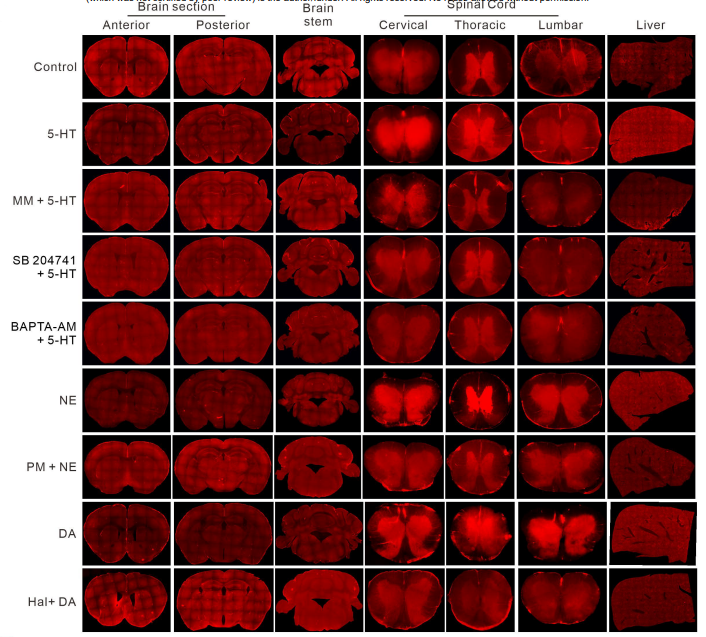
Representative images of fluorescence of TR-D3 in the anterior and posterior brain sections, brainstem, the cervical, thoracic and lumbar spinal cord, and liver in control and in the presence of dopamine (DA).
-
Biomed Pharmacother
Dopamine delays articular cartilage degradation in osteoarthritis by negative regulation of the NF-κB and JAK2/STAT3 signaling pathways. [Abstract]2019 Nov:119:109419. PMID: 31563117


Lösungsmittel & Löslichkeit
In Vitro:
H2O : ≥ 50 mg/mL (263.66 mM)
DMSO : 50 mg/mL (263.66 mM; Need ultrasonic; Hygroscopic DMSO has a significant impact on the solubility of product, please use newly opened DMSO)
* "≥" means soluble, but saturation unknown.
* Note: If you choose water as the stock solution, please dilute it to the working solution, then filter and sterilize it with a 0.22 μm filter before use.
* Note: If you choose water as the stock solution, please dilute it to the working solution, then filter and sterilize it with a 0.22 μm filter before use.
Konzentration (Stammlösung) × Volumen (Stammlösung) = Konzentration (Ziellösung) × Volumen (Ziellösung)


Reinheit & Dokumentation
-
Data Sheet (276 KB)
-
SDS (598 KB)
- English - EN (598 KB)
- Français - FR (598 KB)
- Deutsch - DE (598 KB)
- Norwegian - NO (598 KB)
- Español - ES (598 KB)
- Swedish - SV (598 KB)
- Italian - IT (598 KB)
- Korean - KR (598 KB)
- Portuguese - PT (598 KB)
-
Handling Instructions (2659 KB)
Verweise
[1]. Juárez Olguín H, et al. The Role of Dopamine and Its Dysfunction as a Consequence of Oxidative Stress. Oxid Med Cell Longev. 2016;2016:9730467. [Content Brief]
[2]. Basu S, et al. The neurotransmitter dopamine inhibits angiogenesis induced by vascular permeability factor/vascular endothelial growth factor. Nat Med. 2001 May;7(5):569-74. [Content Brief]


Complete Stock Solution Preparation Table
| Optional Solvent | Concentration Solvent Mass | 1 mg | 5 mg | 10 mg | 25 mg |
|---|---|---|---|---|---|
| H2O / DMSO | 1 mM | 5.2731 mL | 26.3657 mL | 52.7315 mL | 131.8287 mL |
| 5 mM | 1.0546 mL | 5.2731 mL | 10.5463 mL | 26.3657 mL | |
| 10 mM | 0.5273 mL | 2.6366 mL | 5.2731 mL | 13.1829 mL | |
| 15 mM | 0.3515 mL | 1.7577 mL | 3.5154 mL | 8.7886 mL | |
| 20 mM | 0.2637 mL | 1.3183 mL | 2.6366 mL | 6.5914 mL | |
| 25 mM | 0.2109 mL | 1.0546 mL | 2.1093 mL | 5.2731 mL | |
| 30 mM | 0.1758 mL | 0.8789 mL | 1.7577 mL | 4.3943 mL | |
| 40 mM | 0.1318 mL | 0.6591 mL | 1.3183 mL | 3.2957 mL | |
| 50 mM | 0.1055 mL | 0.5273 mL | 1.0546 mL | 2.6366 mL | |
| 60 mM | 0.0879 mL | 0.4394 mL | 0.8789 mL | 2.1971 mL | |
| 80 mM | 0.0659 mL | 0.3296 mL | 0.6591 mL | 1.6479 mL | |
| 100 mM | 0.0527 mL | 0.2637 mL | 0.5273 mL | 1.3183 mL |
* Note: If you choose water as the stock solution, please dilute it to the working solution, then filter and sterilize it with a 0.22 μm filter before use.


Dopamine hydrochloride Related Classifications
HY-B0451A Related Classifications
 Powered by Bioz