



Loxapine hydrochloride
Based on 1 publication(s) in Google Scholar
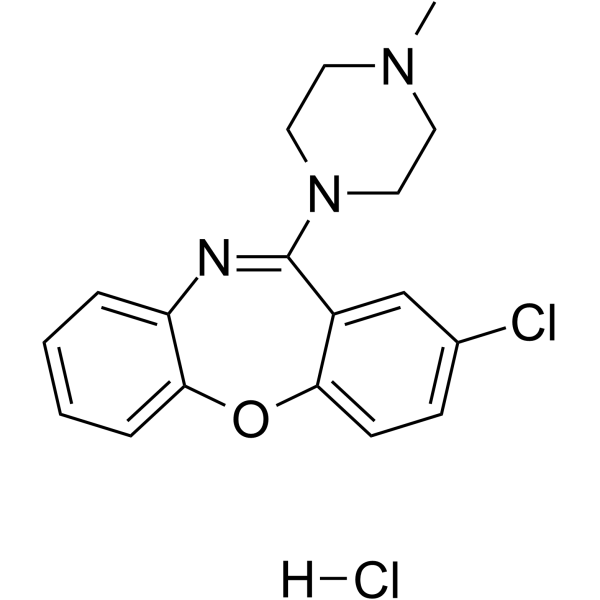
Loxapine hydrochloride is an orally active dopamine inhibitor, 5-HT receptor antagonist and also a dibenzoxazepine anti-psychotic agent.
For research use only. We do not sell to patients.
- CAS No.: 54810-23-0
- Formula: C18H19Cl2N3O
- Molecular Weight:364.27
-
Storage:
Please store the product under the recommended conditions in the Certificate of Analysis.

To place orders, for customer services and technical support, please contact: MedChemExpress USA
Tel: 609-228-6898 E-mail: [email protected] [email protected]


-
 Biological Activity
-
Chemical Information
- Purity & Documentation
- References
-
 Help & FAQs


Publications Citing Use of MedChemExpress (MCE) Loxapine hydrochloride
MoreAll Dopamine Receptor Isoforms
MoreAll 5-HT Receptor Isoforms
More

Biological Activity
Description
IC50 & Target
|
human 5-HT2 |
Human D4 Receptor |
Human D1 Receptor |
Human D2 Receptor |
In Vitro
In the presence of Loxapine, [3H]ketanserin binds to 5-HT2 receptor in Frontal cortex of brain in human and bovine with Ki value of 6.2 nM and 6.6 nM, respectively. Loxapine has the rank order of potency for the various receptors appears to be as follows: 5-HT2≥D4>>>D1>D2 in comparing competition experiments involving the human membranes[1].
Loxapine (0-20 μM, 24 h or 72 h) reduces IL-1β secretion by LPS-activated mixed glia cultures, reduces IL-2 secretion in mixed glia cultures, and decreases IL-1β and IL-2 secretion in LPS-induced microglia cultures[2].
MedChemExpress (MCE) has not independently confirmed the accuracy of these methods. They are for reference only.
In Vivo
MedChemExpress (MCE) has not independently confirmed the accuracy of these methods. They are for reference only.
-
Animal Model:Adult male Wistar rats (150-175 g)[3]
-
Dosage:5 mg/kg
-
Administration:Intraperitoneal injection, daily for 4 or 10 weeks
-
Result:Induced a very significant reduction (more than 50%) of serotonin (S2) receptor density after 4 weeks or 10 weeks of daily injection, but did not produce any significant increase in dopamine receptor density.


Chemical Information
-
CAS No. 54810-23-0
-
Molecular Weight 364.27
-
Formula C18H19Cl2N3O
-
SMILES
CN1CCN(C2=NC3=CC=CC=C3OC4=CC=C(Cl)C=C24)CC1.[H]Cl
-
Shipping
Room temperature in continental US; may vary elsewhere.
-
Storage
Please store the product under the recommended conditions in the Certificate of Analysis.


Publications (1)
-
Journal Impact Factor
-
Most Recent


Purity & Documentation
References
[1]. Singh AN, et al. A neurochemical basis for the antipsychotic activity of loxapine: interactions with dopamine D1, D2, D4 and serotonin 5-HT2 receptor subtypes. J Psychiatry Neurosci. 1996 Jan;21(1):29-35. [Content Brief]
[2]. Labuzek K, et al. Chlorpromazine and loxapine reduce interleukin-1beta and interleukin-2 release by rat mixed glial and microglial cell cultures. Eur Neuropsychopharmacol. 2005 Jan;15(1):23-30. [Content Brief]
[3]. Lee T, et al. Loxapine and clozapine decrease serotonin (S2) but do not elevate dopamine (D2) receptor numbers in the rat brain. Psychiatry Res. 1984 Aug;12(4):277-85. [Content Brief]
[4]. Keating GM. Loxapine inhalation powder: a review of its use in the acute treatment of agitation in patients with bipolar disorder or schizophrenia. CNS Drugs. 2013 Jun;27(6):479-89. [Content Brief]

Calculators
Concentration (start) × Volume (start) = Concentration (final) × Volume (final)


Loxapine hydrochloride Related Classifications
HY-17390B Related Classifications
 Powered by Bioz