



CD276/B7-H3
B7 homolog 3 protein
CD276/B7-H3 is a member of the B7 family of immune checkpoint molecules and plays an important role in regulating immune responses. As a co-stimulatory/co-inhibitory protein, it affects both adaptive and innate immune responses. CD276/B7-H3 was first discovered on dendritic cells and is widely expressed in various tumor tissues, including breast cancer, lung cancer, ovarian cancer, and gastric cancer. Its upregulation is often associated with poor prognosis, increased tumor invasiveness, and metastasis.
CD276/B7-H3 has a dual role in the immune system. It can act as a co-stimulatory molecule, enhancing T cell proliferation and cytotoxicity in certain cases, but it can also function as a co-inhibitory molecule by suppressing T cell activity and promoting immune evasion by tumors, thus contributing to tumor progression and metastasis. This dual function makes CD276/B7-H3 a promising target in cancer immunotherapy research. In the tumor microenvironment, its expression is linked to immune suppression, further promoting tumor growth and metastasis.
Research strategies targeting B7-H3 include monoclonal antibodies, antibody-drug conjugates (ADC), bispecific antibodies, and chimeric antigen receptor (CAR) T cell therapies. These strategies have demonstrated promising results in preclinical studies, enhancing immune responses and inhibiting tumor growth in various tumor models[1].
All Product Categories
-
CD276/B7-H3 Related Products (24)
Related Products (24)

-
Antibodies (1)
- 1
- 2
-
Ifinatamab deruxtecan
 0 ImagesSynonyms: DS-7300a; MABX-9001a; I-DXdIfinatamab deruxtecan (DS-7300a) is a B7-H3-targeting Antibody-drug conjugate (ADC), which is composed of a humanized anti-B7-H3 monoclonal antibody, an enzymatically cleavable peptide-based linker, and Exatecan derivative (DXd) (HY-13631D). Ifinatamab deruxtecan is a DNA Topoisomerase I inhibitor. Ifinatamab deruxtecan induces Apoptosis. DS-7300a exerts potent antitumor activities against B7-H3-expressing tumors. against rhabdomyosarcoma, endometrial adenocarcinoma and lung adenocarcinoma. Ifinatamab deruxtecan does not exert direct immunomodulatory effects


-
Omburtamab
 0 ImagesSynonyms: Mab 8H9Omburtamab (Mab 8H9) is a mouse monoclonal immunoglobulin G1 (IgG1) antibody targeting B7-H3. Omburtamab specifically binds to the glycoprotein antigen B7-H3, which is widely expressed on the surface of tumor cells. As a targeting carrier for recombinant toxins, it delivers PE38 to inhibit cellular protein synthesis and induce cytotoxicity in antigen-expressing cancer cells. Omburtamab can be used in research related to glioma, breast cancer, osteosarcoma and neuroblastoma.

-
Puxitatug samrotecan
 0 ImagesSynonyms: AZD 8205; P-SamPuxitatug samrotecan (AZD 8205) is an antibody-drug conjugate (ADC) targeting B7-H4, formed by the random conjugation of the Puxitatug (HY-P990059) antibody and AZ14170133 (HY-145399) via interchain cysteine reduction. Puxitatug samrotecan binds to B7-H4 to deliver the payload to B7-H4-expressing cells, inhibits topoisomerase I, and induces cytotoxicity in cancer cells and xenograft models. Puxitatug samrotecan can be used in studies of B7-H4-expressing tumors.
-
Anti-Mouse CD276/B7-H3 Antibody (MJ18)
 0 ImagesCat. No.: HY-P990279Anti-Mouse CD276/B7-H3 Antibody (MJ18) is a rat-derived anti-mouse CD276/B7-H3 IgG1 monoclonal antibody. Anti-Mouse CD276/B7-H3 Antibody (MJ18) can inhibit CD276/B7-H3 and induce tumor cell apoptosis. Anti-Mouse CD276/B7-H3 Antibody (MJ18) enhances anti-tumor immune response by reducing immunosuppressive cells and promoting T cell activation. Anti-Mouse CD276/B7-H3 Antibody (MJ18) can be used for research on cancer such as breast cancer and prostate cancer.
-
GT19630
 0 ImagesGT19630 is an orally active c-Myc PROTAC targeted degrader based on the cereblon E3 ubiquitin ligase, with an IC50 of 1.5 nM against human c-Myc. GT19630 mediates the degradation of MYC, GSPT1, GSPT2, CK1 alpha, N-Myc, B7-H3 and XIAP, and disrupts the MYC-GSPT1 synergistic regulatory feedback loop. GT19630 inhibits cell proliferation, blocks S-phase progression of the cell cycle, promotes cell apoptosis, reduces cell migration capacity, induces integrated stress response, and blocks oxidative phosphorylation by inhibiting the TCA cycle. GT19630 can be used in the research of Myc-driven hematological cancers, small cell lung cancer, breast cancer, TP53-mutant cancers, and venetoclax-resistant cancers.
-
Piperacetazine
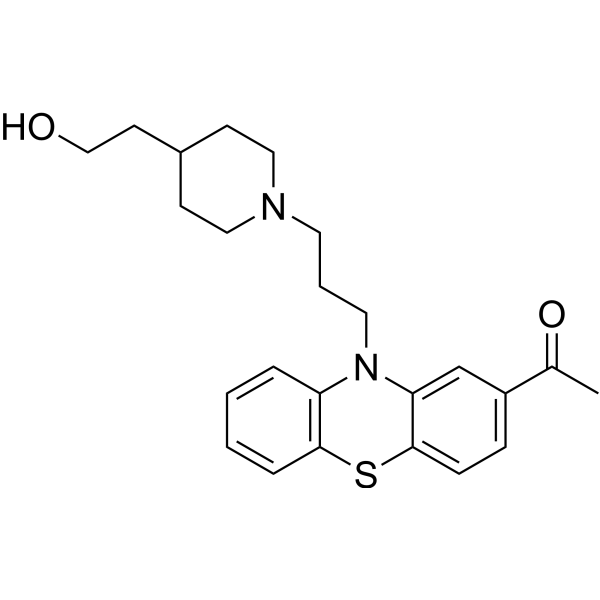 0 ImagesPiperacetazine is an orally active dopamine receptor antagonist and phenothiazine antipsychotic. Piperacetazine can directly bind to the PAX3::FOXO1 fusion protein and inhibit its transcriptional activity. Piperacetazine also exhibits antitumor activity with an IC50 of 7.627 μM against PANC-1 cells. Piperacetazine can be used for the research of diseases such as schizophrenia and pancreatic cancer and other tumors.
-
Puxitatug
 0 ImagesSynonyms: INT-016; AZD8205 AntibodyPuxitatug (INT-016; AZD8205 Antibody) is a monoclonal antibody targeting VTCN1/B7-H4. Puxitatug can be used to synthesize antibody-drug conjugates (ADCs), such as Puxitatug samrotecan (HY-171689), which can be applied to various solid tumors. Puxitatug can also be used for researching adjuvant therapies for gastric cancer.
-
Risvutatug
 0 ImagesSynonyms: HS-20093 Antibody; GSK5764227 AntibodyHS-20093 Antibody (GSK5764227 Antibody) is an antibody targeting B7-H3, which can be used to synthesize the ADC HS-20093. HS-20093 Antibody exhibits anti-tumor activity. HS-20093 Antibody can be studied in research for small cell lung cancer, relapsed or refractory osteosarcoma, and advanced solid tumors.
-
Mirzotamab
 0 ImagesMirzotamab is an IgG1κ monoclonal antibody targeting to CD276/B7-H3 with anti-tumor activity. Mirzotamab conjugates with Clezutoclax (HY-137774), a BCL inhibitor to form Mirzotamab clezutoclax (HY-P99741), involving in research with taxane research in relapsed/refractory solid tumors. Mirzotamab clezutoclax (ABBV-155) is a targeted antibody drug conjugate (ADC).

-
Risvutatug rezetecan
 0 ImagesSynonyms: HS-20093; GSK5764227Risvutatug rezetecan (HS-20093; GSK5764227) is a B7-H3-targeting antibody-drug conjugate (ADC). Risvutatug rezetecan binds to B7-H3 on tumor cells and delivers a topoisomerase I inhibitor payload via a tumor microenvironment-responsive cleavable linker. Risvutatug rezetecan is applicable for the research of extensive-stage small cell lung cancer and non-small cell lung cancer.


-
Elfetabart
 0 ImagesSynonyms: DB-1311 Antibody; BNT324 Antibody
-
IBI-334
 0 ImagesCat. No.: HY-P991092Purity: 98.18%IBI-334 is a bispecific B7-H3 and EGFR antibody. IBI-334 has an EGFR arm for signal blockage and is coupled with a fine-tuned B7-H3 arm with optimal affinity and binding domain. IBI-334 shows antibody-mediated cell cytotoxicity (ADCC) effects. IBI-334 has a wide range of applications in many EGFR-driven solid tumors.
-
IBI-334 (FUT8-KO)
 0 ImagesCat. No.: HY-P991092AIBI-334 (FUT8-KO) is a bispecific B7-H3 and EGFR antibody that has knocked out the fucosyltransferase 8 gene (FUT8). IBI-334 (FUT8-KO) has an EGFR arm for signal blocking and is coupled with a fine-tuned B7-H3 arm with the best affinity and binding domain. IBI-334 (FUT8-KO), compared to IBI-334 (HY-P991092), has enhanced antibody-mediated cytotoxicity (ADCC) effect. IBI-334 (FUT8-KO) has wide applications in many EGFR-driven solid tumors.
-
HBM1020
 0 ImagesCat. No.: HY-P992363HBM1020 is a fully human monoclonal antibody targeting B7H7. HBM1020 binds to B7H7 and enhances the anti-tumor response of T cells. HBM1020 can be used in research related to advanced solid tumors.
- 1
- 2




