



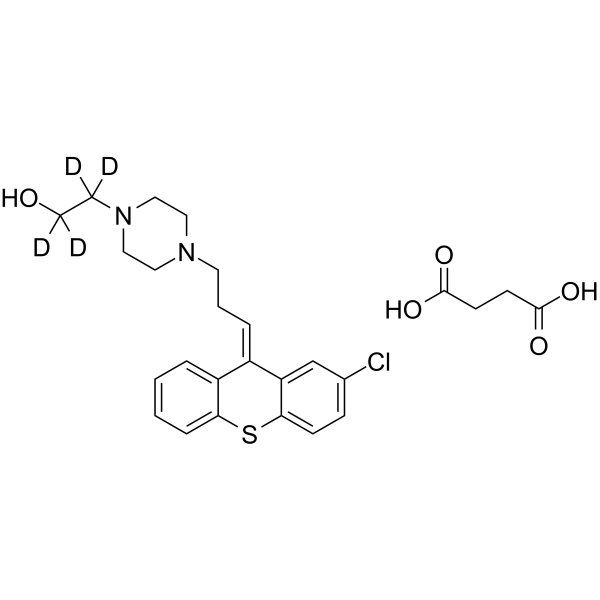
Zuclopenthixol-d4 succinate

Based on 1 Customer Validation
Zuclopenthixol-d4 succinate is the deuterium labeled Zuclopenthixol. Zuclopenthixol is a thioxanthene derivative which acts as a mixed dopamine D1/D2 receptor antagonist.
Nur für Forschungszwecke. Wir verkaufen nicht an Patienten.
- Reinheit : 99.0%
- CAS. Nr.: 1246833-97-5
- Formel: C26H27D4ClN2O5S
- Molecular Weight:523.08
-
Speicherung:Powder -20°C, 3 years ; In solvent -80°C, 6 months , -20°C, 1 month

To place orders, for customer services and technical support, please contact: MedChemExpress USA
Tel: 609-228-6898 E-mail: [email protected] [email protected]


-
 Biologische Aktivität
-
Chemical Information
- Reinheit & Dokumentation
- Verweise
-
 Help & FAQs


Alle Dopamine Receptor Isoform-spezifische Produkte anzeigen
More

Biologische Aktivität
Beschreibung
IC50 & Target
|
D2 Receptor |
In Vitro
Stable heavy isotopes of hydrogen, carbon, and other elements have been incorporated into drug molecules, largely as tracers for quantitation during the drug development process. Deuteration has gained attention because of its potential to affect the pharmacokinetic and metabolic profiles of drugs[1].
MedChemExpress (MCE) has not independently confirmed the accuracy of these methods. They are for reference only.
Anwendung
1. This compound can be used as a tracer
2. This compound can be used as an internal standard for quantitative analysis by NMR, GC-MS, or LC-MS.


Chemical Information
-
CAS. Nr. 1246833-97-5
-
Unlabeled CAS 53772-83-1
-
Appearance Solid
-
Molecular Weight 523.08
-
Formel C26H27D4ClN2O5S
-
Color White to light yellow
-
SMILES
C(CC(O)=O)C(O)=O.C(CCN1CCN(C(C(O)([2H])[2H])([2H])[2H])CC1)=C2C=3C(SC=4C2=CC=CC4)=CC=C(Cl)C3
-
Versand
Room temperature in continental US; may vary elsewhere.
-
Speicherung
Powder -20°C 3 years In solvent -80°C 6 months -20°C 1 month


Reinheit & Dokumentation
-
Data Sheet (267 KB)
-
SDS (252 KB)
- English - EN (252 KB)
- Français - FR (252 KB)
- Deutsch - DE (252 KB)
- Norwegian - NO (252 KB)
- Español - ES (252 KB)
- Swedish - SV (252 KB)
- Italian - IT (252 KB)
- Korean - KR (252 KB)
- Portuguese - PT (252 KB)
-
Handling Instructions (2659 KB)
Verweise
[1]. Russak EM, et al. Impact of Deuterium Substitution on the Pharmacokinetics of Pharmaceuticals. Ann Pharmacother. 2019;53(2):211-216. [Content Brief]
[2]. Manzaneque JM, et al. An ethopharmacological assessment of the effects of zuclopenthixol on agonistic interactions in male mice. Methods Find Exp Clin Pharmacol. 1999 Jan-Feb;21(1):11-5. [Content Brief]
[3]. Khalifa AE, et al. Pro-oxidant activity of zuclopenthixol in vivo: differential effect of the drug on brain oxidative status of scopolamine-treated rats. Hum Exp Toxicol. 2004 Aug;23(9):439-45. [Content Brief]

Calculators
Konzentration (Stammlösung) × Volumen (Stammlösung) = Konzentration (Ziellösung) × Volumen (Ziellösung)


Zuclopenthixol-d4 succinate Related Classifications
HY-A0163S Related Classifications
 Powered by Bioz