



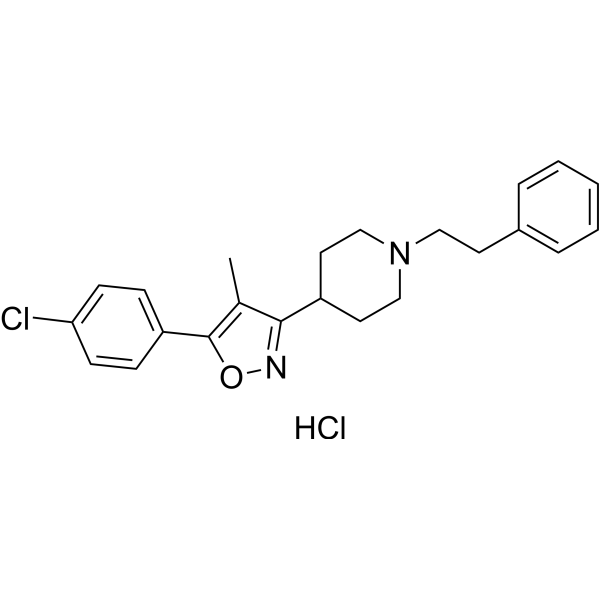
L 741742 hydrochloride
L 741742 hydrochloride is a highly selective and brain-penetrant D4 dopamine receptor antagonist, with Ki values of 3.5 nM, 770 nM and >1700 nM for human D4, D3 and D2 receptors, respectively. L 741742 hydrochloride suppresses PDGFRβ, ERK1/2, and mTOR signaling pathways, and impairs autophagic flux while disrupting lysosomal function.L 741742 hydrochloride induces G0/G1 cell-cycle arrest and apoptosis, promotes neuronal differentiation of normal human neural stem cells, selectively inhibits growth and clonogenic potential of glioblastoma neural stem cells and primary glioblastoma tumor cells, exerts synergistic effects with Temozolomide (TMZ) (HY-17364) against glioblastoma neural stem cells in vitro, and inhibits glioblastoma neural stem cell xenograft growth in immunocompromised mice. L 741742 hydrochloride can be used for the research of schizophrenia and glioblastoma.
For research use only. We do not sell to patients.
- CAS No.: 874882-93-6
- Formula: C23H26Cl2N2O
- Molecular Weight:417.37
-
Storage:
Please store the product under the recommended conditions in the Certificate of Analysis.

To place orders, for customer services and technical support, please contact: MedChemExpress USA
Tel: 609-228-6898 E-mail: [email protected] [email protected]


-
 Biological Activity
-
Chemical Information
- Purity & Documentation
- References
-
 Help & FAQs


All Dopamine Receptor Isoforms
More

Biological Activity
Description
IC50 & Target
[1]|
Human D4 Receptor 3.5 nM (Ki) |
Human D3 Receptor 770 nM (Ki) |
Human D2 Receptor >1500 nM (Ki) |
In Vitro
L 741742 (compound 36) hydrochloride is a high-affinity, selective antagonist for hD4 receptors with a Ki of 3.5 nM, >500-fold selectivity over hD2 receptors, and >200-fold selectivity over hD3 receptors[1].
L 741742 (1.5-6.2 μM; 5 days) hydrochloride selectively inhibits the growth of patient-derived glioblastoma neural stem cells (GNS) with an IC50 of 1.5-6.2 μM and shows minimal activity against non-neural stem cell lines[2].
L 741742 (10 μM; 14 days) hydrochloride potently reduces the clonogenic potential of freshly isolated patient-derived glioblastoma tumor cells by 40- to 83-fold[3].
L 741742 (3 weeks) hydrochloride promotes neuronal differentiation of normal human neural stem cells, as indicated by increased VGlut1 expression[2].
L 741742 (10 μM; 48 hr) hydrochloride induces massive accumulation of autophagosomes in G411 and G362 glioblastoma neural stem cells, as shown by increased LC3B-II levels and LC3B+ puncta[2].
L 741742 (10 μM; 48 hr) hydrochloride impairs autophagic flux in G411 glioblastoma neural stem cells, as indicated by blocked LC3B-II turnover in the presence of Chloroquine (HY-17589A)[2].
L 741742 (10 μM) hydrochloride inhibits the PDGFRβ-ERK1/2 and mTOR signaling pathways in glioblastoma neural stem cells, as shown by reduced phosphorylation of ERK1/2, PDGFRβ, and S6[2].
L 741742 (10 μM; 48 hr) hydrochloride induces G0/G1 cell cycle arrest and subsequent apoptosis in G411 and G362 glioblastoma neural stem cells[2].
MedChemExpress (MCE) has not independently confirmed the accuracy of these methods. They are for reference only.
-
Cell Line:GNS lines (G411, G362)
-
Concentration:10 μM
-
Incubation Time:2 hr; 24 hr; 48 hr
-
Result:Increased LC3B-II levels (a marker of autophagosome formation) at 48 hr.
Induced LC3B+ puncta in >50% of cells at 48 hr, with a significant increase in the percentage of LC3B+ cells compared with controls.
-
Cell Line:GNS lines (G411, G362)
-
Concentration:10 μM
-
Incubation Time:48 hr
-
Result:Increased LC3B-II levels when administered alone, but did not increase LC3B-II levels in the presence of chloroquine, confirming impaired autophagic flux.
-
Cell Line:GNS lines (G411, G362)
-
Concentration:10 μM
-
Incubation Time:2 hr; 24 hr; 48 hr
-
Result:Decreased phosphorylation of ERK1/2 over time in GNS (but not in NS or fibroblasts).
Decreased phosphorylation of PDGFRβ at 48 hr.
Decreased phosphorylation of S6 (a downstream mTOR effector) at 48 hr.
-
Cell Line:GNS lines (G411, G362)
-
Concentration:10 μM
-
Incubation Time:48 hr
-
Result:Induced G0/G1 phase arrest, with G411 cells showing a shift from 74.7% G1 (control) to 92.2% G1.
Increased caspase 3/7 activity.
Induced cleaved PARP expression at 48 hr.
In Vivo
L 741742 (25 mg/kg; i.p.; 5 days on, 2 days off; 2 weeks) hydrochloride provides a significant survival benefit in mice with intracranial glioblastoma xenografts[2].
MedChemExpress (MCE) has not independently confirmed the accuracy of these methods. They are for reference only.
-
Animal Model:NOD scid gamma (NSG) (female)[2]
-
Dosage:20 m/kg
-
Administration:i.p.; 5 days on, 2 days off; until study endpoint
-
Result:Reduced endpoint tumor volumes.
Reduced average tumor weight by 40.9% relative to controls.
Reduced the frequency of sphere-forming (stem-like) cells to 1 in 75.6.
Increased levels of p62, ubiquitinated protein conjugates, and LC3-positive cells, confirming impaired autophagic flux in vivo.


Chemical Information
-
CAS No. 874882-93-6
-
Molecular Weight 417.37
-
Formula C23H26Cl2N2O
-
SMILES
CC1=C(C2=CC=C(Cl)C=C2)ON=C1C3CCN(CCC4=CC=CC=C4)CC3.Cl
-
Shipping
Room temperature in continental US; may vary elsewhere.
-
Storage
Please store the product under the recommended conditions in the Certificate of Analysis.


Purity & Documentation
References
[1]. Rowley M, et al. 4-Heterocyclylpiperidines as selective high-affinity ligands at the human dopamine D4 receptor. J Med Chem. 1997;40(15):2374-2385. [Content Brief]
[2]. Dolma S, et al. Inhibition of Dopamine Receptor D4 Impedes Autophagic Flux, Proliferation, and Survival of Glioblastoma Stem Cells. Cancer Cell. 2016;29(6):859-873. [Content Brief]

Calculators
Concentration (start) × Volume (start) = Concentration (final) × Volume (final)


L 741742 hydrochloride Related Classifications
HY-101349A Related Classifications
 Powered by Bioz