



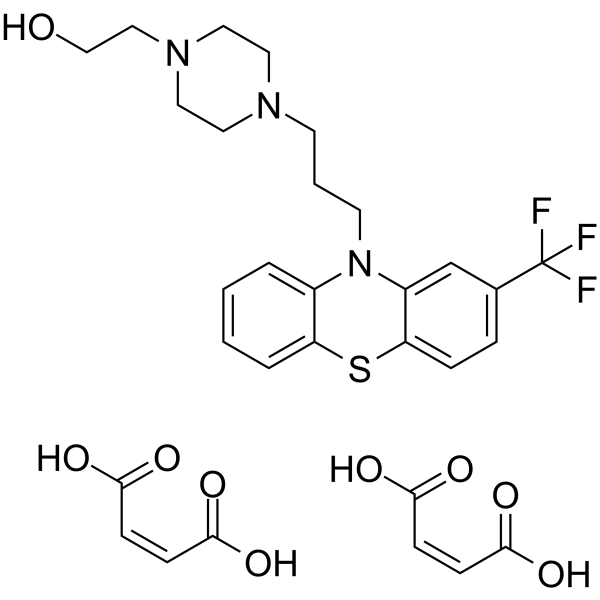
Fluphenazine dimaleate
Based on 3 publication(s) in Google Scholar
Fluphenazine dimaleate is a potent, orally active phenothiazine-based dopamine receptor antagonist. Fluphenazine dimaleate blocks neuronal voltage-gated sodium channels. Fluphenazine dimaleate acts primarily through antagonism of postsynaptic dopamine-2 receptors in mesolimbic, nigrostriatal, and tuberoinfundibular neural pathways. Fluphenazine dimaleate can antagonize Methylphenidate-induced stereotyped gnawing and inhibit climbing behaviour in mice. Fluphenazine dimaleate can be used for researching psychosis and painful peripheral neuropathy associated with diabetes and has potential to inhibit SARS-CoV-2.
For research use only. We do not sell to patients.
- CAS No.: 3093-66-1
- Formula: C30H34F3N3O9S
- Molecular Weight:669.67
-
Storage:
Please store the product under the recommended conditions in the Certificate of Analysis.

To place orders, for customer services and technical support, please contact: MedChemExpress USA
Tel: 609-228-6898 E-mail: [email protected] [email protected]


-
 Biological Activity
-
Chemical Information
- Protocols
- Purity & Documentation
- References
-
 Help & FAQs


Publications Citing Use of MedChemExpress (MCE) Fluphenazine dimaleate
More Customer Validation & Images

-
WB

-
Cell Imaging/Staining

-
RT-PCR

-
WB

-
WB

All Dopamine Receptor Isoforms
More

Biological Activity
Description
IC50 & Target
In Vivo
Fluphenazine (0.125-1 mg/kg; IP, single dosage) antagonizes Methylphenidate-induced stereotyped gnawing; inhibits significantly climbing behaviour[6].
MedChemExpress (MCE) has not independently confirmed the accuracy of these methods. They are for reference only.
-
Animal Model:Mature female Swiss-Webster mice[5]
-
Dosage:1 mg/kg
-
Administration:IG, treated from day 6 to day 15 of gestation
-
Result:Significantly reduced fetal weight and length, increased the incidence of incomplete ossification of sternebrae and skull bones.
-
Animal Model:Mice (injected with 60 mg/kg Methylphenidate)[6]
-
Dosage:0.125, 0.25, 0.5, and 1 mg/kg
-
Administration:IP, single dosage
-
Result:Antagonized Methylphenidate-induced stereotyped gnawing; inhibited significantly climbing behaviour in mice at 0.0625-0.5 mg/kg, and at the dose of 1 mg/kg abolished this effect completely.


Chemical Information
-
CAS No. 3093-66-1
-
Molecular Weight 669.67
-
Formula C30H34F3N3O9S
-
SMILES
OCCN(CC1)CCN1CCCN2C3=CC(C(F)(F)F)=CC=C3SC4=CC=CC=C42.OC(/C=C\C(O)=O)=O.OC(/C=C\C(O)=O)=O
-
Shipping
Room temperature in continental US; may vary elsewhere.
-
Storage
Please store the product under the recommended conditions in the Certificate of Analysis.


Publications (3)
-
Journal Impact Factor
-
Most Recent
-
Nat Commun
2025 Dec 18;16(1):11196. PMID: 41413037 -
Dev Cell
2024 Aug 19;59(16):2035-2052.e10. PMID: 39094564
Fluphenazine dimaleate purchased from MedChemExpress. Usage Cited in: Dev Cell. 2024 Aug 19;59(16):2035-2052.e10. [Abstract]
Fluphenazine dihydrochloride (10 μM; 12 h) increased the protein expression of mKeima-RAMP4 in RCS cells.
Fluphenazine dimaleate purchased from MedChemExpress. Usage Cited in: Dev Cell. 2024 Aug 19;59(16):2035-2052.e10. [Abstract]
Fluphenazine dihydrochloride (10 μM; 12 h) increased the protein expression of TFE3 in TFEB/TFE3 DKO U2OS cells.
Fluphenazine dimaleate purchased from MedChemExpress. Usage Cited in: Dev Cell. 2024 Aug 19;59(16):2035-2052.e10. [Abstract]
Fluphenazine dihydrochloride (10 μM; 12 h) increased the RNA expression of FAM134B isoform 2 in WT and TFEB/3 DKO RCS cells.
Fluphenazine dimaleate purchased from MedChemExpress. Usage Cited in: Dev Cell. 2024 Aug 19;59(16):2035-2052.e10. [Abstract]
Fluphenazine dihydrochloride (10 μM; 12 h) reduced GFP-COL1A2 G610C protein levels in control but not in FAM134B-, TFEB/TFE3-, and ATG7-depleted cells.
Fluphenazine dimaleate purchased from MedChemExpress. Usage Cited in: Dev Cell. 2024 Aug 19;59(16):2035-2052.e10. [Abstract]
Fluphenazine dihydrochloride (10 μM; 12 h) showed no effect on the levels of insoluble ATZ from PIZ hepatocytes.
-
Insect Biochem Mol Biol
Molecular and pharmacological characterization of the dopamine receptors in the oriental fruit fly, Bactrocera dorsalis. [Abstract]2025 May:180:104312. PMID: 40245998

Protocols
-
Research Protocol for Metabolic Diseases
AMP-activated protein kinase, AMPK, is a conserved cellular energy sensor that responds to reduced cellular energy status and coordinates metabolism by increasing ATP-generating catabolic pathways while suppressing ATP-consuming anabolic processes. In metabolic disease research, the AMPK pathway is experimentally relevant because it regulates hepatic lipid synthesis, fatty acid oxidation, glucose production, skeletal-muscle glucose disposal, mTORC1-linked biosynthesis, autophagy, mitochondrial homeostasis, and whole-body energy balance. The central pathway logic is that energy stress, metformin, exercise-like stimulation, or direct AMPK activators increase AMPKα Thr172 phosphorylation and downstream substrate phosphorylation, including ACC and RAPTOR. Phosphorylation of ACC suppresses lipogenesis and supports fatty acid oxidation, whereas phosphorylation of RAPTOR suppresses mTORC1 signaling and links cellular energy status to growth and protein synthesis control. The pathway is linked


Purity & Documentation
References
[1]. Zhou X, et al. The neuroleptic drug, fluphenazine, blocks neuronal voltage-gated sodium channels. Brain Res. 2006 Aug 23;1106(1):72-81. [Content Brief]
[2]. Nazeam J, et al. Based on Principles and Insights of COVID-19 Epidemiology, Genome Sequencing, and Pathogenesis: Retrospective Analysis of Sinigrin and ProlixinRX (Fluphenazine) Provides Off-Label Drug Candidates. SLAS Discov. 2020 Dec;25(10):1123-1140. [Content Brief]
[3]. Siragusa S, Bistas KG, Saadabadi A. Fluphenazine. 2022 May 8. In: StatPearls [Internet]. Treasure Island (FL): StatPearls Publishing; 2022 Jan. [Content Brief]
[4]. Davis JL, et al. Peripheral diabetic neuropathy treated with amitriptyline and fluphenazine. JAMA. 1977 Nov 21;238(21):2291-2. [Content Brief]
[5]. Abdel-Hamid HA, et al. Teratogenic effect of diphenylhydantoin and/or fluphenazine in mice. J Appl Toxicol. 1996 May-Jun;16(3):221-5. [Content Brief]
[6]. Langwiński R, Niedzielski J. Narcotic analgesics and stereotyped behaviour in mice. Naunyn Schmiedebergs Arch Pharmacol. 1980 Jul;312(3):225-7. [Content Brief]

Calculators
Concentration (start) × Volume (start) = Concentration (final) × Volume (final)


Fluphenazine dimaleate Related Classifications
HY-119980A Related Classifications
 Powered by Bioz