



Agroclavine

Based on 1 Customer Validation
Agroclavine acts as an agonist of the D1-dopamine receptor and α1-adrenergic receptor. Agroclavine enhances the sensitivity of the brain to magnetic fields; it impairs spatial memory without affecting hippocampal long-term potentiation (LTP). Agroclavine exerts bidirectional regulatory effects on immune activity: it enhances NK cell activity with low toxicity under normal conditions, while it inhibits NK cell activity and exhibits significant cardiac and hepatic toxicity under stress conditions. Agroclavine can be used for research on neuroelectrophysiology, learning and memory, and immunoregulation.
For research use only. We do not sell to patients.
- CAS No.: 548-42-5
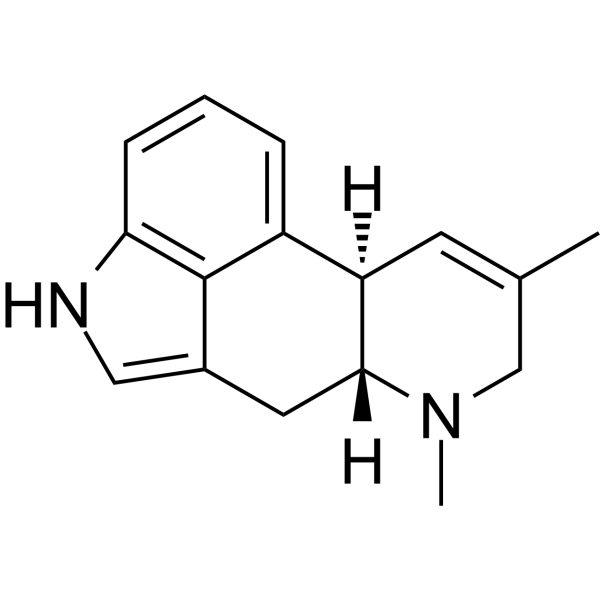
- Formula: C16H18N2
- Molecular Weight:238.33
-
Storage:Powder -20°C, 3 years , 4°C, 2 years ; In solvent -80°C, 6 months , -20°C, 1 month

To place orders, for customer services and technical support, please contact: MedChemExpress USA
Tel: 609-228-6898 E-mail: [email protected] [email protected]


-
 Biological Activity
-
Chemical Information
- Protocols
- Purity & Documentation
- References
-
 Help & FAQs




Biological Activity
Description
|
D1 Receptor |
α1-adrenergic receptor |
In Vitro
Agroclavine exhibits cytostatic activity against L5178y mouse lymphoma cells, with an EC50 value of 6.3 μM[3].
Agroclavine (0.01-0.1 μM) enhances NK cell activity and promotes the production of interleukin-2 and interferon-γ[3].
MedChemExpress (MCE) has not independently confirmed the accuracy of these methods. They are for reference only. Further protocols information, click here.
In Vivo
Agroclavine (50 μg/kg; i.p.; single dose) alters cortical and hippocampal EEG activity in healthy rats, and potentiates a robust, persistent increase in hippocampal beta2 activity (46.3% above pre-exposure levels) following combined magnetic field exposure[2].
Agroclavine (0.05-0.5 mg/kg; i.p.; single dose) at 0.5 mg/kg significantly increases splenic NK cell activity and serum CKMB levels in non-stressed normal male Wistar-Kyoto rats, while the 0.05 mg/kg dose has minimal, non-significant effects on these endpoints[3].
MedChemExpress (MCE) has not independently confirmed the accuracy of these methods. They are for reference only.
-
Animal Model:Wistar rats (male, 300-360 g)[2]
-
Dosage:50 μg/kg
-
Administration:i.p.; single dose
-
Result:Significantly increased delta (0.5-3.5 Hz) EEG activity in both the cortex and hippocampus during the first 30 minutes post-injection, with a larger effect in the cortex.
Decreased alpha (7.6-12.5 Hz) EEG activity in both the cortex and hippocampus, and decreased beta1 (12.6-17.5 Hz) activity in both regions, with a significantly greater attenuation in the cortex than the hippocampus.
Produced a significant increase in hippocampal beta2 activity, with only a non-significant trend toward increased beta2 activity in the cortex.
Potentiated an immediate, robust increase in hippocampal beta2 (22.5-30.5 Hz) activity relative to pre-exposure levels when combined with CMF exposure starting 1 hour post-injection; this effect persisted throughout the 30-minute post-exposure period, with a 46.3% increase in beta2 activity relative to pre-exposure values.
Did not produce significant changes in cortical EEG in agroclavine-pretreated rats during CMF exposure.
-
Animal Model:Wistar-Kyoto (3-month-old male, 230-280 g)[3]
-
Dosage:0.05 mg/kg; 0.5 mg/kg
-
Administration:i.p.; single dose
-
Result:Caused a moderate, non-significant increase in spleen NK cell activity at 0.05 mg/kg.
Caused a significant increase in spleen NK cell activity at 0.5 mg/kg.
Showed no significant effect on serum CKMB at 0.05 mg/kg.
Caused a significant increase in serum CKMB at 0.5 mg/kg.
Had no effect on serum ALT at both 0.05 mg/kg and 0.5 mg/kg.
-
Animal Model:Wistar-Kyoto (3-month-old male, 230-280 g; restraint and immersion in 23°C water stress model)[3]
-
Dosage:0.05 mg/kg; 0.5 mg/kg
-
Administration:i.p.; single dose; 30 min pre-stress
-
Result:Caused a significant decrease in spleen NK cell activity at 0.05 mg/kg compared to stressed control rats.
Caused a significant decrease in spleen NK cell activity at 0.5 mg/kg compared to stressed control rats.
Showed no significant effect on serum CKMB and ALT levels at 0.05 mg/kg relative to stressed controls.
Caused a more than twofold significant increase in serum CKMB at 0.5 mg/kg compared to stressed control rats.
Caused a significant increase in serum ALT at 0.5 mg/kg compared to stressed control rats.


Chemical Information
-
CAS No. 548-42-5
-
Appearance Solid
-
Molecular Weight 238.33
-
Formula C16H18N2
-
Color Off-white to light brown
-
SMILES
CN1[C@@]2([H])[C@@](C=C(C1)C)([H])C3=CC=CC4=C3C(C2)=CN4
-
Structure Classification
-
Initial Source
-
Shipping
Room temperature in continental US; may vary elsewhere.
-
Storage
Powder -20°C 3 years 4°C 2 years In solvent -80°C 6 months -20°C 1 month

Protocols
-
Protocol for Shuttle Box Test (TDPA)
The Shuttle Box Test for TDPA, or temporally dissociated passive avoidance, measures hippocampus-dependent associative learning by testing whether a rodent avoids entering a dark compartment that was previously paired with foot shock after a temporal delay between dark-compartment entry and shock delivery. The main behavioral readout is crossover or step-through latency from the light chamber into the dark chamber; increased latency across training or retention trials reflects learned avoidance memory rather than motor performance alone.
-
Protocol for Water Maze
The Morris Water Maze is a rodent spatial learning and memory assay in which a mouse or rat swims in opaque water to find an escape platform; in the hidden-platform version, the animal cannot see the platform and must use distal extra-maze cues to learn its fixed spatial location. The assay primarily measures hippocampus-dependent spatial learning during acquisition trials and spatial reference memory during probe trials after platform removal; readouts include escape latency, swim path length, swim speed, quadrant occupancy, platform-site crossings, and proximity to the former platform location.


Purity & Documentation
-
Data Sheet (278 KB)
-
SDS (252 KB)
- Français - FR (252 KB)
- Deutsch - DE (252 KB)
- Norwegian - NO (252 KB)
- Español - ES (252 KB)
- Swedish - SV (252 KB)
- Italian - IT (252 KB)
- Korean - KR (252 KB)
- Portuguese - PT (252 KB)
-
Handling Instructions (2659 KB)
References
[1]. Vorobyov V, et al. Spatial memory deficits initiated by agroclavine injection or olfactory bulbectomy in rats are characterized by different levels of long-term potentiation expression in the hippocampus. Int J Neurosci. 2020;130(12):1225-1229. [Content Brief]
[2]. Vorobyov V, et al. Agroclavine potentiates hippocampal EEG effects of weak combined magnetic field in rats. Brain Res Bull. 2009;80(1-2):1-8. [Content Brief]
[3]. Starec M, et al. Effect of agroclavine on NK activity in vivo under normal and stress conditions in rats. Physiol Res. 2001;50(5):513-519. [Content Brief]

Calculators
Concentration (start) × Volume (start) = Concentration (final) × Volume (final)


Agroclavine Related Classifications
HY-135525 Related Classifications
 Powered by Bioz