



Clozapine hydrochloride
Based on 14 publication(s) in Google Scholar
Clozapine hydrochloride (HF 1854 hydrochloride) is an antipsychotic used for the research of schizophrenia. Clozapine hydrochloride has high affinity for a number of neuroreceptors. Clozapine hydrochloride is a potent antagonist of dopamine D2 with a Ki of 75 nM. Clozapine hydrochloride inhibits the muscarinic M1 receptor and serotonin 5HT2A receptor with Kis of 9.5 nM and 4 nM, respectively. Clozapine hydrochloride is also a potent and selective agonist at the muscarinic M4 receptor (EC50=11 nM).
For research use only. We do not sell to patients.
- Purity : 99.83%
- CAS No.: 54241-01-9
- Formula: C18H20Cl2N4
- Molecular Weight:363.28
-
Storage:Powder -20°C, 3 years , 4°C, 2 years ; In solvent -80°C, 6 months , -20°C, 1 month


To place orders, for customer services and technical support, please contact: MedChemExpress USA
Tel: 609-228-6898 E-mail: [email protected] [email protected]


-
 Biological Activity
-
Chemical Information
-
Solvent & Solubility
- Purity & Documentation
- References
-
 Help & FAQs


Publications Citing Use of MedChemExpress (MCE) Clozapine hydrochloride
More- Nat Commun. 2026 Jun 16. [Abstract]
- Nat Commun. 2025 Dec 13;16(1):11318. [Abstract]
- Nat Commun. 2024 Sep 1;15(1):7603. [Abstract]
- Mol Psychiatry. 2021 Jun;26(6):2514-2532. [Abstract]
- Commun Med (Lond). 2025 Jul 1;5(1):249. [Abstract]
- Cell Rep Methods. 2023 Oct 23;3(10):100599. [Abstract]
- Int J Mol Sci. 2026 Apr 9;27(8):3381. [Abstract]
- Eur J Pharm Sci. 2023 Aug 1:187:106475. [Abstract]
- Eur J Pharm Sci. 2021 Sep 1:164:105889. [Abstract]
- FEBS J. 2024 Nov;291(21):4680-4695. [Abstract]
- Toxicol Appl Pharmacol. 2026 Oct:515:117973.
- Biochem Biophys Res Commun. 2025 Oct 30:786:152756. [Abstract]
- bioRxiv. 2024 November 03.
- bioRxiv. 2024 Jun 8:2024.06.07.597973. [Abstract]
 Customer Validation & Images

-
In Vivo Efficacy Study
-
Bio/Physico-chemical Assay
-
In Vivo Efficacy Study
-
Cell Imaging/Staining
-
In Vivo Efficacy Study
All Dopamine Receptor Isoforms
MoreAll Adrenergic Receptor Isoforms
MoreAll 5-HT Receptor Isoforms
More

Biological Activity
Description
IC50 & Target
|
5-HT2A Receptor 4 nM (Ki) |
5-HT2A Receptor |
5-HT6 Receptor |
Human 5-HT7 Receptor |
mAChR1 9.5 nM (Ki) |
mAChR4 11 nM (EC50) |
α2-adrenergic receptor 51 nM (Ki) |
D2 Receptor 75 nM (Ki) |
In Vivo
MedChemExpress (MCE) has not independently confirmed the accuracy of these methods. They are for reference only.
-
Animal Model:Male 129 S6/Sv mice, lysergic acid diethylamide (LSD)-induced psychosis model[3]
-
Dosage:25 mg/kg/day
-
Administration:Intraperitoneal injection, 21 days
-
Result:Decreased head-twitch response, reduced 5-HT2A mRNA, rescued induction of c-fos, but not egr-1 and egr-2.
Clinical Trial
| NCT Number | Sponsor | Condition | Start Date |
Phase

|
|---|---|---|---|---|
| NCT01329991 | Plexxikon| | 2011-05 | PHASE1 |


Chemical Information
-
CAS No. 54241-01-9
-
Appearance Solid
-
Molecular Weight 363.28
-
Formula C18H20Cl2N4
-
Color Light yellow to yellow
-
SMILES
CN1CCN(C2=NC3=CC(Cl)=CC=C3NC4=CC=CC=C42)CC1.[H]Cl
-
Synonyms
HF 1854 hydrochloride
-
Shipping
Room temperature in continental US; may vary elsewhere.
-
Storage
Powder -20°C 3 years 4°C 2 years In solvent -80°C 6 months -20°C 1 month


Publications (14)
-
Journal Impact Factor
-
Most Recent
-
Nat Commun
Targeting dopamine transporter for treating social transmission of depression-like behaviors in male mice. [Abstract]2026 Jun 16. PMID: 42303982 -
Nat Commun
Norepinephrine-mediated arousal fluctuations drive inverted U-shaped functional connectivity dynamics. [Abstract]2025 Dec 13;16(1):11318. PMID: 41390822
Clozapine hydrochloride purchased from MedChemExpress. Usage Cited in: Nat Commun. 2025 Dec 13;16(1):11318. [Abstract]
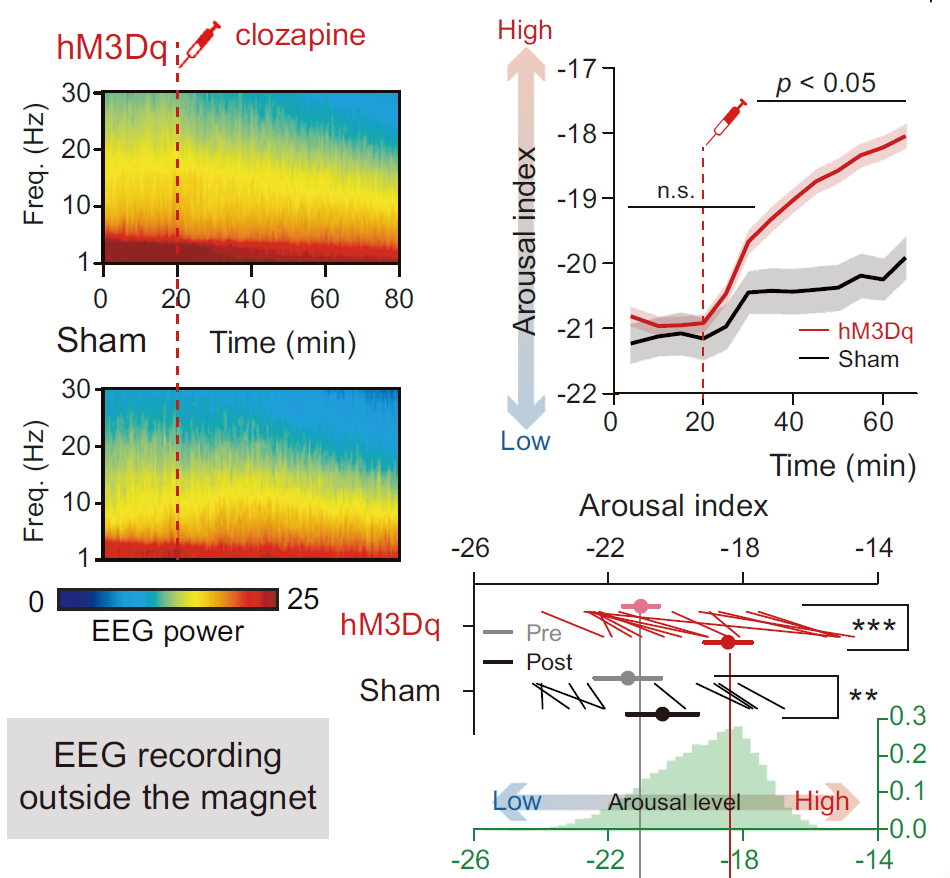
In isoflurane anesthetized mice, the injection of Clozapine (0.03 mg/kg; i.p.) significantly increased EEG-based arousal index, but from a low to middle arousal level.
-
Nat Commun
2024 Sep 1;15(1):7603. PMID: 39217143
Clozapine hydrochloride purchased from MedChemExpress. Usage Cited in: Nat Commun. 2024 Sep 1;15(1):7603. [Abstract]
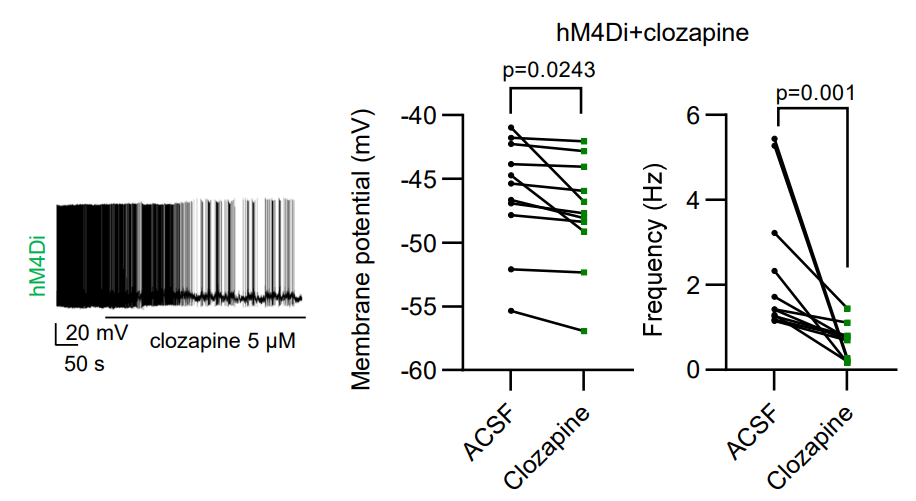
Representative current clamp recording of a NPYDRN/vlPAG-hM4Di neuron with the bath of Clozapine (5 μM). Average membrane potential and firing frequency before and after Clozapine application to inhibit NPY DRN/vlPAGneurons were also recorded. Clozapine effectively inhibited hM4Di+ NPYDRN/vlPAG neurons with decreased neuronal membrane potential and firing frequency.
Clozapine hydrochloride purchased from MedChemExpress. Usage Cited in: Nat Commun. 2024 Sep 1;15(1):7603. [Abstract]
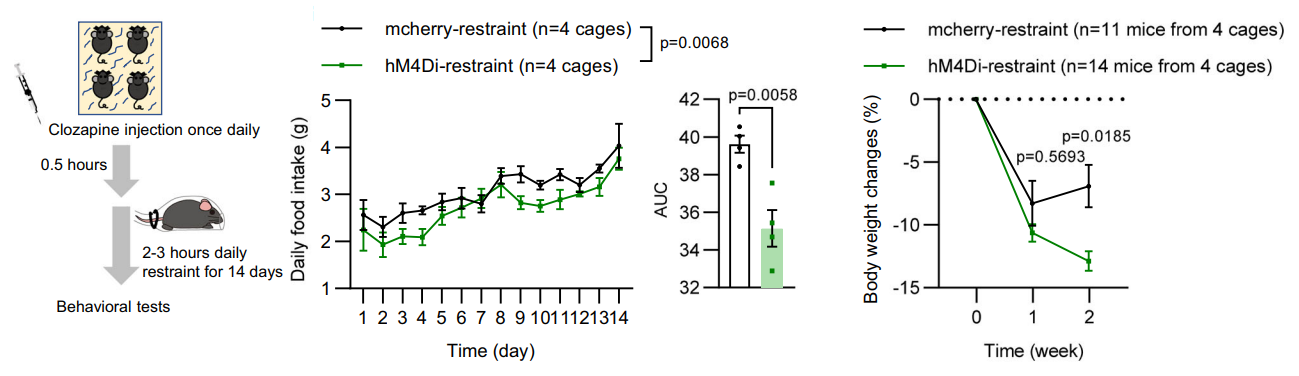
Percentage of body weight changes, daily food intake and its area under curve (AUC) of mCherry-restraint and hM4Di-restraint mice. Clozapine (i.p.; 0.2mg/kg; 30 min before restraint for 14 d) caused NPYhM4Di mice to consume less food and lost more body weight than NPYmCherry mice during chronic restraint stress.
-
Mol Psychiatry
2021 Jun;26(6):2514-2532. PMID: 33303946
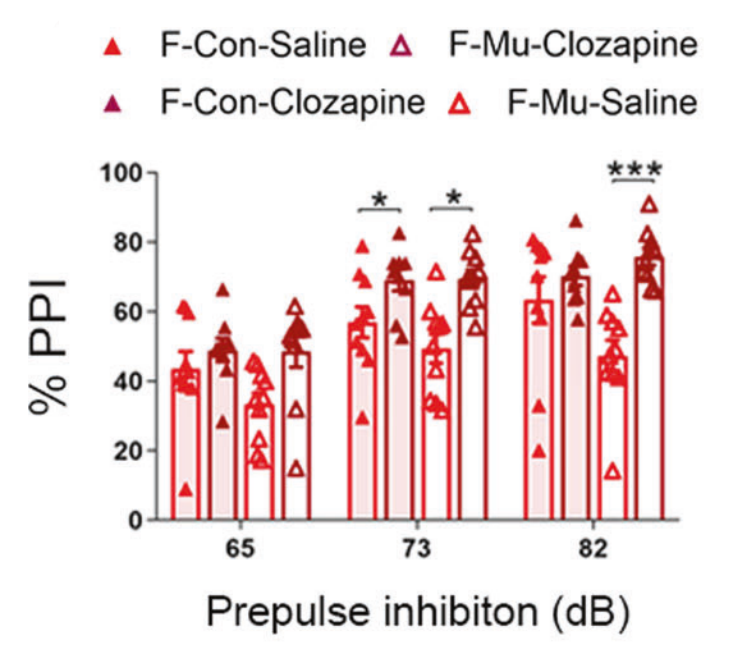
Clozapine hydrochloride purchased from MedChemExpress. Usage Cited in: Mol Psychiatry. 2021 Jun;26(6):2514-2532. [Abstract]
The administration of Clozapine (i.p.; 2 d) restored impaired PPI in female ZFP804A mutant mice.
-
Commun Med (Lond)
AI-enabled drug prediction and gene network analysis reveal therapeutic use of vorinostat for Rett Syndrome in preclinical models. [Abstract]2025 Jul 1;5(1):249. PMID: 40595330 -
Cell Rep Methods
RECOVER identifies synergistic drug combinations in vitro through sequential model optimization. [Abstract]2023 Oct 23;3(10):100599. PMID: 37797618 -
Int J Mol Sci
A Clozapine-Responsive GPCR-Based Gene Switch for Pharmacological Control of Gene Expression in Mammalian Cells and In Vivo. [Abstract]2026 Apr 9;27(8):3381. PMID: 42074026 -
Eur J Pharm Sci
Investigating the relevance of CYP2J2 inhibition for drugs known to cause intermediate to high risk torsades de pointes. [Abstract]2023 Aug 1:187:106475. PMID: 37225005 -
Eur J Pharm Sci
Atypical kinetics of cytochrome P450 2J2: Epoxidation of arachidonic acid and reversible inhibition by xenobiotic inhibitors. [Abstract]2021 Sep 1:164:105889. PMID: 34044117 -
FEBS J
TRPM7 controls skin keratinocyte senescence by targeting intracellular calcium signaling. [Abstract]2024 Nov;291(21):4680-4695. PMID: 39185948
Clozapine hydrochloride purchased from MedChemExpress. Usage Cited in: FEBS J. 2024 Nov;291(21):4680-4695. [Abstract]
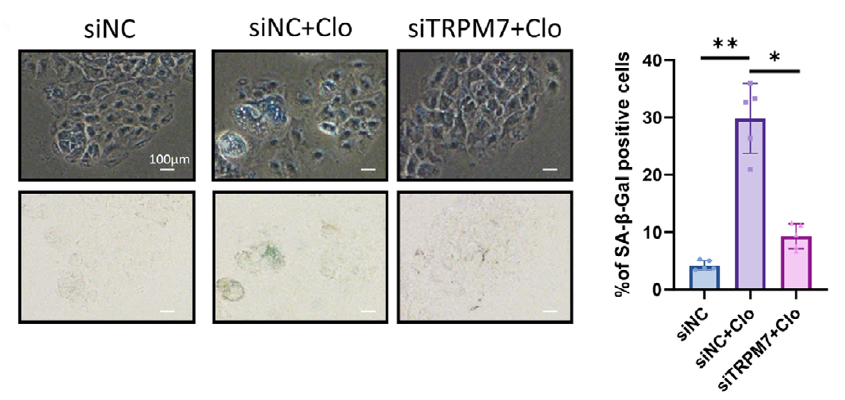
HaCaT cells were transfected with siNC or siRNA against TRPM7 and then treated with Clozapine (Clo) (10 μM; 6 d) the next day. Clozapine (Clo) promoted activation of TRPM7 and increased SA-b-Gal activity.
-
-
Biochem Biophys Res Commun
Dual-cardiotoxicity evaluation of torsadogenic risk drugs using human iPSC-derived cardiomyocytes. [Abstract]2025 Oct 30:786:152756. PMID: 41043280 -
-
bioRxiv
Functional coupling between MC4R and Kir7.1 contributes to clozapine-induced hyperphagia. [Abstract]2024 Jun 8:2024.06.07.597973. PMID: 38895206


Solvent & Solubility
In Vitro:
DMSO : 100 mg/mL (275.27 mM; Need ultrasonic; Hygroscopic DMSO has a significant impact on the solubility of product, please use newly opened DMSO)
Please refer to the solubility information to select the appropriate solvent. Once prepared, please aliquot and store the solution to prevent product inactivation from repeated freeze-thaw cycles.
Storage method and period of stock solution: -80°C, 6 months; -20°C, 1 month. When stored at -80°C, please use it within 6 months. When stored at -20°C, please use it within 1 month.
Please refer to the solubility information to select the appropriate solvent. Once prepared, please aliquot and store the solution to prevent product inactivation from repeated freeze-thaw cycles.
Storage method and period of stock solution: -80°C, 6 months; -20°C, 1 month. When stored at -80°C, please use it within 6 months. When stored at -20°C, please use it within 1 month.
Concentration (start) × Volume (start) = Concentration (final) × Volume (final)
In Vivo:
Select the appropriate dissolution method based on your experimental animal and administration route.
- For the following dissolution methods, please ensure to first prepare a clear stock solution using an In Vitro approach and then sequentially add co-solvents:
- To ensure reliable experimental results, the clarified stock solution can be appropriately stored based on storage conditions. As for the working solution for In Vivo experiments, it is recommended to prepare freshly and use it on the same day.
- The percentages shown for the solvents indicate their volumetric ratio in the final prepared solution. If precipitation or phase separation occurs during preparation, heat and/or sonication can be used to aid dissolution.
Add each solvent one by one: 10% DMSO 40% PEG300 5% Tween-80 45% Saline
Solubility: ≥ 2.5 mg/mL (6.88 mM); Clear solution
This protocol yields a clear solution of ≥ 2.5 mg/mL (saturation unknown).
Taking 1 mL working solution as an example, add 100 μL DMSO stock solution (25.0 mg/mL) to 400 μL PEG300, and mix evenly; then add 50 μL Tween-80 and mix evenly; then add 450 μL Saline to adjust the volume to 1 mL.
Preparation of Saline: Dissolve 0.9 g sodium chloride in ddH₂O and dilute to 100 mL to obtain a clear Saline solution.
Add each solvent one by one: 10% DMSO 90% (20% SBE-β-CD in Saline)
Solubility: ≥ 2.5 mg/mL (6.88 mM); Clear solution
This protocol yields a clear solution of ≥ 2.5 mg/mL (saturation unknown).
Taking 1 mL working solution as an example, add 100 μL DMSO stock solution (25.0 mg/mL) to 900 μL 20% SBE-β-CD in Saline, and mix evenly.
Preparation of 20% SBE-β-CD in Saline (4°C, storage for one week): 2 g SBE-β-CD powder is dissolved in 10 mL Saline, completely dissolve until clear.
In Vivo Dissolution Calculator
Please enter the basic information of animal experiments:
-
-
-
-
Recommended: Prepare an additional quantity of animals to account for potential losses during experiments.
Please enter your animal formula composition:
-
%DMSO +
Recommended: Keep the proportion of DMSO in working solution below 2% if your animal is weak.
-
%+
-
+%Tween-80 + +
-
%Saline +
The co-solvents required include: DMSO, . All of co-solvents are available by MedChemExpress (MCE). , Tween 80. All of co-solvents are available by MedChemExpress (MCE).
Working solution concentration: 0.22 mg/mL
Method for preparing stock solution: mg drug dissolved in μL DMSO. Stock solution concentration: mg/mL.
1. Take μL DMSO stock solution;
2. Add μL .
μL , mix evenly;
3. Then add μL Tween 80, mix evenly;
4. Then add μL
Please ensure that the stock solution in the first step is dissolved to a clear state, and add co-solvents in sequence. You can use ultrasonic heating (ultrasonic cleaner, recommended frequency 20-40 kHz), vortexing, etc. to assist dissolution.


Purity & Documentation
-
Data Sheet (277 KB)
-
SDS (254 KB)
- English - EN (254 KB)
- Français - FR (254 KB)
- Deutsch - DE (254 KB)
- Norwegian - NO (254 KB)
- Español - ES (254 KB)
- Swedish - SV (254 KB)
- Italian - IT (254 KB)
- Korean - KR (254 KB)
- Portuguese - PT (254 KB)
-
Handling Instructions (2659 KB)
References
[1]. Seeman P, et al. Clozapine, a fast-off-D2 antipsychotic. ACS Chem Neurosci. 2014 Jan 15;5(1):24-9. [Content Brief]
[2]. Zhukovskaya NL, et al. Clozapine downregulates 5-hydroxytryptamine6 (5-HT6) and upregulates 5-HT7 receptors in HeLa cells. Neurosci Lett. 2000 Jul 21;288(3):236-40. [Content Brief]
[3]. Moreno JL, et al. Persistent effects of chronic clozapine on the cellular and behavioral responses to LSD in mice. Psychopharmacology (Berl). 2013 Jan;225(1):217-26. [Content Brief]
[4]. Zorn SH, et al. Clozapine is a potent and selective muscarinic M4 receptor agonist. Eur J Pharmacol. 1994 Nov 15;269(3):R1-2. [Content Brief]


Complete Stock Solution Preparation Table
Please refer to the solubility information to select the appropriate solvent. Once prepared, please aliquot and store the solution to prevent product inactivation from repeated freeze-thaw cycles.
Storage method and period of stock solution: -80°C, 6 months; -20°C, 1 month. When stored at -80°C, please use it within 6 months. When stored at -20°C, please use it within 1 month.
| Optional Solvent | Concentration Solvent Mass | 1 mg | 5 mg | 10 mg | 25 mg |
|---|---|---|---|---|---|
| DMSO | 1 mM | 2.7527 mL | 13.7635 mL | 27.5270 mL | 68.8174 mL |
| 5 mM | 0.5505 mL | 2.7527 mL | 5.5054 mL | 13.7635 mL | |
| 10 mM | 0.2753 mL | 1.3763 mL | 2.7527 mL | 6.8817 mL | |
| 15 mM | 0.1835 mL | 0.9176 mL | 1.8351 mL | 4.5878 mL | |
| 20 mM | 0.1376 mL | 0.6882 mL | 1.3763 mL | 3.4409 mL | |
| 25 mM | 0.1101 mL | 0.5505 mL | 1.1011 mL | 2.7527 mL | |
| 30 mM | 0.0918 mL | 0.4588 mL | 0.9176 mL | 2.2939 mL | |
| 40 mM | 0.0688 mL | 0.3441 mL | 0.6882 mL | 1.7204 mL | |
| 50 mM | 0.0551 mL | 0.2753 mL | 0.5505 mL | 1.3763 mL | |
| 60 mM | 0.0459 mL | 0.2294 mL | 0.4588 mL | 1.1470 mL | |
| 80 mM | 0.0344 mL | 0.1720 mL | 0.3441 mL | 0.8602 mL | |
| 100 mM | 0.0275 mL | 0.1376 mL | 0.2753 mL | 0.6882 mL |


Clozapine hydrochloride Related Classifications
HY-14539A Related Classifications
 Powered by Bioz