



Olanzapine-d8
Olanzapine-d8 is a deuterated labeled Olanzapine. Olanzapine (LY170053) is a selective, orally active monoaminergic antagonist with high affinity binding to serotonin H1, 5HT2A/2C, 5HT3, 5HT6 (Ki=7, 4, 11, 57, and 5 nM, respectively), dopamine D1-4 (Ki=11 to 31 nM), muscarinic M1-5 (Ki=1.9-25 nM), and adrenergic α1 receptor (Ki=19 nM). Olanzapine is an atypical antipsychotic.
For research use only. We do not sell to patients.
- CAS No.: 1093380-13-2
- Formula: C17H12D8N4S
- Molecular Weight:320.48
-
Storage:
4°C, sealed storage, away from moisture and light
* In solvent : -80°C, 6 months; -20°C, 1 month (sealed storage, away from moisture and light)


To place orders, for customer services and technical support, please contact: MedChemExpress USA
Tel: 609-228-6898 E-mail: [email protected] [email protected]


-
 Biological Activity
-
Chemical Information
- Purity & Documentation
- References
-
 Help & FAQs


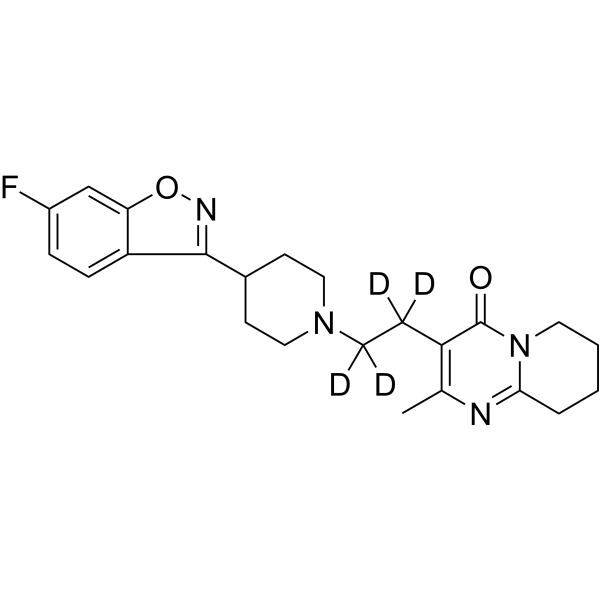
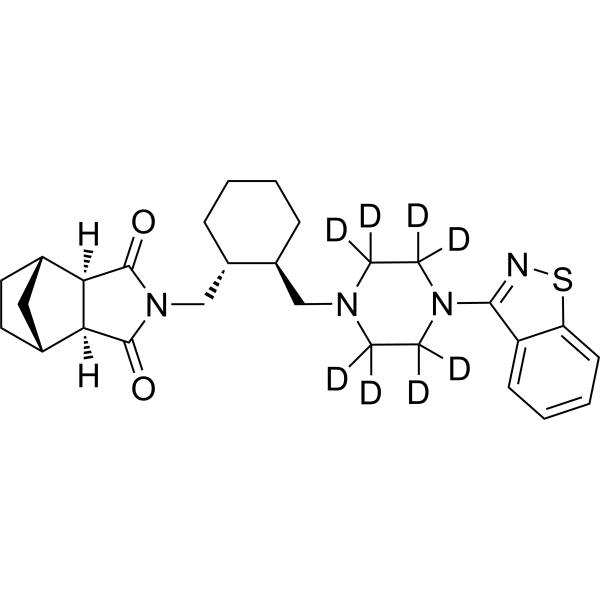
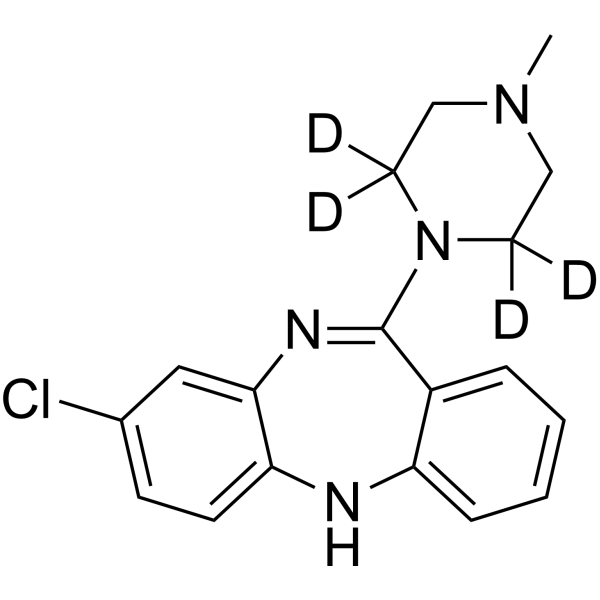
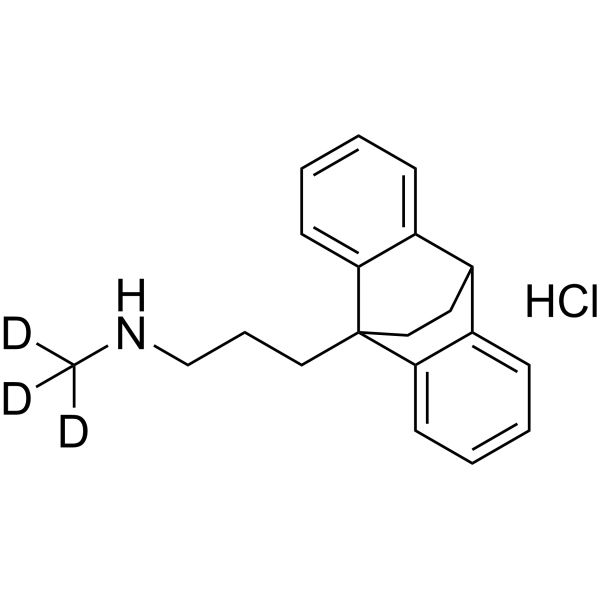
All Dopamine Receptor Isoforms
MoreAll 5-HT Receptor Isoforms
MoreAll Adrenergic Receptor Isoforms
More

Biological Activity
Description
IC50 & Target
|
5-HT2A Receptor |
5-HT6 Receptor |
In Vitro
Stable heavy isotopes of hydrogen, carbon, and other elements have been incorporated into drug molecules, largely as tracers for quantitation during the drug development process. Deuteration has gained attention because of its potential to affect the pharmacokinetic and metabolic profiles of drugs[1].
Olanzapine binds weakly to GABAA, Benzodiazepine (BZD), and β-adrenergic receptors (Ki>10 μM) [2][3].
Olanzapine induces autophagy in human SH-SY5Y neuronal cell line[4].
Olanzapine (1-100 μM for 144 h under serum starvation) results in a marked anti-proliferative effect in glioblastoma cell lines as well as glioma stem-like cells[5].
Olanzapine also enhances Temozolomide (HY-17364)’s anti-tumor activity in glioblastoma cell lines[5].
Olanzapine induces apoptosis and necrosis in glioblastoma cell lines[5].
MedChemExpress (MCE) has not independently confirmed the accuracy of these methods. They are for reference only.
In Vivo
MedChemExpress (MCE) has not independently confirmed the accuracy of these methods. They are for reference only.
Application
1. This compound can be used as a tracer
2. This compound can be used as an internal standard for quantitative analysis by NMR, GC-MS, or LC-MS.


Chemical Information
-
CAS No. 1093380-13-2
-
Unlabeled CAS 132539-06-1
-
Appearance Solid
-
Molecular Weight 320.48
-
Formula C17H12D8N4S
-
Color White to yellow
-
SMILES
CC1=CC2=C(S1)NC3=CC=CC=C3N=C2N4C([2H])([2H])C([2H])([2H])N(C([2H])([2H])C4([2H])[2H])C
-
Synonyms
LY170053-d8
-
Shipping
Room temperature in continental US; may vary elsewhere.
-
Storage
4°C, sealed storage, away from moisture and light
* In solvent : -80°C, 6 months; -20°C, 1 month (sealed storage, away from moisture and light)


Purity & Documentation
-
Data Sheet (284 KB)
-
SDS (605 KB)
- English - EN (605 KB)
- Français - FR (605 KB)
- Deutsch - DE (605 KB)
- Norwegian - NO (605 KB)
- Español - ES (605 KB)
- Swedish - SV (605 KB)
- Italian - IT (605 KB)
- Korean - KR (605 KB)
- Portuguese - PT (605 KB)
-
Handling Instructions (2659 KB)
References
[1]. Russak EM, et al. Impact of Deuterium Substitution on the Pharmacokinetics of Pharmaceuticals. Ann Pharmacother. 2019 Feb;53(2):211-216. [Content Brief]
[2]. Vucicevic L, et al. Autophagy inhibition uncovers the neurotoxic action of the antipsychotic drug olanzapine. Autophagy. 2014;10(12):2362-78. [Content Brief]
[3]. APPROVED AGREED-UPON LABELING.
[4]. Karpel-Massler G, et al. Olanzapine inhibits proliferation, migration and anchorage-independent growth in human glioblastoma cell lines and enhances temozolomide's antiproliferative effect. J Neurooncol. 2015 Mar;122(1):21-33. [Content Brief]
[5]. Olanzapine for Injection, powder, for solution for intramuscular use.
[6]. Coccurello R, et al. Chronic administration of olanzapine induces metabolic and food intake alterations: a mousemodel of the atypical antipsychotic-associated adverse effects. Psychopharmacology (Berl). 2006 Jul;186(4):561-71. [Content Brief]

Calculators
Concentration (start) × Volume (start) = Concentration (final) × Volume (final)


Olanzapine-d8 Related Classifications
HY-14541S2 Related Classifications
 Powered by Bioz