



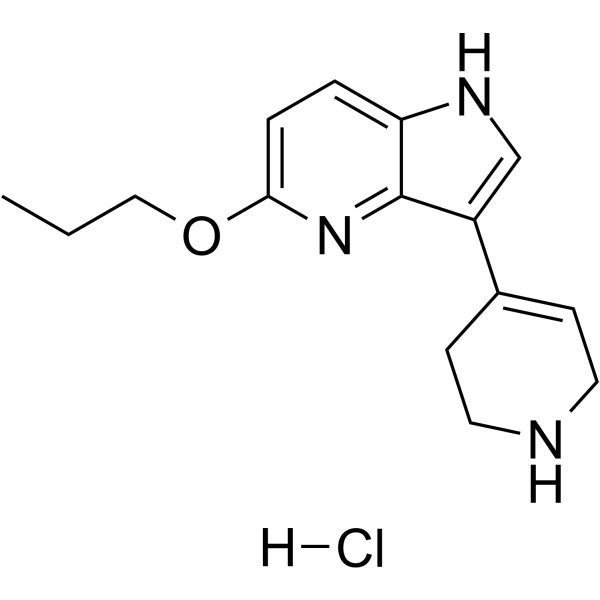
CP94253 hydrochloride

Based on 1 Customer Validation
CP94253 hydrochloride is an orally active, brain-penetrant and selective 5-HT1B receptor agonist with an Ki of 2 nM. CP94253 hydrochloride induces antidepressant-like effects, waking enhancement, sleep inhibition, increased sleep latency, hyperlocomotion, and suppressed aggressive behavior. CP94253 hydrochloride can be used for the research of depression and heightened aggressive behavior.
For research use only. We do not sell to patients.
- Purity : 98.00%
- CAS No.: 845861-39-4
- Formula: C15H20ClN3O
- Molecular Weight:293.79
-
Storage:
-20°C, sealed storage, away from moisture
* In solvent : -80°C, 6 months; -20°C, 1 month (sealed storage, away from moisture)

To place orders, for customer services and technical support, please contact: MedChemExpress USA
Tel: 609-228-6898 E-mail: [email protected] [email protected]


-
 Biological Activity
-
Chemical Information
-
Solvent & Solubility
- Purity & Documentation
- References
-
 Help & FAQs


All 5-HT Receptor Isoforms
More

Biological Activity
Description
IC50 & Target
[3]|
5-HT1B Receptor 2 nM (Ki) |
5-HT1A Receptor 89 nM (Ki) |
5-HT1D Receptor 49 nM (Ki) |
5-HT2A Receptor 1600 nM (Ki) |
5-HT2C Receptor 860 nM (Ki) |
In Vitro
CP94253 hydrochloride potently and selectively binds to 5-HT1B receptors (Ki = 2 nM) with minimal affinity for other serotonin receptor subtypes and no significant binding to a broad range of off-target receptors[3].
CP94253 (1.0-2.0 nM) hydrochloride acts as a competitive inhibitor of [125I]iodocyanopindolol binding to rat cerebral cortex membrane 5-HT1B receptors[4].
CP94253 (50-100 nM) hydrochloride competitively inhibits [3H]5-HT binding to bovine caudate membrane 5-HT1D receptors[4].
MedChemExpress (MCE) has not independently confirmed the accuracy of these methods. They are for reference only. .
In Vivo
CP94253 (5 mg/kg; i.p.; single dose) hydrochloride exerts a potent antidepressant-like effect in mice, reducing forced swimming test immobility time by 43%, via stimulation of 5-HT1B receptors (likely postsynaptic or heteroreceptors), with dopamine and noradrenaline systems contributing to this action[2].
CP94253 (0.5-10.0 mg/kg; s.c.) hydrochloride activates 5-HT1B receptors with dose-dependently increasing waking and reducing SWS (at 5.0-10.0 mg/kg) and suppresses REMS across all tested doses in male Wistar rats[3].
CP94253 (5.0-10.0 mg/kg; s.c.) hydrochloride-induced increases in waking and reductions in SWS can be reversed by pretreatment with 2.0 mg/kg (±) Pindolol (HY-B0982)[3].
CP94253 (3.2-32 mg/kg; p.o.; daily; 9 days) hydrochloride administered orally to healthy rats induces transient anorexia, sustained reduced body weight gain, and persistent hyperlocomotion at 32 mg/kg, while 3.2 mg/kg and 10 mg/kg doses show no significant effects on these endpoints[4].
CP94253 (3-17 mg/kg; i.p.; single dose) hydrochloride dose-dependently reduces species-typical aggression in male CFW mice with an ED50 of 7.2 mg/kg for attack bite reduction, an effect specific to 5-HT1B receptors as shown by antagonism with GR 127935 (HY-123869) and no effect of WAY 100,635 (HY-10349), without concurrent locomotor sedation[5].
CP94253 (3-10 mg/kg; i.p.; single dose) hydrochloride reduces alcohol-heightened aggression in male CFW mice with a lower ED50 (3.8 mg/kg) than for non-heightened aggression, with dose-dependent effects that only reduce locomotor behaviors at the highest tested dose[5].
CP94253 (1-10 mg/kg; i.p.; single dose) hydrochloride reduces instigation-heightened aggression in male CFW mice with a lower ED50 (2.7 mg/kg) than for non-instigated aggression, with dose-dependent effects on locomotor behaviors only at higher doses[5].
CP94253 (5-40 µmol/kg; i.p.; single injection 30 minutes prior to feeding) hydrochloride produces a potent hypophagic effect in mildly deprived rats consuming pellets, with an ID50 of 12.5 µmol/kg, by reducing meal duration and feeding frequency without altering resting behaviour[6].
CP94253 (5-28 µmol/kg; i.p.; single injection 30 minutes prior to sucrose access) hydrochloride produces a hypophagic effect in mildly deprived rats consuming 10% sucrose, with an ID50 of 22.8 µmol/kg, by reducing meal duration, feeding frequency, and licking burst/cluster frequency without impairing oral motor efficiency[6].
MedChemExpress (MCE) has not independently confirmed the accuracy of these methods. They are for reference only.
-
Animal Model:Wistar (female, ~200 g body weight)[1]
-
Dosage:1 mg/kg; 3 mg/kg; 10 mg/kg
-
Administration:i.p.; single dose
-
Result:Induced a dose-dependent reduction of food intake, with an ED50 value of 3.48 mg/kg for the first hour of food access.
Showed hypophagic effect unaffected by pretreatment with 5-HT2C receptor antagonists metergoline or SB 242,084.
Had hypophagic effect potentiated by pretreatment with a low, inactive dose of ORG 37684, lowering its ED50 to 2.44 mg/kg for the 0-1 h interval, 1.19 mg/kg for the 0-2 h interval, and 1.93 mg/kg for the 0-6 h interval.
-
Animal Model:Albino Swiss (male, 24-26 g)[2]
-
Dosage:5 mg/kg
-
Administration:i.p.; single dose
-
Result:Shortened the immobility time of mice by 43%.
Did not alter spontaneous locomotor activity of mice.
-
Animal Model:Wistar (male, 350-380 g, implanted with chronic sleep recording electrodes, habituated to recording chambers and injection procedures)[3]
-
Dosage:0.5 mg/kg; 1.0 mg/kg; 5.0 mg/kg; 10.0 mg/kg
-
Administration:s.c.
-
Result:Decreased REM sleep to 8.8 minutes and number of REM periods to 3.5 during 0-3 hour period at 0.5 mg/kg; no significant changes to waking, slow wave sleep, or light sleep observed at 0.5 mg/kg.
Decreased REM sleep to 4.3 minutes and number of REM periods to 2.0, and increased REM sleep latency to 90.8 minutes during 0-3 hour period at 1.0 mg/kg; decreased REM sleep to 11.0 minutes and number of REM periods to 4.1 during 4-6 hour period at 1.0 mg/kg.
Increased waking to 86.0 minutes, decreased slow wave sleep to 71.9 minutes and REM sleep to 1.4 minutes, increased REM sleep latency to 164.6 minutes, and decreased number of REM periods to 0.7 during 0-3 hour period at 5.0 mg/kg; increased waking to 58.4 minutes, decreased slow wave sleep to 92.6 minutes and REM sleep to 4.7 minutes, and decreased number of REM periods to 2.3 during 4-6 hour period at 5.0 mg/kg.
Increased waking to 96.9 minutes and light sleep to 34.5 minutes, decreased slow wave sleep to 48.3 minutes and REM sleep to 0.3 minutes, increased slow wave sleep latency to 23.4 minutes and REM sleep latency to 239.2 minutes, and decreased number of REM periods to 0.2 during 0-3 hour period at 10.0 mg/kg; increased waking to 79.9 minutes and light sleep to 36.8 minutes, decreased slow wave sleep to 59.1 minutes and REM sleep to 4.2 minutes, and decreased number of REM periods to 2.0 during 4-6 hour period at 10.0 mg/kg.
-
Animal Model:Wistar (male, 350-380 g, implanted with chronic sleep recording electrodes, pretreated with (±) pindolol)[3]
-
Dosage:5.0 mg/kg plus 2.0 mg/kg (±) Pindolol; 10.0 mg/kg plus 2.0 mg/kg (±) Pindolol
-
Administration:s.c.
-
Result:Decreased REM sleep to 2.9 minutes and number of REM periods to 1.6, and increased REM sleep latency to 125.0 minutes during 0-3 hour period at 5.0 mg/kg with (±) Pindolol pretreatment.
Decreased REM sleep to 6.0 minutes and number of REM periods to 2.9 during 4-6 hour period at 5.0 mg/kg with (±) Pindolol pretreatment.
No significant changes to waking or slow wave sleep observed at 5.0 mg/kg with (±) Pindolol pretreatment.
Decreased REM sleep to 2.7 minutes and number of REM periods to 1.6, and increased REM sleep latency to 135.6 minutes during 0-3 hour period at 10.0 mg/kg with (±) Pindolol pretreatment.
Decreased REM sleep to 3.4 minutes and number of REM periods to 3.1 during 4-6 hour period at 10.0 mg/kg with (±) Pindolol pretreatment.
No significant changes to waking or slow wave sleep observed at 10.0 mg/kg with (±) Pindolol pretreatment.
-
Animal Model:Charles River Sprague-Dawley CD (male, 170-190 g)[4]
-
Dosage:3.2 mg/kg; 10 mg/kg; 32 mg/kg
-
Administration:p.o.; daily; 9 days
-
Result:Reduced food intake significantly in the first 24 hours (to ~14 g/24 hr, compared to vehicle ~24 g/24 hr), with the anorectic effect diminishing over time and returning to vehicle levels by day 7.
Inhibited body weight gain after the first and second injections, with a persistent weight differential relative to vehicle-treated rats maintained for the entire study (day 9 body weight ~290 g, compared to vehicle ~320 g).
Induced a ~2-fold increase in horizontal locomotion relative to vehicle starting on day 1, which persisted throughout the 9-day study with slight evidence of tolerance.
Showed no significant effect on food intake or body weight gain relative to vehicle at 3.2 mg/kg and 10 mg/kg.
Exerted little or no effect on horizontal locomotion at 3.2 mg/kg and 10 mg/kg.
-
Animal Model:CFW (male, adult, 20-25 g, arrived at 5 weeks old)[5]
-
Dosage:3.0 mg/kg; 5.6 mg/kg; 10.0 mg/kg; 17.0 mg/kg; 10 mg/kg plus GR 127935; 17 mg/kg plus GR 127935; 30 mg/kg plus GR 127935
-
Administration:i.p.; single dose
-
Result:Reduced attack bite and tail rattle frequencies significantly at all tested doses (3-17 mg/kg).
Reduced sideways threats significantly at 10.0 and 17.0 mg/kg.
Achieved an ED50 of 7.2 mg/kg for attack bite reduction.
Shifted the ED50 for attack bite reduction to 14.5 mg/kg when pretreated with GR 127935.
Shifted the ED50 for sideways threat reduction to 15.6 mg/kg when pretreated with GR 127935.
Did not alter anti-aggressive effects when pretreated with WAY 100,635.
Did not reduce locomotor behaviors (walking, rearing) at any tested dose.
Decreased grooming duration at all doses.
-
Animal Model:CFW (male, adult, 20-25 g, arrived at 5 weeks old)[5]
-
Dosage:3.0 mg/kg; 5.6 mg/kg; 10.0 mg/kg
-
Administration:i.p.; single dose
-
Result:Reduced attack bite and sideways threat frequencies significantly at all tested doses (3-10 mg/kg).
Reduced tail rattle frequency at 10.0 mg/kg.
Achieved an ED50 of 3.8 mg/kg for attack bite reduction in alcohol-heightened aggression mice, which was significantly lower than the ED50 of 7.1 mg/kg in alcohol-non-heightened aggression mice.
Reduced locomotor behaviors (walking, rearing) only at the 10.0 mg/kg dose.
Did not significantly affect grooming duration.
-
Animal Model:CFW (male, adult, 20-25 g, arrived at 5 weeks old)[5]
-
Dosage:1.0 mg/kg; 3.0 mg/kg; 10.0 mg/kg
-
Administration:i.p.; single dose
-
Result:Reduced attack bite and sideways threat frequencies significantly at 3.0 and 10.0 mg/kg.
Achieved an ED50 of 2.7 mg/kg for attack bite reduction in instigation-heightened aggression mice, which was significantly lower than the ED50 of 8.3 mg/kg for non-instigated aggression.
Reduced walking duration at 3.0 and 10.0 mg/kg.
Reduced rearing and grooming durations only at 10.0 mg/kg.
-
Animal Model:Sprague-Dawley (male, mildly food-deprived)[6]
-
Dosage:5 µmol/kg; 10 µmol/kg; 14 µmol/kg; 20 µmol/kg; 40 µmol/kg
-
Administration:i.p.; single injection 30 minutes prior to feeding
-
Result:Produced a dose-related decrease in 30-minute pellet intake, with significant reductions at 10, 14, 20, and 40 µmol/kg.
Reduced water intake in a non-systematic, non-dose-related manner across all doses.
Reduced the frequency of feeding observations at all doses.
Shortened meal duration in a dose-related manner.
Increased standing at the 20 µmol/kg dose.
Left resting frequency unchanged.
Induced an abnormal prone posture at the 40 µmol/kg dose.
Achieved an ID50 of 12.5 µmol/kg for pellet intake reduction.
-
Animal Model:Sprague-Dawley (male, mildly food-deprived)[6]
-
Dosage:5 µmol/kg; 10 µmol/kg; 14 µmol/kg; 20 µmol/kg; 40 µmol/kg
-
Administration:i.p.; single injection 30 minutes prior to sucrose access
-
Result:Produced a dose-related decrease in 30-minute sucrose intake, with significant reductions at 20 and 28 µmol/kg.
Reduced the frequency of feeding observations at 20 and 28 µmol/kg.
Shortened meal duration in a dose-related manner.
Increased standing at the 28 µmol/kg dose.
Left resting frequency unchanged.
Reduced the total number of licks at 20 and 28 µmol/kg, with lick efficiency unchanged.
Decreased the frequency of licking bursts and clusters without altering their size.
Achieved an ID50 of 22.8 µmol/kg for sucrose intake reduction.


Chemical Information
-
CAS No. 845861-39-4
-
Appearance Solid
-
Molecular Weight 293.79
-
Formula C15H20ClN3O
-
Color Light yellow to yellow
-
SMILES
CCCOC1=CC=C(NC=C2C3=CCNCC3)C2=N1.[H]Cl
-
Shipping
Room temperature in continental US; may vary elsewhere.
-
Storage
-20°C, sealed storage, away from moisture
* In solvent : -80°C, 6 months; -20°C, 1 month (sealed storage, away from moisture)


Solvent & Solubility
In Vitro:
DMSO : 125 mg/mL (425.47 mM; Need ultrasonic; Hygroscopic DMSO has a significant impact on the solubility of product, please use newly opened DMSO)
Please refer to the solubility information to select the appropriate solvent. Once prepared, please aliquot and store the solution to prevent product inactivation from repeated freeze-thaw cycles.
Storage method and period of stock solution: -80°C, 6 months; -20°C, 1 month (sealed storage, away from moisture). When stored at -80°C, please use it within 6 months. When stored at -20°C, please use it within 1 month.
Please refer to the solubility information to select the appropriate solvent. Once prepared, please aliquot and store the solution to prevent product inactivation from repeated freeze-thaw cycles.
Storage method and period of stock solution: -80°C, 6 months; -20°C, 1 month (sealed storage, away from moisture). When stored at -80°C, please use it within 6 months. When stored at -20°C, please use it within 1 month.
Concentration (start) × Volume (start) = Concentration (final) × Volume (final)
In Vivo:
Select the appropriate dissolution method based on your experimental animal and administration route.
- For the following dissolution methods, please ensure to first prepare a clear stock solution using an In Vitro approach and then sequentially add co-solvents:
- To ensure reliable experimental results, the clarified stock solution can be appropriately stored based on storage conditions. As for the working solution for In Vivo experiments, it is recommended to prepare freshly and use it on the same day.
- The percentages shown for the solvents indicate their volumetric ratio in the final prepared solution. If precipitation or phase separation occurs during preparation, heat and/or sonication can be used to aid dissolution.
Add each solvent one by one: 10% DMSO 40% PEG300 5% Tween-80 45% Saline
Solubility: ≥ 2.08 mg/mL (7.08 mM); Clear solution
This protocol yields a clear solution of ≥ 2.08 mg/mL (saturation unknown).
Taking 1 mL working solution as an example, add 100 μL DMSO stock solution (20.8 mg/mL) to 400 μL PEG300, and mix evenly; then add 50 μL Tween-80 and mix evenly; then add 450 μL Saline to adjust the volume to 1 mL.
Preparation of Saline: Dissolve 0.9 g sodium chloride in ddH₂O and dilute to 100 mL to obtain a clear Saline solution.
Add each solvent one by one: 10% DMSO 90% (20% SBE-β-CD in Saline)
Solubility: ≥ 2.08 mg/mL (7.08 mM); Clear solution
This protocol yields a clear solution of ≥ 2.08 mg/mL (saturation unknown).
Taking 1 mL working solution as an example, add 100 μL DMSO stock solution (20.8 mg/mL) to 900 μL 20% SBE-β-CD in Saline, and mix evenly.
Preparation of 20% SBE-β-CD in Saline (4°C, storage for one week): 2 g SBE-β-CD powder is dissolved in 10 mL Saline, completely dissolve until clear.
In Vivo Dissolution Calculator
Please enter the basic information of animal experiments:
-
-
-
-
Recommended: Prepare an additional quantity of animals to account for potential losses during experiments.
Please enter your animal formula composition:
-
%DMSO +
Recommended: Keep the proportion of DMSO in working solution below 2% if your animal is weak.
-
%+
-
+%Tween-80 + +
-
%Saline +
The co-solvents required include: DMSO, . All of co-solvents are available by MedChemExpress (MCE). , Tween 80. All of co-solvents are available by MedChemExpress (MCE).
Working solution concentration: 0.22 mg/mL
Method for preparing stock solution: mg drug dissolved in μL DMSO. Stock solution concentration: mg/mL. * In solvent : -80°C, 6 months; -20°C, 1 month (sealed storage, away from moisture)
1. Take μL DMSO stock solution;
2. Add μL .
μL , mix evenly;
3. Then add μL Tween 80, mix evenly;
4. Then add μL
Please ensure that the stock solution in the first step is dissolved to a clear state, and add co-solvents in sequence. You can use ultrasonic heating (ultrasonic cleaner, recommended frequency 20-40 kHz), vortexing, etc. to assist dissolution.


Purity & Documentation
-
Data Sheet (295 KB)
-
SDS (394 KB)
- English - EN (394 KB)
- Français - FR (394 KB)
- Deutsch - DE (394 KB)
- Norwegian - NO (394 KB)
- Español - ES (394 KB)
- Swedish - SV (394 KB)
- Italian - IT (394 KB)
- Korean - KR (394 KB)
- Portuguese - PT (394 KB)
-
Handling Instructions (2659 KB)
References
[1]. Schreiber R, et al. Role of 5-hT2C receptors in the hypophagic effect of m-CPP, ORG 37684 and CP-94,253 in the rat. Prog Neuropsychopharmacol Biol Psychiatry. 2002;26(3):441-449. [Content Brief]
[2]. Tatarczyńska E, et al. Antidepressant-like effect of the selective 5-HT1B receptor agonist CP 94253: a possible mechanism of action. Eur J Pharmacol. 2005;516(1):46-50. [Content Brief]
[3]. Monti JM, et al. Effects of selective activation of the 5-HT1B receptor with CP-94,253 on sleep and wakefulness in the rat. Neuropharmacology. 1995 Dec;34(12):1647-51. [Content Brief]
[5]. Fish EW, et al. Aggression heightened by alcohol or social instigation in mice: reduction by the 5-HT(1B) receptor agonist CP-94,253. Psychopharmacology (Berl). 1999;146(4):391-399. [Content Brief]
[6]. Lee MD, et al. CP-94, 253: a selective serotonin1B (5-HT1B) agonist that promotes satiety. Psychopharmacology (Berl). 1997;131(3):264-270. [Content Brief]


Complete Stock Solution Preparation Table
Please refer to the solubility information to select the appropriate solvent. Once prepared, please aliquot and store the solution to prevent product inactivation from repeated freeze-thaw cycles.
Storage method and period of stock solution: -80°C, 6 months; -20°C, 1 month (sealed storage, away from moisture). When stored at -80°C, please use it within 6 months. When stored at -20°C, please use it within 1 month.
| Optional Solvent | Concentration Solvent Mass | 1 mg | 5 mg | 10 mg | 25 mg |
|---|---|---|---|---|---|
| DMSO | 1 mM | 3.4038 mL | 17.0190 mL | 34.0379 mL | 85.0948 mL |
| 5 mM | 0.6808 mL | 3.4038 mL | 6.8076 mL | 17.0190 mL | |
| 10 mM | 0.3404 mL | 1.7019 mL | 3.4038 mL | 8.5095 mL | |
| 15 mM | 0.2269 mL | 1.1346 mL | 2.2692 mL | 5.6730 mL | |
| 20 mM | 0.1702 mL | 0.8509 mL | 1.7019 mL | 4.2547 mL | |
| 25 mM | 0.1362 mL | 0.6808 mL | 1.3615 mL | 3.4038 mL | |
| 30 mM | 0.1135 mL | 0.5673 mL | 1.1346 mL | 2.8365 mL | |
| 40 mM | 0.0851 mL | 0.4255 mL | 0.8509 mL | 2.1274 mL | |
| 50 mM | 0.0681 mL | 0.3404 mL | 0.6808 mL | 1.7019 mL | |
| 60 mM | 0.0567 mL | 0.2836 mL | 0.5673 mL | 1.4182 mL | |
| 80 mM | 0.0425 mL | 0.2127 mL | 0.4255 mL | 1.0637 mL | |
| 100 mM | 0.0340 mL | 0.1702 mL | 0.3404 mL | 0.8509 mL |


CP94253 hydrochloride Related Classifications
HY-103151 Related Classifications
 Powered by Bioz