



SB-699551
Based on 2 publication(s) in Google Scholar
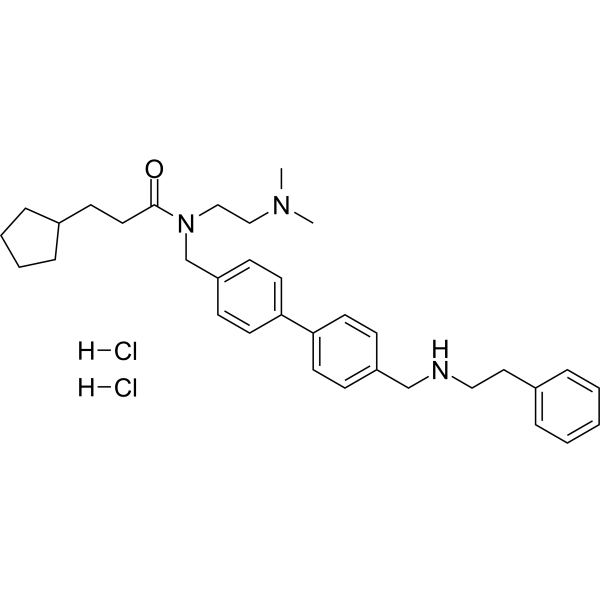
SB-699551 is a selective and brain penetrant 5-HT5A receptor antagonist with a pKi of 8.2 nM. SB-699551 shows high selectivity over most other 5-HT receptor subtypes, dopamine receptors, and α1B adrenoceptor. SB-699551 disrupts Gαi/o-coupled and PI3K/AKT/mTOR signaling pathways, alters CREB, ATF1, AKT, PRAS40, S6K, and FOXO1 phosphorylation in breast tumor cells. SB-699551 can be used for the research of anxiety, breast cancer, and Alzheimer's disease.
Nos produits utilisent uniquement pour la recherche. Nous ne vendons pas aux patients.
- Pureté : 99.53%
- CAS No.: 864741-95-7
- Formule: C34H47Cl2N3O
- Masse moléculaire:584.66
-
Stockage:
4°C, sealed storage, away from moisture
* In solvent : -80°C, 6 months; -20°C, 1 month (sealed storage, away from moisture)

To place orders, for customer services and technical support, please contact: MedChemExpress USA
Tel: 609-228-6898 E-mail: [email protected] [email protected]


-
 Activité biologique
-
Chemical Information
-
Solvant et solubilité
- Protocole
- Pureté et documentation
- Références
-
 Help & FAQs


Publications Citing Use of MedChemExpress (MCE) SB-699551
MoreVoir tous les produits spécifiques à Isoform 5-HT Receptor
More

Activité biologique
Description
IC50 & Target
[1]|
5-HT5A Receptor |
5-HT5A Receptor 8.2 (pKi) |
In Vitro
SB-699551 potently binds to human 5-HT5A receptors expressed in CHO cells with a pKi of 8.2 and exhibits ≥100-fold selectivity against most other 5-HT receptor subtypes[1].
SB-699551 (1 μM) acts as a competitive antagonist at human 5-HT5A receptors expressed in HEK 293 cells, with an apparent pKB of 8.0[1].
SB-699551 (72 h) inhibits tumorsphere formation and cell viability in HCC1954 and MCF-7 human breast tumor cell lines with IC50 values ranging from 0.2 to 0.3 μM[3].
SB-699551 inhibits tumorsphere formation in PDX-derived human breast tumor cell lines (PDX 81, PDX 18, PDX 12) with IC50 values ranging from 470 nM to 775 nM, independent of subtype[3].
SB-699551 (4 μM, 30 min; 4 μM, 5-60 min; 3-5 μM, 24 h) modulates signaling via the Gαi/o pathway and the PI3K/AKT/mTOR axis in MCF-7 and MDA-MB-157 human breast tumor cell lines, with increased CREB phosphorylation and reduced phosphorylation of AKT and downstream targets[3].
MedChemExpress (MCE) has not independently confirmed the accuracy of these methods. They are for reference only. Further protocols information, click here.
In Vivo
SB-699551 (3-60 mg/kg; i.p.; once) shows anxiolytic-like effects in the foot-shock-induced USV model with an ED50 of 25.4 mg/kg[2].
SB-699551-A (3-30 mg/kg; i.p.; three times: 23.5, 5, and 1 h before test) does not exhibit antidepressant-like effects in the forced swim test[2].
SB-699551 (25 mg/kg; i.p.; 5 days a week; 3 weeks) reduces human breast tumor xenograft growth in NOD/SCID mice[3].
SB-699551 (0.1-3.0 mg/kg; s.c.; single injection post-first autoshaping session) impairs short-term memory at 0.3 mg/kg and long-term memory at 0.3, 1.0, and 3.0 mg/kg in male Wistar rats in an autoshaping associative learning task[4].
SB-699551 (0.3-3.0 mg/kg; s.c.) prevents forgetting induced by a 216-hour interruption of autoshaping training in rats[5].
SB-699551 (0.3 mg/kg; s.c.) alone induces amnesia-like effects in rats, with co-administration with Dizocilpine (HY-15084B) reversing these effects in 48-hour long-term memory and co-administration with Scopolamine (HY-N0296) reversing effects in 1.5-hour short-term and 24- and 48-hour long-term memory[5].
MedChemExpress (MCE) has not independently confirmed the accuracy of these methods. They are for reference only.
-
Animal Model:Hannover Wistar (male, 225-360 g, 8-12 animals/group)[2]
-
Dosage:3, 10, 30, 60 mg/kg
-
Administration:i.p.
-
Result:Dose-dependently decreased ultrasonic vocalization, with a significant effect at 30 mg/kg and an ED50 value of 25.4 mg/kg.
-
Animal Model:Hannover Wistar (male, 240-290 g and 160-210 g)[2]
-
Dosage:3, 10, 30 mg/kg
-
Administration:i.p.
-
Result:Showed a dose-dependent tendency to decrease the number of square entries; dose-dependently decreased the number of rearings and groomings, with significant effects at 10 and 30 mg/kg doses, respectively; did not induce writhing behavior.
-
Animal Model:NOD/SCID (female, 6-8-week old) injected with HCC1954 cells[3]
-
Dosage:25 mg/kg
-
Administration:i.p.; 5 days a week; 3 weeks
-
Result:Reduced xenograft growth rate compared to vehicle; Induced large fibrotic areas with reduced tumor cell density and a subtle increase in TUNEL-positive cells in xenografts.
-
Animal Model:Wistar (male, 12 weeks-old, body weight reduced to 85% of ad libitum weight)[4]
-
Dosage:0.1, 0.3, 1.0, 3.0 mg/kg
-
Administration:s.c.; single injection post-first autoshaping session
-
Result:Decreased conditioned responses (CR%) during both short-term memory (1.5 h) and long-term memory (24 h) at 0.3 mg/kg; decreased CR% during long-term memory (24 h) at 1.0 and 3.0 mg/kg relative to vehicle controls (all effects significant per Tukey test); showed no significant effect at 0.1 mg/kg.
-
Animal Model:Wistar rats (adult male)[5]
-
Dosage:0.3, 3.0 mg/kg
-
Administration:s.c.
-
Result:Produced a significant anti-forgetting effect (114% of control-saline group values) at 0.3 mg/kg; produced a slight anti-forgetting effect (82% of control-saline group values) at 3.0 mg/kg following the 216-hour interruption period.
-
Animal Model:Wistar rats (adult male)[5]
-
Dosage:0.3 mg/kg
-
Administration:s.c.
-
Result:Induced amnesia-like effects with significant decrements in conditioned responses (CR) at 1.5 hours, 24 hours, and 48 hours; co-administration with dizocilpine reversed these effects in 48-hour long-term memory; co-administration with scopolamine reversed effects in 1.5-hour short-term and 24- and 48-hour long-term memory.


Chemical Information
-
CAS No. 864741-95-7
-
Appearance Solid
-
Masse moléculaire 584.66
-
Formule C34H47Cl2N3O
-
Color White to light yellow
-
SMILES
O=C(N(CCN(C)C)CC1=CC=C(C2=CC=C(CNCCC3=CC=CC=C3)C=C2)C=C1)CCC4CCCC4.[H]Cl.[H]Cl
-
Livraison
Room temperature in continental US; may vary elsewhere.
-
Stockage
4°C, sealed storage, away from moisture
* In solvent : -80°C, 6 months; -20°C, 1 month (sealed storage, away from moisture)


Publications (2)
-
Journal Impact Factor
-
Most Recent
-
Mol Cancer Ther
AKT Inhibition Sensitizes to Polo-Like Kinase 1 Inhibitor Onvansertib in Prostate Cancer. [Abstract]2024 Oct 1;23(10):1404-1417. PMID: 38894678 -


Solvant et solubilité
In Vitro:
DMSO : 100 mg/mL (171.04 mM; Need ultrasonic; Hygroscopic DMSO has a significant impact on the solubility of product, please use newly opened DMSO)
H2O : 1 mg/mL (1.71 mM; ultrasonic and warming and heat to 60°C)
Please refer to the solubility information to select the appropriate solvent. Once prepared, please aliquot and store the solution to prevent product inactivation from repeated freeze-thaw cycles.
Storage method and period of stock solution: -80°C, 6 months; -20°C, 1 month (sealed storage, away from moisture). When stored at -80°C, please use it within 6 months. When stored at -20°C, please use it within 1 month.
* Note: If you choose water as the stock solution, please dilute it to the working solution, then filter and sterilize it with a 0.22 μm filter before use.
Please refer to the solubility information to select the appropriate solvent. Once prepared, please aliquot and store the solution to prevent product inactivation from repeated freeze-thaw cycles.
Storage method and period of stock solution: -80°C, 6 months; -20°C, 1 month (sealed storage, away from moisture). When stored at -80°C, please use it within 6 months. When stored at -20°C, please use it within 1 month.
* Note: If you choose water as the stock solution, please dilute it to the working solution, then filter and sterilize it with a 0.22 μm filter before use.
Concentration (start) × Volume (start) = Concentration (final) × Volume (final)
In Vivo:
Select the appropriate dissolution method based on your experimental animal and administration route.
- For the following dissolution methods, please ensure to first prepare a clear stock solution using an In Vitro approach and then sequentially add co-solvents:
- To ensure reliable experimental results, the clarified stock solution can be appropriately stored based on storage conditions. As for the working solution for In Vivo experiments, it is recommended to prepare freshly and use it on the same day.
- The percentages shown for the solvents indicate their volumetric ratio in the final prepared solution. If precipitation or phase separation occurs during preparation, heat and/or sonication can be used to aid dissolution.
Add each solvent one by one: 10% DMSO 40% PEG300 5% Tween-80 45% Saline
Solubility: 2.5 mg/mL (4.28 mM); Clear solution; Need ultrasonic
This protocol yields a clear solution of 2.5 mg/mL.
Taking 1 mL working solution as an example, add 100 μL DMSO stock solution (25.0 mg/mL) to 400 μL PEG300, and mix evenly; then add 50 μL Tween-80 and mix evenly; then add 450 μL Saline to adjust the volume to 1 mL.
Preparation of Saline: Dissolve 0.9 g sodium chloride in ddH₂O and dilute to 100 mL to obtain a clear Saline solution.
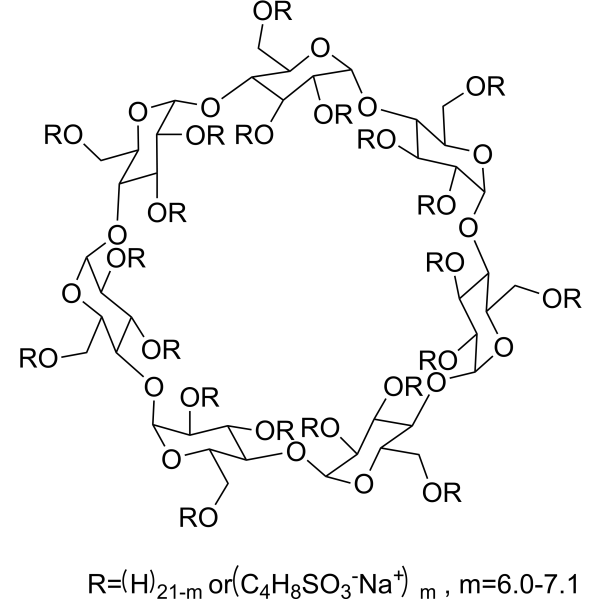
Add each solvent one by one: 10% DMSO 90% (20% SBE-β-CD in Saline)
Solubility: 2.5 mg/mL (4.28 mM); Clear solution; Need ultrasonic
This protocol yields a clear solution of 2.5 mg/mL.
Taking 1 mL working solution as an example, add 100 μL DMSO stock solution (25.0 mg/mL) to 900 μL 20% SBE-β-CD in Saline, and mix evenly.
Preparation of 20% SBE-β-CD in Saline (4°C, storage for one week): 2 g SBE-β-CD powder is dissolved in 10 mL Saline, completely dissolve until clear.
In Vivo Dissolution Calculator
Please enter the basic information of animal experiments:
-
-
-
-
Recommended: Prepare an additional quantity of animals to account for potential losses during experiments.
Please enter your animal formula composition:
-
%DMSO +
Recommended: Keep the proportion of DMSO in working solution below 2% if your animal is weak.
-
%+
-
+%Tween-80 + +
-
%Saline +
The co-solvents required include: DMSO, . All of co-solvents are available by MedChemExpress (MCE). , Tween 80. All of co-solvents are available by MedChemExpress (MCE).
Working solution concentration: 0.22 mg/mL
Method for preparing stock solution: mg drug dissolved in μL DMSO. Stock solution concentration: mg/mL. * In solvent : -80°C, 6 months; -20°C, 1 month (sealed storage, away from moisture)
1. Take μL DMSO stock solution;
2. Add μL .
μL , mix evenly;
3. Then add μL Tween 80, mix evenly;
4. Then add μL
Please ensure that the stock solution in the first step is dissolved to a clear state, and add co-solvents in sequence. You can use ultrasonic heating (ultrasonic cleaner, recommended frequency 20-40 kHz), vortexing, etc. to assist dissolution.

Protocole
-
Kinase activity and phosphorylation assays
Kinase activity assays measure the ability of kinases to transfer phosphate groups from ATP to specific substrates, while phosphorylation assays detect the presence and levels of phosphorylated proteins. Common methods include radiolabeled ATP incorporation (e. g. ,), ADP release detection via bioluminescence (e. g. ,[3]), enzyme-linked immunosorbent assays (ELISA) for phospho-specific epitopes (e. g. ,[6]), and microtiter-based formats for high-throughput screening (e. g. ,[8]). The ADP-Glo assay quantifies kinase activity by measuring ADP produced during phosphorylation using a luciferase-based system. Radiometric assays involve autoradiography or scintillation counting after incorporation of 32P-labeled ATP into substrate proteins. ELISA-based approaches rely on phospho-specific antibodies to detect activated kinases in cell lysates or purified samples.
-
Western Blot
Western blotting (WB) is a commonly used experimental method in molecular biology, biochemistry, and immunogenetics for identifying and quantifying target proteins. It combines gel electrophoresis with immunoassay, enabling researchers to analyze protein expression, post-translational modifications, and molecular weight.
-
Protocol for Kinase activity and phosphorylation assays
Kinase activity assays measure transfer of phosphate from ATP to a protein or peptide substrate, generating phosphorylated substrate, ADP, or incorporated radiolabeled phosphate as the readout; phosphorylation assays measure site-specific phosphorylation in cells or tissues as a proxy for kinase-pathway activation, inhibition, or substrate regulation. Phosphorylation can be detected by phospho-specific Western blot, immunoprecipitation kinase assay, phospho-immunofluorescence, phospho-flow cytometry, luminescent ADP detection, radiolabeled ATP incorporation, or reporter-based pathway assays, and these readouts can be applied to cancer cells, primary neurons, mouse tumors, organoids, inflammatory macrophages, ferroptosis studies, and mitophagy studies when the kinase target is biologically relevant.
-
Breast Cancer Modeling
Breast cancer is a heterogeneous cancer, and it has been distinguished into four subtypes: luminal A, luminal B, HER2-positive and basal-like. Molecular mutations, epigenetic alterations, hormone exposure and immune microenvironment are related to the progression of breast cancer.
-
Alzheimer’s Disease Modeling
Alzheimer’s Disease (AD) is a neurodegenerative disorder characterized by a progressive decline in cognitive functions and loss of specific types of neurons and synapses. Alzheimer's symptoms can be simulated in mice by injecting drugs (such as Aβ) or genetically modified.


Pureté et documentation
-
Fiche technique (282 KB)
-
SDS (393 KB)
- English - EN (393 KB)
- Français - FR (393 KB)
- Deutsch - DE (393 KB)
- Norwegian - NO (393 KB)
- Español - ES (393 KB)
- Swedish - SV (393 KB)
- Italian - IT (393 KB)
- Korean - KR (393 KB)
- Portuguese - PT (393 KB)
-
Instruction de manipulation (2659 KB)
Références
[1]. Corbett DF, et al. Discovery of a potent and selective 5-ht5A receptor antagonist by high-throughput chemistry. Bioorg Med Chem Lett. 2005;15(18):4014-4018. [Content Brief]
[2]. Kassai F, et al. Effect of 5-HT5A antagonists in animal models of schizophrenia, anxiety and depression. Behav Pharmacol. 2012;23(4):397-406. [Content Brief]
[3]. Gwynne WD, et al. Antagonists of the serotonin receptor 5A target human breast tumor initiating cells. BMC Cancer. 2020;20(1):724. Published 2020 Aug 5. [Content Brief]
[4]. Gonzalez R, et al. Role of 5-HT5A receptors in the consolidation of memory. Behav Brain Res. 2013 Sep 1;252:246-51. [Content Brief]
[5]. Aparicio-Nava L, et al. Effects of 5-HT5A receptor blockade on amnesia or forgetting. Behav Brain Res. 2019;357-358:98-103. [Content Brief]


Complete Stock Solution Preparation Table
Please refer to the solubility information to select the appropriate solvent. Once prepared, please aliquot and store the solution to prevent product inactivation from repeated freeze-thaw cycles.
Storage method and period of stock solution: -80°C, 6 months; -20°C, 1 month (sealed storage, away from moisture). When stored at -80°C, please use it within 6 months. When stored at -20°C, please use it within 1 month.
| Optional Solvent | Concentration Solvent Mass | 1 mg | 5 mg | 10 mg | 25 mg |
|---|---|---|---|---|---|
| H2O / DMSO | 1 mM | 1.7104 mL | 8.5520 mL | 17.1040 mL | 42.7599 mL |
| DMSO | 5 mM | 0.3421 mL | 1.7104 mL | 3.4208 mL | 8.5520 mL |
| 10 mM | 0.1710 mL | 0.8552 mL | 1.7104 mL | 4.2760 mL | |
| 15 mM | 0.1140 mL | 0.5701 mL | 1.1403 mL | 2.8507 mL | |
| 20 mM | 0.0855 mL | 0.4276 mL | 0.8552 mL | 2.1380 mL | |
| 25 mM | 0.0684 mL | 0.3421 mL | 0.6842 mL | 1.7104 mL | |
| 30 mM | 0.0570 mL | 0.2851 mL | 0.5701 mL | 1.4253 mL | |
| 40 mM | 0.0428 mL | 0.2138 mL | 0.4276 mL | 1.0690 mL | |
| 50 mM | 0.0342 mL | 0.1710 mL | 0.3421 mL | 0.8552 mL | |
| 60 mM | 0.0285 mL | 0.1425 mL | 0.2851 mL | 0.7127 mL | |
| 80 mM | 0.0214 mL | 0.1069 mL | 0.2138 mL | 0.5345 mL | |
| 100 mM | 0.0171 mL | 0.0855 mL | 0.1710 mL | 0.4276 mL |
* Note: If you choose water as the stock solution, please dilute it to the working solution, then filter and sterilize it with a 0.22 μm filter before use.


SB-699551 Related Classifications
HY-103100 Related Classifications
 Powered by Bioz