



FOXO3
FOXO3 is a forkhead transcription factor that links survival-factor signaling to apoptosis, oxidative-stress control, cell-cycle restraint, and homeostasis[1][2]. Mechanistically, Akt phosphorylates FOXO3/FKHRL1, promotes 14-3-3 association, retains it in the cytoplasm, and suppresses target-gene activation, whereas survival-factor withdrawal drives nuclear FOXO3 activity[1]. In quiescent cells, FOXO3a protects against oxidative stress by increasing MnSOD mRNA and protein, thereby limiting reactive oxygen species-linked apoptosis[2]. In mice, Foxo3 deficiency disrupts oxidative-stress regulation, erythroid maturation, cell-cycle control, and erythrocyte lifespan during erythropoiesis[3]. Compared with related FOXO isoforms, FOXO3 research requires isoform-aware design because FOXO family proteins show differential roles across homeostasis, stem-cell maintenance, cancer, metabolic disease, and cardiovascular disease[4]. A focused model identified Foxo3 isoform 2 as an N-terminal-truncated form that suppresses osteoclastogenesis through type I IFN response genes and endogenous IFN-β feedback during RANKL stimulation[5]. For experimental applications, carbenoxolone was identified as a FOXO inhibitor that overcomes FOXO3-mediated chemoprotection in high-stage neuroblastoma[6]. Small DBD-binding compounds S9 and S9OX interfere with FOXO3 target-promoter binding and gene transcription, supporting use of DNA-binding-domain modulation in FOXO3 pathway studies[7].
References:
- [1]. Brunet A, et al. Akt promotes cell survival by phosphorylating and inhibiting a Forkhead transcription factor. Cell. 1999 Mar 19;96(6):857-68. [Content Brief]
- [2]. Kops GJ, et al. Forkhead transcription factor FOXO3a protects quiescent cells from oxidative stress. Nature. 2002 Sep 19;419(6904):316-21. [Content Brief]
- [3]. Marinkovic D, et al. Foxo3 is required for the regulation of oxidative stress in erythropoiesis. J Clin Invest. 2007 Aug;117(8):2133-44. [Content Brief]
- [4]. Santos BF, et al. FOXO family isoforms. Cell Death Dis. 2023 Oct 27;14(10):702. [Content Brief]
- [5]. Xu C, et al. Identification of a Novel Role for Foxo3 Isoform2 in Osteoclastic Inhibition. J Immunol. 2019 Oct 15;203(8):2141-2149. [Content Brief]
- [6]. Salcher S, et al. A drug library screen identifies Carbenoxolone as novel FOXO inhibitor that overcomes FOXO3-mediated chemoprotection in high-stage neuroblastoma. Oncogene. 2020 Jan;39(5):1080-1097. [Content Brief]
- [7]. Hagenbuchner J, et al. Modulating FOXO3 transcriptional activity by small, DBD-binding molecules. Elife. 2019 Dec 4;8:e48876. [Content Brief]
All Product Categories
-
FOXO3 Related Products (2)
Related Products (2)

-
DC-Y13-27
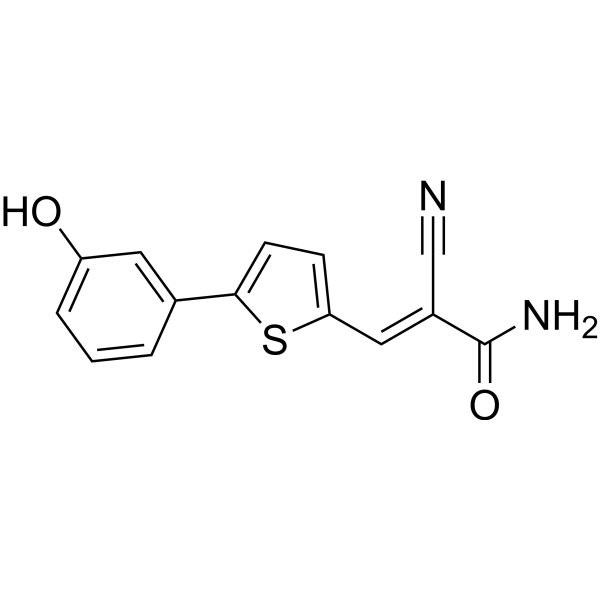 0 ImagesCat. No.: HY-154919Purity: 98.56%DC-Y13-27 is a DC-Y13 derivative and YTHDF2 inhibitor (KD: 37.9 μM). DC-Y13-27 inhibits YTHDF2, restores FOXO3 and TIMP1 protein levels, and reduces MMP1/3/7/9 expression. DC-Y13-27 induces Pyroptosis and increases IL-1β secretion. DC-Y13-27 reduces intervertebral disc degeneration and enhances the response to radiotherapy in colon cancer and melanoma. DC-Y13-27 has antitumor activity against breast cancer.




