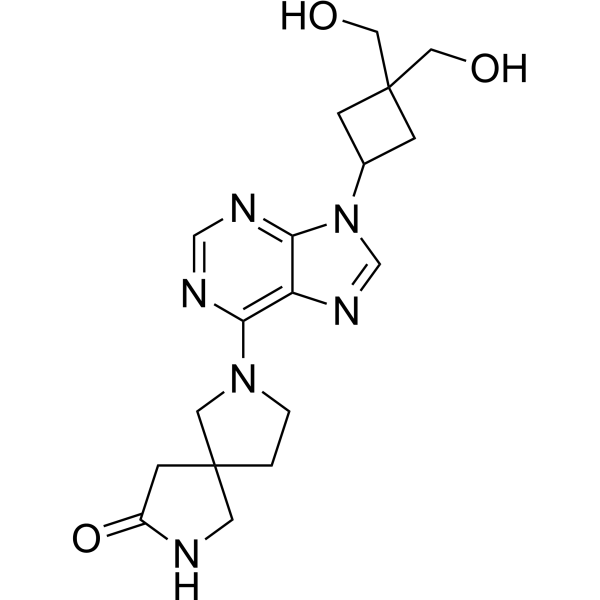
YTHDF2
YTHDF2 is a cytoplasmic m6A reader that controls m6A-modified RNA fate through mRNA degradation and, in selected contexts, translation regulation[1][2]. Mechanistically, YTHDF2-mediated mRNA decay targets multiple TGF-β signaling components in early postnatal mouse hippocampal neural stem cells, thereby limiting quiescence acquisition and supporting neurogenesis[1]. In glioma models, YTHDF2 accelerates UBXN1 mRNA degradation through METTL3-mediated m6A recognition, activates NF-κB signaling, and promotes malignant progression[3]. In glioblastoma stem cells, YTHDF2 instead stabilizes MYC and VEGFA transcripts, identifies a cancer-specific dependency, and links the YTHDF2-MYC-IGFBP3 axis to tumor growth[2]. Compared with related YTHDF isoforms, YTHDF proteins share m6A-reader activity but display distinct cellular functions because their low-complexity N termini, post-translational modifications, subcellular localization, and partner competition differ[4]. For experimental applications, linsitinib preferentially targeted YTHDF2-expressing glioblastoma stem cells, while a YTHDF2-specific small-molecule inhibitor suppressed tumor-cell translation and reversed paclitaxel resistance in ovarian cancer models[2][5].
Références:
- [1]. Zhang F, et al. m6A/YTHDF2-mediated mRNA decay targets TGF-β signaling to suppress the quiescence acquisition of early postnatal mouse hippocampal NSCs. Cell Stem Cell. 2025 Jan 2;32(1):144-156.e8. [Content Brief]
- [2]. Dixit D, et al. The RNA m6A Reader YTHDF2 Maintains Oncogene Expression and Is a Targetable Dependency in Glioblastoma Stem Cells. Cancer Discov. 2021 Feb;11(2):480-499. [Content Brief]
- [3]. Chai RC, et al. YTHDF2 facilitates UBXN1 mRNA decay by recognizing METTL3-mediated m6A modification to activate NF-κB and promote the malignant progression of glioma. J Hematol Oncol. 2021 Jul 10;14(1):109. [Content Brief]
- [4]. Zou Z, et al. The YTHDF proteins display distinct cellular functions on m6A-modified RNA. Trends Biochem Sci. 2024 Jul;49(7):611-621. [Content Brief]
- [5]. Liu T, et al. The RNA-stability-independent role of the RNA m6A reader YTHDF2 in promoting protein translation to confer tumor chemotherapy resistance. Mol Cell. 2025 Jun 19;85(12):2320-2336.e9. [Content Brief]
-
YTHDF2 Produits associés (9)
Produits associés (9)

-
DC-Y13-27
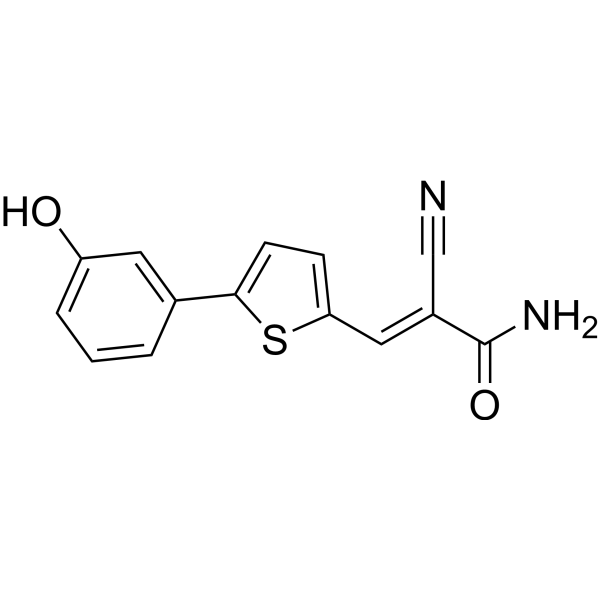 0 ImagesCat. No.: HY-154919Pureté: 98.56%DC-Y13-27 is a DC-Y13 derivative and YTHDF2 inhibitor (KD: 37.9 μM). DC-Y13-27 inhibits YTHDF2, restores FOXO3 and TIMP1 protein levels, and reduces MMP1/3/7/9 expression. DC-Y13-27 induces Pyroptosis and increases IL-1β secretion. DC-Y13-27 reduces intervertebral disc degeneration and enhances the response to radiotherapy in colon cancer and melanoma. DC-Y13-27 has antitumor activity against breast cancer.
-
SK-3-91
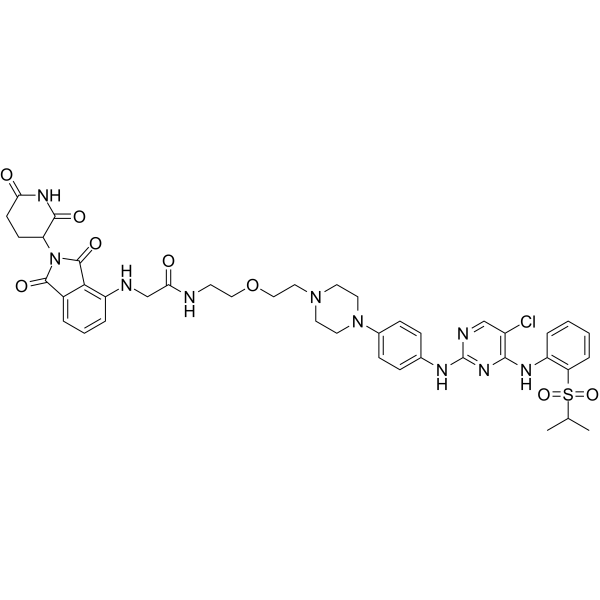 0 ImagesSK-3-91 is a multi-kinase PROTAC degrader that induces the degradation of the maximum number of unique kinases (over 125 distinct kinases) simultaneously. SK-3-91 induces protein degradation via the ubiquitin biotinylation (E-STUB) pathway, such as inducing the degradation of YTHDF2. SK-3-91 also inhibits cell proliferation and induces cell morphological changes. SK-3-91 can be used in research related to acute lymphoblastic leukemia, multiple myeloma, neuroblastoma, ovarian cancer, mantle cell lymphoma, and gastric cancer.
-
YTHDF2-IN-1
 0 ImagesCat. No.: HY-173008Pureté: 99.42%YTHDF2-IN-1 (Compound CK-75) is a selective YTHDF2 inhibitor (Kd = 26.2 μM). YTHDF2-IN-1 binds to a small hydrophobic pocket on the YTH domain of YTHDF2, disrupting the interaction between YTHDF2 and m6A-modified RNA. YTHDF2-IN-1 induces cell cycle arrest and Apoptosis. YTHDF2-IN-1 is applicable to research on chronic myeloid leukemia, colon cancer and choriocarcinoma.

-
SKLB-Y13
 0 ImagesCat. No.: HY-176848Pureté: 98.44%SKLB-Y13 is a selective YTHDF1 inhibitor with an IC50 of 0.76 μM and a KD of 5.097 μM. SKLB-Y13 binds to the Tyr397 and Trp470 residues in the m6A-binding pocket of YTHDF1, disrupting the interaction between YTHDF1 and m6A-modified mRNA. SKLB-Y13 inhibits cancer cell proliferation and promotes apoptosis. SKLB-Y13 is applicable to breast cancer-related research.
-
PROTAC FTO degrader 1
 0 ImagesCat. No.: HY-175885PROTAC FTO degrader 1 is a Fat Mass and Obesity-associated Protein (FTO) PROTAC degrader. PROTAC FTO degrader 1 selectively degrades FTO depending on VHL E3 ligase and ubiquitin-proteasome system. PROTAC FTO degrader 1 can increase m6A modifications on mRNAs associated with ribosome biogenesis and promote their YTHDF2-mediated decay. PROTAC FTO degrader 1 can inhibit cancer cells proliferation and induce apoptosis. PROTAC FTO degrader 1 can be used for the research of cancer, such as acute myeloid leukemia (AML).