15 Results for "

KMT2A

" in MedChemExpress (MCE) Product Catalog:
Products (15)

15 Results for "KMT2A" in MCE Product Catalog:

2
2 Cited Publications
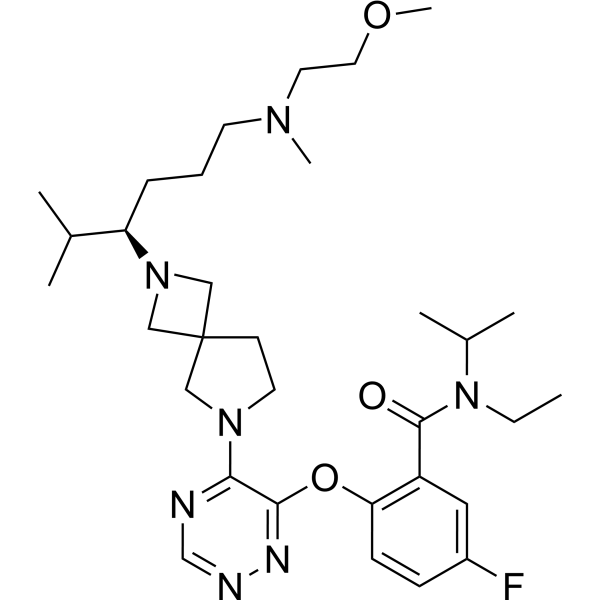
Cat. No.: HY-148669
CAS No.: 2654081-35-1
Purity:  99.05%
Synonyms: JNJ-75276617; Menin-MLL inhibitor 24
Research Areas:  

Cancer

Bleximenib (JNJ-75276617) is an orally active and selective menin-KMT2A inhibitor, with IC50 values of 0.1 nM, 0.045 nM, and ≤0.066 nM for humans, mice, and dogs, respectively. Bleximenib can inhibit the proliferation and induce apoptosis and differentiation of tumor cells. Bleximenib can be used in the research of tumors such as leukemia [2].
2
2 Cited Publications
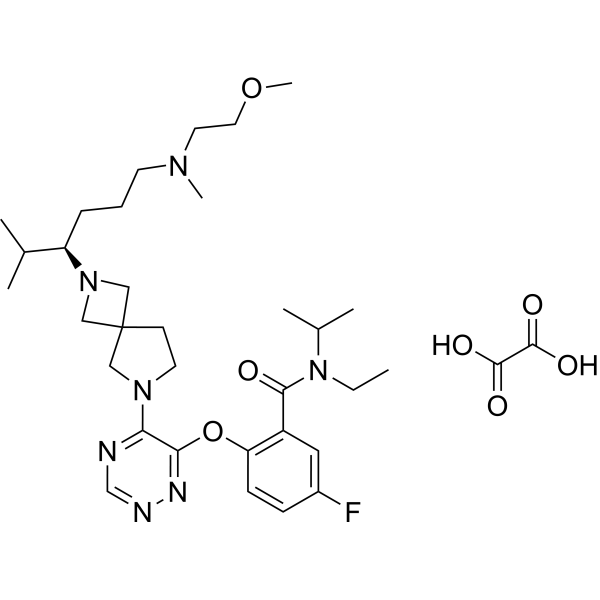
Cat. No.: HY-148669A
CAS No.: 2866179-95-3
Purity:  ≥98.0%
Synonyms: JNJ-75276617 oxalate; Menin-MLL inhibitor 24 oxalate
Research Areas:  

Cancer

Bleximenib (JNJ-75276617) oxalate is an orally active and selective menin-KMT2A inhibitor, with IC50 values of 0.1 nM, 0.045 nM, and ≤0.066 nM for humans, mice, and dogs, respectively. Bleximenib oxalate can inhibit the proliferation and induce apoptosis and differentiation of tumor cells. Bleximenib oxalate can be used in the research of tumors such as leukemia [2].
Cat. No.: HY-156794
CAS No.: 2412555-70-3
Purity:  99.88%
Synonyms: DSP-5336
Research Areas:  

Cancer

Enzomenib (DSP-5336) is an orally active Menin inhibitor (IC50=1.4 nM, Kd=6.0 nM). Enzomenib disrupts the interaction between Menin and KMT2A/MLL fusion proteins, specifically inhibits the expression of leukemia driver genes such as HOX/MEIS1, and upregulates ITGAM. Enzomenib effectively induces cell differentiation, inhibits tumor cell proliferation, and suppresses primitive cell colony formation. Enzomenib reduces disease burden and prolongs survival, but causes adverse reactions including differentiation syndrome and QTc interval prolongation. Enzomenib is used for research on relapsed/refractory acute myeloid leukemia, acute lymphoblastic leukemia, and other hematologic malignancies with mixed lineage leukemia (MLL) rearrangements or NPM1 mutations [2] .
Cat. No.: HY-172416
CAS No.: 2939850-17-4
Synonyms: ZE63-0302
Research Areas:  

Cancer

Balomenib (ZE63-0302) is an orally bioavailable menin-KMT2A interaction inhibitor. Balomenib disrupts menin-KMT2A binding, reverses aberrant HOX gene expression. Balomenib inhibits Meis1 mRNA expression in KMT2A-rearranged acute myeloid leukemia cells. Balomenib can be used for the research of leukemia .
Cat. No.: HY-RS07401
Research Areas:  

Others

KMT2A Human Pre-designed siRNA Set A contains three designed siRNAs for KMT2A gene (Human), as well as a negative control, a positive control, and a FAM-labeled negative control.

Cat. No.: HY-RS18528
Research Areas:  

Others

Kmt2a Mouse Pre-designed siRNA Set A contains three designed siRNAs for Kmt2a gene (Mouse), as well as a negative control, a positive control, and a FAM-labeled negative control.

Cat. No.: HY-RS25010
Research Areas:  

Others

Kmt2a Rat Pre-designed siRNA Set A contains three designed siRNAs for Kmt2a gene (Rat), as well as a negative control, a positive control, and a FAM-labeled negative control.

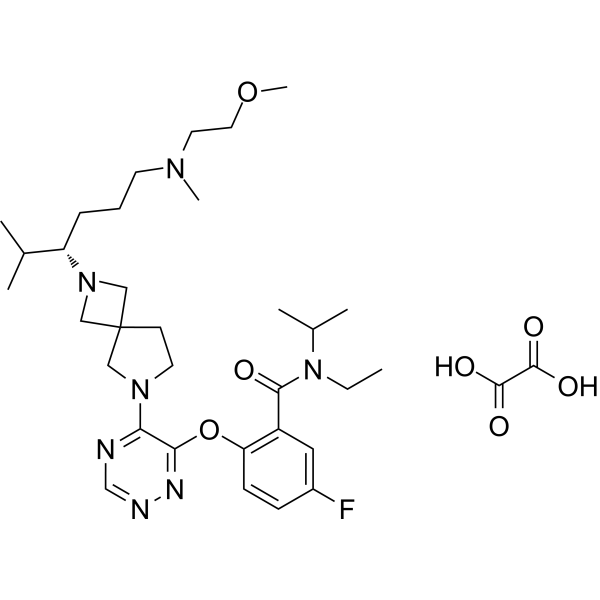
Cat. No.: HY-148669B
Purity:  98.37%
Synonyms: (S)-JNJ-75276617 oxalate; (S)-Menin-MLL inhibitor 24 oxalate
Research Areas:  

Cancer

(S)-Bleximenib (oxalate) is a S-Enantiomer of Bleximenib oxalate (HY-148669A). Bleximenib (JNJ-75276617) oxalate is an orally active and selective menin-KMT2A inhibitor, with IC50 values of 0.1 nM, 0.045 nM, and ≤0.066 nM for humans, mice, and dogs, respectively. Bleximenib oxalate can inhibit the proliferation and induce apoptosis and differentiation of tumor cells. Bleximenib oxalate can be used in the research of tumors such as leukemia .
Cat. No.: HY-170832
Research Areas:  

Cancer

Menin–KMT2A-IN-1 (Compound 20) is the inhibitor for menin–KMT2A that binds to menin with an IC50 of 8 nM, and inhibits the interaction between menin and lysine methyltransferase 2A (KMT2A). Menin–KMT2A-IN-1 inhibits hERG with an IC50 of 65 μM. Menin–KMT2A-IN-1 inhibits cell MV4-11 with an IC50 of 74 nM. Menin–KMT2A-IN-1 exhibits good pharmacokinetic characteristics in CD-1 mouse with an orally bioavailability of 74% .
Cat. No.: HY-P85279
Synonyms: MLL; ALL1; CXXC7; HRX; HTRX; KMT2A; MLL1; TRX1; Histone-lysine N-methyltransferase MLL; ALL-1; CXXC-type zinc finger protein 7; Lysine N-methyltransferase 2A; KMT2A; Trithorax-like protein; Zinc finger protein HRX

Host:  

Mouse

Application:  

IHC-P, ELISA

Reactivity:  

Human

Cat. No.: HY-P85279A
Synonyms: MLL; ALL1; CXXC7; HRX; HTRX; KMT2A; MLL1; TRX1; Histone-lysine N-methyltransferase MLL; ALL-1; CXXC-type zinc finger protein 7; Lysine N-methyltransferase 2A; KMT2A; Trithorax-like protein; Zinc finger protein HRX

Host:  

Mouse

Application:  

IHC-P, ELISA

Reactivity:  

Human

Cat. No.: HY-P84475
Synonyms: HRX; MLL; MLL1; TRX1; ALL-1; CXXC7; HTRX1; MLL1A; WDSTS

Host:  

Mouse

Application:  

IHC-P, ICC/IF, FC, ELISA

Reactivity:  

Human

Cat. No.: HY-P84475A
Synonyms: HRX; MLL; MLL1; TRX1; ALL-1; CXXC7; HTRX1; MLL1A; WDSTS

Host:  

Mouse

Application:  

IHC-P, ICC/IF, FC, ELISA

Reactivity:  

Human

Cat. No.: HY-148829
CAS No.: 2407449-49-2
Target:  

WDR5

Research Areas:  

Cancer

MS40 is a WDR5 PROTAC degrader (Kd = 125 nM). MS40 promotes the ubiquitination and degradation of WDR5. MS40-induced WDR5 degradation leads to the dissociation of the MLL/KMT2A complex from chromatin, resulting in decreased H3K4me2 levels. MS40 can be used in the study of primary leukemia .
Cat. No.: HY-156794A
Synonyms: DSP-5336 enantiomer
Enzomenib enantiomer (DSP-5336 enantiomer) is an enantiomer of Enzomenib (HY-156794). Enzomenib (DSP-5336) is an orally active Menin inhibitor (IC50=1.4 nM, Kd=6.0 nM). Enzomenib disrupts the interaction between Menin and KMT2A/MLL fusion proteins, specifically inhibits the expression of leukemia driver genes such as HOX/MEIS1, and upregulates ITGAM. Enzomenib effectively induces cell differentiation, inhibits tumor cell proliferation, and suppresses primitive cell colony formation. Enzomenib reduces disease burden and prolongs survival, but causes adverse reactions including differentiation syndrome and QTc interval prolongation. Enzomenib is used for research on relapsed/refractory acute myeloid leukemia, acute lymphoblastic leukemia, and other hematologic malignancies with mixed lineage leukemia (MLL) rearrangements or NPM1 mutations [2] .
  • 1

