



Virtual Screening
In the last decades, high-throughput screening (HTS), which refers the experimental screening of large libraries of chemicals against a biological target, plays a crucial role in the identification of new lead compounds in the early-stage drug discovery. However, HTS requires expensive equipment and facilities, and its success depends on the size of the compound library. The high cost and low hit rate associated with HTS have stimulated the development of in silico virtual screening (VS). Virtual screening is a computational technique used to search libraries of small molecules in order to identify those structures which are most likely to bind to a drug target. Nowadays, it has become a crucial step in early-stage drug discovery owing to its unique advantages over experimental HTS: drug target-relevant, competitive price and efficient.
MedChemExpress (MCE) provides high quality virtual screening service that enables researchers to identify most promising candidates. Based on the laws of quantum and molecular physics, our virtual screening services can achieve highly accurate results. Our optimized virtual screening protocol can reduce the size of chemical library to be screened experimentally, increase the likelihood to find innovative hits in a faster and less expensive manner, and mitigate the risk of failure in the lead optimization process.
Publications Citing Use of MCE Virtual Screening (Part)
- Signal Transduct Target Ther. 2025 Oct 7;10(1):333.
- Circulation. 2025 Sep 23;152(12):882-898.
- Cell Death Differ. 2025 Apr;32(4):613-631.
- Adv Sci (Weinh). 2025 Aug;12(31):e14902.
- Adv Sci (Weinh). 2025 Jul 17:e07167.
- Adv Sci (Weinh). 2025 Jul 16:e17278.
- Nat Chem Biol. 2025 Jun 2.
- Theranostics. 2025 Mar 18;15(9):4188–4211.
- Environment International 198 (2025) 109442
- Cell Death Dis. 2025 Apr 29;16(1):351.
- NPJ Biofilms Microbiomes. 2025 Mar 7;11(1):40.
- Nat Commun. 2024 Jan 2;15(1):9.
- Nat Commun. 2024 May 17;15(1):4216.
- Adv Sci (Weinh). 2024 Oct;11(39):e2402115.
- Adv Sci (Weinh). 2025 Feb;12(6):e2410525
- Theranostics. 2024 Jul 1;14(10):3984-3996.
- J Hematol Oncol. 2022 Jul 14;15(1):93.
- Theranostics. 2022 Sep 6;12(15):6509-6526.
- Cancer Lett. 2022 Oct 10:546:215851.
- J Transl Med. 2024 Feb 21;22(1):192
Types
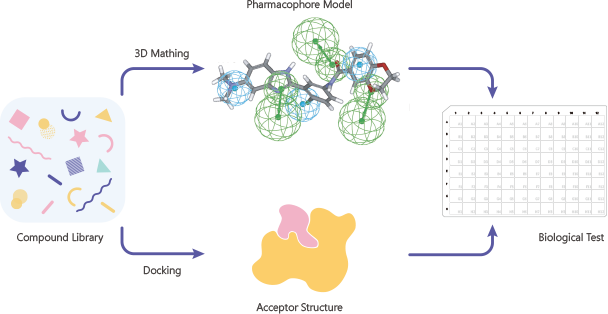
The virtual screening methods are mainly divided into two types: structure-based virtual screening (SBVS) and ligand-based virtual screening (LBVS).
• SBVS
The general scheme of a SBVS strategy starts with processing the 3D target structural information of pharmaceutical protein interested (determined either experimentally or computationally through homology modeling) and then dock the small molecules to targeted binding sites. These docked compounds are then ranked based on their predicted binding affinity or complementarity to the binding site, as well as other criteria. Usually only a few top-ranked compounds are selected as candidates for further experimental assays. Our fast and accurate ligand docking and scoring procedures lead to efficient virtual screening.
• LBVS
In the absence of 3D structures of potential drug targets, LBVS is one of the most popular approaches for drug discovery and lead optimization. Biological data are explored in order to identify known active or inactive compounds that will be used to retrieve other potentially active molecular scaffolds for experimental evaluation. LBVS methods include approaches such as similarity and substructure searching, quantitative structure-activity relationships (QSAR), pharmacophore mapping, and machine learning.
Screening Process
• Target research
• Model building
• Preparation of small molecule compound library
• Molecular docking/pharmacophore mapping
• Scoring/ranking
• Compound selection
Advantages
• Ligand-based and structure-based virtual screening
• Super high-performance computer
• Compound database containing over 16 million purchasable compounds
• 3D pharmacophore model building
• Consideration of water and solvation effects

Compound Databases
| Cat. No. | Name | Size | Description |
|---|
MedChemExpress (MCE) virtual screening services can significantly improve the hit rates and reduce the costs of compound screening. If you have any questions, please do not hesitate to contact us via email [email protected].