



CSRP3 Protein, Human (HEK293, His)
CSRP3 Protein, Human (HEK293, His) is the recombinant human-derived CSRP3 protein, expressed by HEK293, with C-6*His tag.
- Species: Human
- Source: HEK293
-
Speicherung:Stored at -20°C for 2 years from date of receipt. After reconstitution, it is stable at 4°C for 1 week or -20°C for longer (with carrier protein). It is recommended to freeze aliquots at -20°C or -80°C for extended storage.


-
 Biologische Aktivität
-
Technical Parameters
-
Product Properties
- Documentation
- Help & FAQs



Biologische Aktivität
CSRP3 Protein, Human (HEK293, His) is the recombinant human-derived CSRP3 protein, expressed by HEK293, with C-6*His tag.
CSRP3 is a positive regulator of myogenesis, acting as a cofactor for myogenic bHLH transcription factors such as MYOD1, and likely MYOG and MYF6. It enhances the DNA-binding activity of the MYOD1:TCF3 isoform E47 complex and may promote the formation of a functional MYOD1:TCF3 isoform E47:MEF2A complex involved in myogenesis (By similarity). In cardiomyocytes, CSRP3 plays a crucial and specific role in organizing cytosolic structures, potentially sensing mechanical stretch, and functioning as a scaffold protein to facilitate the assembly of interacting proteins at Z-line structures. It is essential for calcineurin anchorage to the Z line and required for stress-induced calcineurin-NFAT activation (By similarity). The role of CSRP3 in regulating cytoskeleton dynamics via interaction with CFL2 is controversially reported: it can enhance CFL2-mediated F-actin depolymerization depending on the CSRP3:CFL2 molecular ratio, but also reduces the ability of CLF1 and CFL2 to promote actin depolymerization. CSRP3 may maintain muscle cell integrity through an actin-based mechanism, directly binding to actin filaments, cross-linking them into non-polar bundles, and protecting them from dilution- and cofilin-mediated depolymerization (a function potentially involving self-association). In vitro, CSRP3 inhibits PKC/PRKCA activity and is proposed to modulate cardiac stress signaling by suppressing excessive PKC/PRKCA signaling (By similarity).

Technical Parameters
-
Species Human
-
Source HEK293
-
Tag C-6*His
-
Accession
P50461-1 (M1-E194)
-
Gene ID8048
-
Molecular Construction
-
N-term
-
CSRP3 (M1-E194)
Accession # P50461-1 -
6*His
-
C-term
-
-
Protein Length
Full Length of Isoform-1
-
Synonyms
Cysteine and glycine-rich protein 3; CSRP3; Cysteine and glycine-rich protein 3
-
AA Sequence
MPNWGGGAKCGACEKTVYHAEEIQCNGRSFHKTCFHCMACRKALDSTTVAAHESEIYCKVCYGRRYGPKGIGYGQGAGCLSTDTGEHLGLQFQQSPKPARSVTTSNPSKFTAKFGESEKCPRCGKSVYAAEKVMGGGKPWHKTCFRCAICGKSLESTNVTDKDGELYCKVCYAKNFGPTGIGFGGLTQQVEKKE
-
Predicted Molecular Mass
21 kDa
-
Molecular Weight
Approximately 23 kDa, based on SDS-PAGE under reducing conditions.
-
Reinheit
≥ 95%, as determined by reducing SDS-PAGE.
-
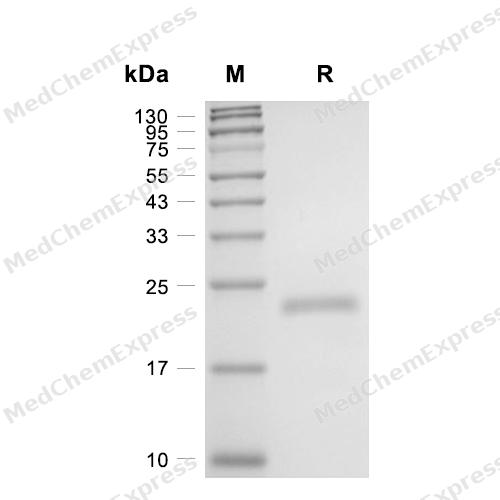 ≥ 95%, as determined by reducing SDS-PAGE.
-

Product Properties
Lyophilized powder.
Lyophilized from a 0.22 μm filtered solution of PBS, pH 7.4, 10% glycerol, 8% trehalose.
<1 EU/μg, determined by LAL method.
It is not recommended to reconstitute to a concentration less than 100 μg/mL in ddH2O.
Stored at -20°C for 2 years from date of receipt. After reconstitution, it is stable at 4°C for 1 week or -20°C for longer (with carrier protein). It is recommended to freeze aliquots at -20°C or -80°C for extended storage.
Room temperature in continental US; may vary elsewhere.


Documentation
-
Data Sheet (236 KB)
-
SDS (251 KB)
- English - EN (251 KB)
- Français - FR (251 KB)
- Deutsch - DE (251 KB)
- Norwegian - NO (251 KB)
- Español - ES (251 KB)
- Swedish - SV (251 KB)
- Italian - IT (251 KB)
- Portuguese - PT (251 KB)
-
Handling Instructions (2659 KB)


Calculators
Konzentration (Stammlösung) × Volumen (Stammlösung) = Konzentration (Ziellösung) × Volumen (Ziellösung)


 Powered by Bioz

