



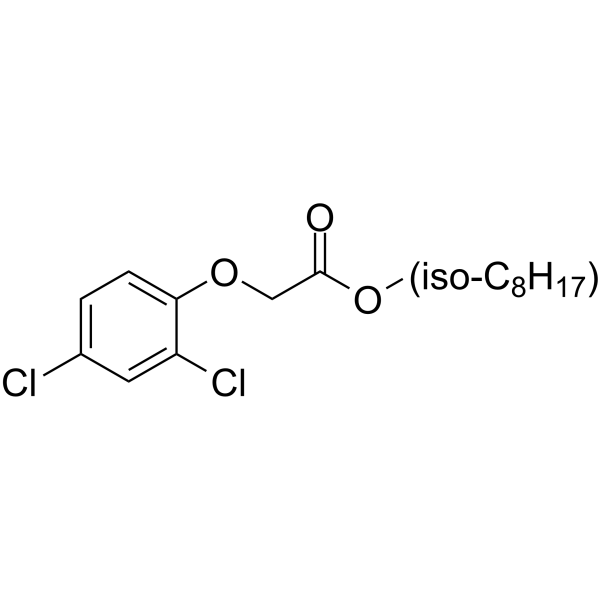
2,4-D isooctyl ester

Based on 1 Customer Validation
2,4-D isooctyl ester, a synthetic auxin herbicide, is a TIR1 protein transport inhibitor. 2,4-D isooctyl ester interacts with TIR1 to facilitate auxin signal transduction, activating auxin-mediated growth responses. 2,4-D isooctyl ester functions as a pro-herbicide bio-transformed into phytotoxic 2,4-D post-plant absorption, disrupting normal plant growth. 2,4-D isooctyl ester can be used to control broadleaf weeds.
For research use only. We do not sell to patients.
- Purity: 97.17%
- CAS No.: 25168-26-7
- Formula: C16H22Cl2O3
- Molecular Weight:333.25
-
Storage:Pure form -20°C, 3 years , 4°C, 2 years ; In solvent -80°C, 6 months , -20°C, 1 month


-
 Biological Activity
-
Chemical Information
-
Solvent & Solubility
- Purity & Documentation
- References
-
 Help & FAQs






Biological Activity
2,4-D isooctyl ester (525-8400 g a.i./ha) is more toxic to Triticum aestivum than Aegilops tauschii Coss., with a 50% growth inhibition dose of 1977 g a.i. ha-1 for T. aestivum and a value exceeding 8400 g a.i. ha-1 for A. tauschii at 30 days after treatment[1].
2,4-D isooctyl ester (4200 g a.i./ha) leads to higher accumulation of the phytotoxic metabolite 2,4-D in Triticum aestivum than Aegilops tauschii Coss., with 45.6% of absorbed herbicide converted to 2,4-D in T. aestivum at 120 h after treatment with 4200 g a.i. ha-1, a value 2.1-fold higher than in A. tauschii[1].
2,4-D isooctyl ester (4200 g a.i./ha) results in significantly higher absolute expression levels of the auxin receptor gene TIR1 in Triticum aestivum than Aegilops tauschii Coss., with levels 6.2-fold higher at 0 h and 3.1-fold higher at 12 h after treatment[1].
2,4-D isooctyl ester (525-8400 g a.i./ha) inhibits growth, photosynthesis, and tiller production in Setaria viridis L. seedlings in a dose-dependent manner, with a 50% tiller growth inhibition dose of 1836.16 g a.i./ha, and significant effects observed at concentrations ≥2100 g a.i./ha after 7 days of treatment[3].
2,4-D isooctyl ester (4200 g a.i./ha) alters the expression of 5975 genes in Setaria viridis L. tiller buds, with significant enrichment of DEGs in plant hormone signal transduction pathways, including auxin, cytokinin, ABA, GA, and brassinosteroid pathways, as well as down-regulation of SPL family genes[3].
MedChemExpress (MCE) has not independently confirmed the accuracy of these methods. They are for reference only.


Chemical Information
-
CAS No. 25168-26-7
-
Appearance Liquid
-
Molecular Weight 333.25
-
Formula C16H22Cl2O3
-
Color Colorless to light yellow
-
SMILES
O=C(O[(iso-C8H17)])COC1=CC=C(Cl)C=C1Cl
-
Shipping
Room temperature in continental US; may vary elsewhere.
-
Storage
Pure form -20°C 3 years 4°C 2 years In solvent -80°C 6 months -20°C 1 month


Solvent & Solubility
DMSO : ≥ 175 mg/mL (525.13 mM; Hygroscopic DMSO has a significant impact on the solubility of product, please use newly opened DMSO)
* "≥" means soluble, but saturation unknown.
Please refer to the solubility information to select the appropriate solvent. Once prepared, please aliquot and store the solution to prevent product inactivation from repeated freeze-thaw cycles.
Storage method and period of stock solution: -80°C, 6 months; -20°C, 1 month. When stored at -80°C, please use it within 6 months. When stored at -20°C, please use it within 1 month.
Please refer to the solubility information to select the appropriate solvent. Once prepared, please aliquot and store the solution to prevent product inactivation from repeated freeze-thaw cycles.
Storage method and period of stock solution: -80°C, 6 months; -20°C, 1 month. When stored at -80°C, please use it within 6 months. When stored at -20°C, please use it within 1 month.
Concentration (start) × Volume (start) = Concentration (final) × Volume (final)
Please enter the basic information of animal experiments:
-
-
-
-
Recommended: Prepare an additional quantity of animals to account for potential losses during experiments.
Working solution concentration: 0.22 mg/mL


Purity & Documentation
-
Data Sheet (272 KB)
-
SDS (537 KB)
- English - EN (537 KB)
- Français - FR (537 KB)
- Deutsch - DE (537 KB)
- Norwegian - NO (537 KB)
- Español - ES (537 KB)
- Swedish - SV (537 KB)
- Italian - IT (537 KB)
- Portuguese - PT (537 KB)
-
Handling Instructions (2659 KB)
References
[1]. Yu H, et al. Different leaf-mediated deposition, absorbed and metabolism behaviors of 2,4-D isooctyl ester between Triticum aestivum and Aegilops tauschii Coss. Pestic Biochem Physiol. 2021;175:104848. [Content Brief]
[2]. Liu C, et al. Dissipation and residue of 2,4-D isooctyl ester in wheat and soil. Environ Monit Assess. 2012;184(7):4247-4251. [Content Brief]
[3]. Xiong W, et al. Understanding the responses of tillering to 2,4-D isooctyl ester in Setaria viridis L. BMC Genomics. 2024;25(1):682. Published 2024 Jul 9. [Content Brief]


Complete Stock Solution Preparation Table
Please refer to the solubility information to select the appropriate solvent. Once prepared, please aliquot and store the solution to prevent product inactivation from repeated freeze-thaw cycles.
Storage method and period of stock solution: -80°C, 6 months; -20°C, 1 month. When stored at -80°C, please use it within 6 months. When stored at -20°C, please use it within 1 month.
| Optional Solvent | Concentration Solvent Mass | 1 mg | 5 mg | 10 mg | 25 mg |
|---|---|---|---|---|---|
| DMSO | 1 mM | 3.0008 mL | 15.0038 mL | 30.0075 mL | 75.0188 mL |
| 5 mM | 0.6002 mL | 3.0008 mL | 6.0015 mL | 15.0038 mL | |
| 10 mM | 0.3001 mL | 1.5004 mL | 3.0008 mL | 7.5019 mL | |
| 15 mM | 0.2001 mL | 1.0003 mL | 2.0005 mL | 5.0013 mL | |
| 20 mM | 0.1500 mL | 0.7502 mL | 1.5004 mL | 3.7509 mL | |
| 25 mM | 0.1200 mL | 0.6002 mL | 1.2003 mL | 3.0008 mL | |
| 30 mM | 0.1000 mL | 0.5001 mL | 1.0003 mL | 2.5006 mL | |
| 40 mM | 0.0750 mL | 0.3751 mL | 0.7502 mL | 1.8755 mL | |
| 50 mM | 0.0600 mL | 0.3001 mL | 0.6002 mL | 1.5004 mL | |
| 60 mM | 0.0500 mL | 0.2501 mL | 0.5001 mL | 1.2503 mL | |
| 80 mM | 0.0375 mL | 0.1875 mL | 0.3751 mL | 0.9377 mL | |
| 100 mM | 0.0300 mL | 0.1500 mL | 0.3001 mL | 0.7502 mL |


 Powered by Bioz