



Delta-like protein 4/DLL4 Protein, Human (HEK293, His)
Based on 1 Customer Validation
Delta-like protein 4 (DLL4) functions as a Notch ligand and activates NOTCH1 and NOTCH4 in the Notch signaling pathway. It regulates angiogenesis by inhibiting endothelial cell proliferation, migration, and angiogenesis. Delta-like protein 4/DLL4 Protein, Human (HEK293, His) is the recombinant human-derived Delta-like protein 4/DLL4 protein, expressed by HEK293 , with C-His labeled tag.
- Species: Human
- Source: HEK293
-
Almacenamiento:Stored at -20°C for 2 years from date of receipt. After reconstitution, it is stable at 4°C for 1 week or -20°C for longer (with carrier protein). It is recommended to freeze aliquots at -20°C or -80°C for extended storage.



-
 Actividad biológica
-
Technical Parameters
-
Product Properties
- Documentación
- Help & FAQs



Actividad biológica
Delta-like protein 4 (DLL4) functions as a Notch ligand and activates NOTCH1 and NOTCH4 in the Notch signaling pathway. It regulates angiogenesis by inhibiting endothelial cell proliferation, migration, and angiogenesis. Delta-like protein 4/DLL4 Protein, Human (HEK293, His) is the recombinant human-derived Delta-like protein 4/DLL4 protein, expressed by HEK293 , with C-His labeled tag.
Delta-like protein 4 (DLL4) is a key participant in the Notch signaling pathway, acting as a Notch ligand with functional implications. It specifically activates NOTCH1 and NOTCH4, contributing to the intricate cellular communication within this signaling cascade. Beyond its role in Notch signaling, DLL4 emerges as a crucial regulator of angiogenesis, exerting a negative influence on endothelial cell proliferation, migration, and angiogenic sprouting. The protein's indispensability extends to retinal progenitor proliferation, where it plays a vital role in suppressing rod fates in late retinal progenitors and ensuring the proper generation of diverse retinal cell types. Additionally, during spinal cord neurogenesis, DLL4 inhibits V2a interneuron fate, adding another layer to its multifaceted functions. The molecular interactions involving DLL4 include its engagement with NOTCH4 and NOTCH1, facilitated by specific domains in DLL4 and NOTCH1, respectively.
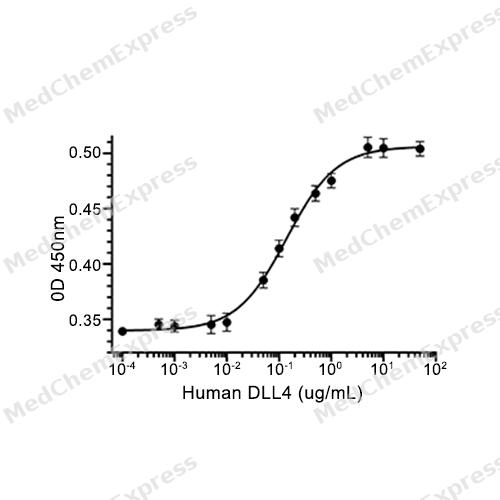
1. Measured by the ability of the immobilized protein to enhance BMP-2 induced alkaline phosphatase activity in C3H10T1/2 mouse embryonic fibroblast cells. The ED50 for this effect is 0.1385 μg/mL in the presence of 100 ng/mL BMP-2, corresponding to a specific activity is 7.220×10³ units/mg.
2. Measured by the ability of the immobilized protein to enhance BMP-2 induced alkaline phosphatase activity in C3H10T1/2 mouse embryonic fibroblast cells. The ED50 for this effect is 0.1-0.3 μg/mL in presence of 200 ng/mL BMP-2, corresponding to a specific activity is 5.126×10³ units/mg.
-
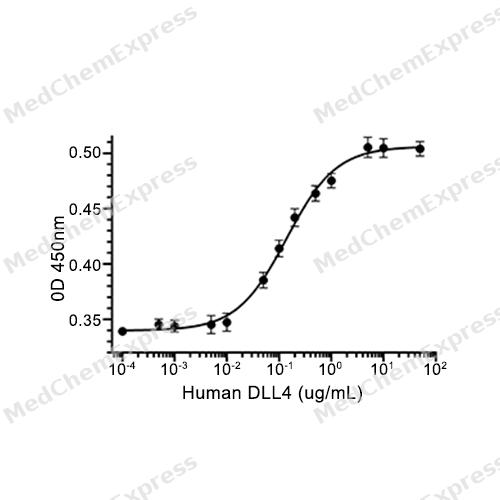 Measured by the ability of the immobilized protein to enhance BMP-2 induced alkaline phosphatase activity in C3H10T1/2 mouse embryonic fibroblast cells. The ED50 for this effect is approximately 0.1385 μg/mL in the presence of 100 ng/mLMouse BMP-2, corresponding to a specific activity is 7.220×10³ units/mg.

Technical Parameters
-
Species Human
-
Source HEK293
-
Tag C-His
-
Accession
Q9NR61/NP_061947.1 (S27-P524)
-
Molecular Construction
-
N-term
-
DLL4 (S27-P524)
Accession # Q9NR61/NP_061947.1 -
His
-
C-term
-
-
Protein Length
Partial
-
Synonyms
rHuDelta-like protein 4/DLL4, His; Delta-like protein 4; Drosophila Delta homolog 4; Delta4; DLL4
-
AA Sequence
SGVFQLQLQEFINERGVLASGRPCEPGCRTFFRVCLKHFQAVVSPGPCTFGTVSTPVLGTNSFAVRDDSSGGGRNPLQLPFNFTWPGTFSLIIEAWHAPGDDLRPEALPPDALISKIAIQGSLAVGQNWLLDEQTSTLTRLRYSYRVICSDNYYGDNCSRLCKKRNDHFGHYVCQPDGNLSCLPGWTGEYCQQPICLSGCHEQNGYCSKPAECLCRPGWQGRLCNECIPHNGCRHGTCSTPWQCTCDEGWGGLFCDQDLNYCTHHSPCKNGATCSNSGQRSYTCTCRPGYTGVDCELELSECDSNPCRNGGSCKDQEDGYHCLCPPGYYGLHCEHSTLSCADSPCFNGGSCRERNQGANYACECPPNFTGSNCEKKVDRCTSNPCANGGQCLNRGPSRMCRCRPGFTGTYCELHVSDCARNPCAHGGTCHDLENGLMCTCPAGFSGRRCEVRTSIDACASSPCFNRATCYTDLSTDTFVCNCPYGFVGSRCEFPVGLP
-
Peso molecular
Approximately 55-70 kDa, based on SDS-PAGE under reducing conditions, due to the glycosylation.
-
Glycosylation
Yes
-
Pureza
≥ 95%, as determined by reducing SDS-PAGE.
-
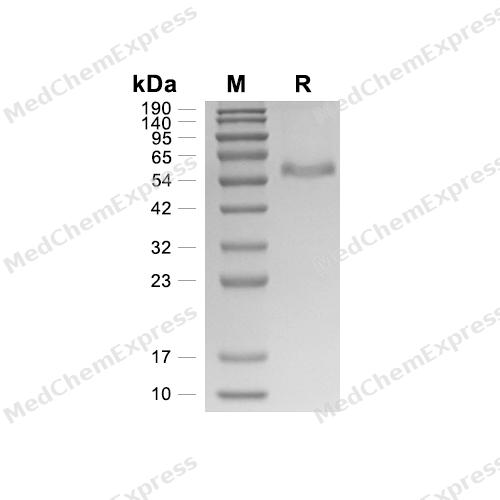 ≥ 95%, as determined by reducing SDS-PAGE.
-

Product Properties
Lyophilized powder
1.Lyophilized from a 0.22 μm filtered solution of 20 mM Tirs-HCl,150 mM NaCl, pH 8.0.
2.Lyophilized from a 0.22 μm filtered solution of PBS, pH 7.4.
Please refer to the lot-specific COA for specific buffer information.
<1 EU/μg, determined by LAL method.
It is not recommended to reconstitute to a concentration less than 100 μg/mL in ddH2O.
Stored at -20°C for 2 years from date of receipt. After reconstitution, it is stable at 4°C for 1 week or -20°C for longer (with carrier protein). It is recommended to freeze aliquots at -20°C or -80°C for extended storage.
Room temperature in continental US; may vary elsewhere.


Documentación
-
Ficha de datos (239 KB)
-
SDS (252 KB)
- English - EN (252 KB)
- Français - FR (252 KB)
- Deutsch - DE (252 KB)
- Norwegian - NO (252 KB)
- Español - ES (252 KB)
- Swedish - SV (252 KB)
- Italian - IT (252 KB)
- Portuguese - PT (252 KB)
-
Instrucciones de manejo (2659 KB)


Calculators
Concentration (start) × Volume (start) = Concentration (final) × Volume (final)


 Powered by Bioz

