10 Results for "

Technetium

" in MedChemExpress (MCE) Product Catalog:
Products (10)

10 Results for "Technetium" in MCE Product Catalog:

1
1 Cited Publications
Cat. No.: HY-47979
CAS No.: 2471983-20-5
Target:  

FAP

Research Areas:  

Cancer

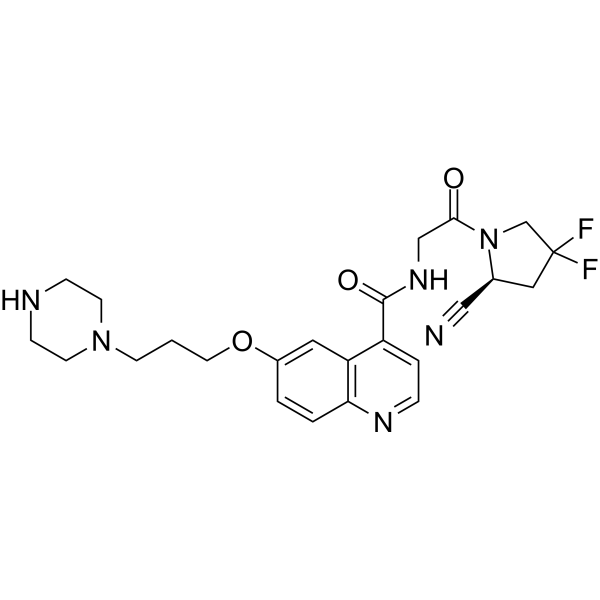
FAP-IN-2 is an isonitrile-containing fibroblast activation protein (FAP) inhibitor. FAP-IN-2 can be labeled with technetium-99m ( 99mTc) for targeted tumor SPECT imaging .
1
1 Cited Publications
Cat. No.: HY-47979A
Target:  

FAP

Research Areas:  

Cancer

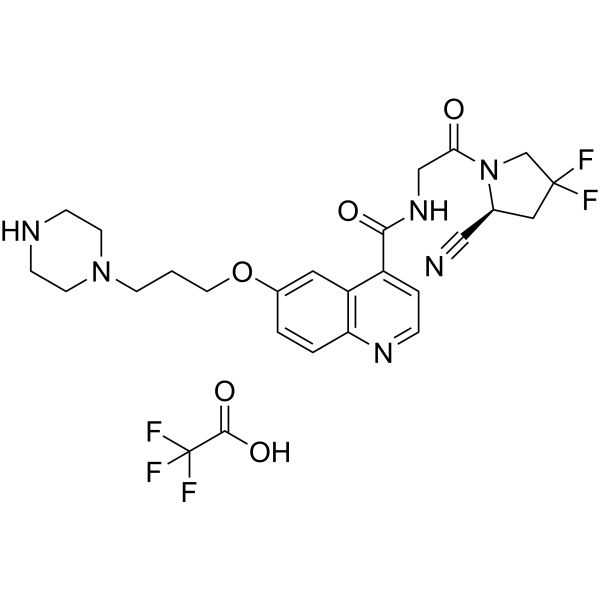
FAP-IN-2 TFA is an isonitrile-containing fibroblast activation protein (FAP) inhibitor. FAP-IN-2 TFA can be labeled with technetium-99m ( 99mTc) for targeted tumor SPECT imaging .
Cat. No.: HY-P10913
CAS No.: 1186217-15-1
Target:  

Bacterial

Research Areas:  

Infection

HYNIC-UBI29-41 is composed of a bifunctional chelator HYNIC and an antimicrobial peptide UBI 29-41 (HY-P10364) (HY-P10364). HYNIC-UBI29-41 retains the antibacterial properties of UBI 29-41, and exhibits good affinity to Gram-positive and Gram-negative bacteria. HYNIC-UBI29-41 can be used as an imaging agent for bacterial infection detection in mouse models, when labeled with the radioactive element technetium (99mTc) .
Cat. No.: HY-P10369
CAS No.: 103725-47-9
Betiatide, as a chelating agent for Technetium-99m ( 99mTc), is used to prepare 99mTc-MAG3 (mercaptoacetyltriglycine), a radiopharmaceutical for renal function imaging. Betiatide is used for the diagnosis of congenital and acquired abnormalities, renal failure, urinary tract obstructions, and calculi . Betiatide can be used for the synthesis/research of Radionuclide-Drug Conjugates (RDCs).
Cat. No.: HY-W039939
CAS No.: 56883-39-7
Synonyms: 2-ADG, 98%
2-Azido-2-deoxy-D-glucose, 98% (2-ADG, 98%) is a substrate of O-GlcNAc transferase (OGT). 2-Azido-2-deoxy-D-glucose, 98% can be transferred from UDP-GlcAz to proteins in vitro via OGT mediation. When delivered as AcGlcAz, 2-Azido-2-deoxy-D-glucose, 98% enables the labeling and investigation of O-GlcNAc-modified nuclear and cytoplasmic proteins in cells. 2-Azido-2-deoxy-D-glucose, 98% undergoes strain-promoted [3+2] azide-alkyne cycloaddition (SPAAC) with technetium- 99m-labeled dibenzocyclooctyne derivatives in vivo. 2-Azido-2-deoxy-D-glucose, 98% can be used in sarcoma-related research .
Cat. No.: HY-114133
CAS No.: 161982-62-3
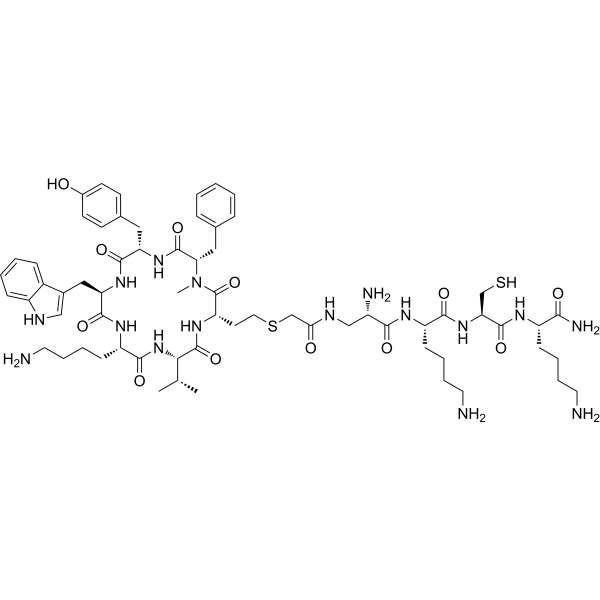
Depreotide is a nove tumor tarcer, can be complexed with technetium-99m ( 99mTc-depreotide) for optimal imaging properties. 99mTc-depreotide somatostain receptor imaging has been playing an important role in medical diagnosis research . Depreotide can be used for the synthesis/research of Radionuclide-Drug Conjugates (RDCs).
Cat. No.: HY-P10913A
Target:  

Bacterial

Research Areas:  

Infection

HYNIC-UBI29-41 TFA is composed of a bifunctional chelator HYNIC and an antimicrobial peptide UBI 29-41 (HY-P10364). HYNIC-UBI29-41 TFA retains the antibacterial properties of UBI 29-41, and exhibits good affinity to Gram-positive and Gram-negative bacteria. HYNIC-UBI29-41 TFA can be used as an imaging agent for bacterial infection detection in mouse models, when labeled with the radioactive element technetium (99mTc) .
Cat. No.: HY-200621
CAS No.: 109434-22-2
Research Areas:  

Cancer

Methoxyisobutylisonitrile is a radioactive compound that can form a complex with technetium-99m and be used as a tracer to diagnose lung lesions and malignant thyroid nodules, etc .
Cat. No.: HY-P9937
CAS No.: 154361-48-5
Synonyms: IMMU-4

Research Areas:  

Cancer

Arcitumomab is a murine anti-carcinoembryonic antigen (CEA) monoclonal antibody Fab’ fragment. Arcitumomab can be labeled with technetium-99m and can be used for single-photon emission computed tomography (SPECT) imaging .
Cat. No.: HY-W244412
CAS No.: 133081-27-3
Research Areas:  

Cancer

2,5-Dioxopyrrolidin-1-yl 6-hydrazinylnicotinate hydrochloride is an intermediate of a radionuclide molecular probe targeting the CD4 receptor. 2,5-Dioxopyrrolidin-1-yl 6-hydrazinylnicotinate hydrochloride serves as an imaging agent for heart transplant rejection. This CD4 probe is prepared by mixing leukocyte differentiation antigen 4 monoclonal antibody with a solution of 6-hydrazinylnicotinoyl succinimide ester hydrochloride, followed by extraction and reaction to obtain 6-hydrazinylnicotinate-leukocyte differentiation antigen 4 monoclonal antibody; this antibody is then mixed with N-tris (hydroxymethyl) glycine, stannous chloride and technetium for an oscillatory reaction. This CD4 probe exhibits high affinity for CD4 + T lymphocytes, along with the characteristics of high sensitivity and high specificity, enabling early diagnosis of acute rejection .

