



Azoreductase/NQO1 Protein, Human
Based on 1 publication(s) in Google Scholar
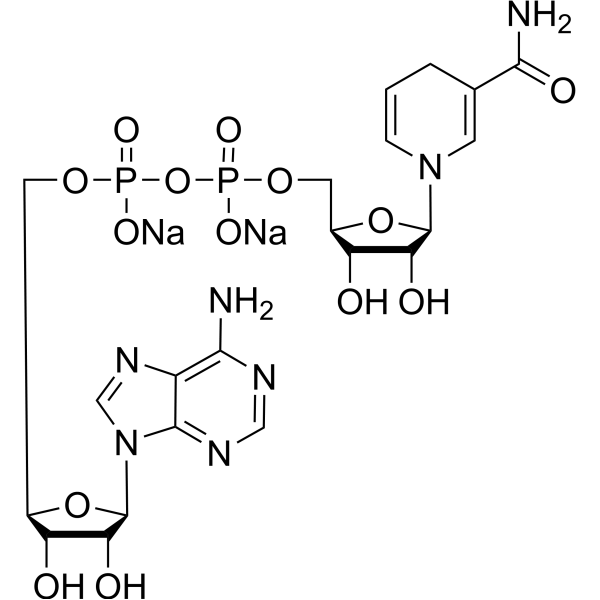
Azo reductase/NQO1 protein is a flavin-containing quinone reductase that uses NADH or NADPH to catalyze the two-electron reduction of quinone to hydroquinone. It regulates cellular redox status by detoxifying quinones and reducing plasma membrane redox components. Azoreductase/NQO1 Protein, Human is the recombinant human-derived Azoreductase/NQO1 protein, expressed by E. coli , with tag free.
- Species: Human
- Source: E. coli
-
Storage:Stored at -20°C for 2 years from date of receipt. After reconstitution, it is stable at 4°C for 1 week or -20°C for longer (with carrier protein). It is recommended to freeze aliquots at -20°C or -80°C for extended storage.


To place orders, for customer services and technical support, please contact: MedChemExpress USA
Tel: 609-228-6898 E-mail: [email protected] [email protected]


-
 Biological Activity
-
Technical Parameters
-
Product Properties
- Documentation
- Help & FAQs




Biological Activity
Description
Azo reductase/NQO1 protein is a flavin-containing quinone reductase that uses NADH or NADPH to catalyze the two-electron reduction of quinone to hydroquinone. It regulates cellular redox status by detoxifying quinones and reducing plasma membrane redox components. Azoreductase/NQO1 Protein, Human is the recombinant human-derived Azoreductase/NQO1 protein, expressed by E. coli , with tag free.
Background
Azoreductase/NQO1 protein is a flavin-containing quinone reductase that facilitates the two-electron reduction of quinones to hydroquinones, utilizing either NADH or NADPH as electron donors. Operating through a ping-pong kinetic mechanism, the electrons are sequentially transferred from NAD(P)H to the flavin cofactor and subsequently to the quinone, effectively bypassing the generation of semiquinone and reactive oxygen species. This enzymatic activity plays a crucial role in regulating cellular redox balance by detoxifying quinones. Azoreductase/NQO1 serves as a superoxide scavenger, preventing hydroquinone oxidation and supporting antioxidant defense mechanisms. Moreover, it participates in the activation of quinones, generating redox-reactive hydroquinones with potential antitumor properties through DNA cross-linking. Notably, the protein acts as a gatekeeper for the core 20S proteasome, interacting with tumor suppressors TP53 and TP73 in a NADH-dependent manner to inhibit their ubiquitin-independent degradation during oxidative stress.
Verified Bioactivity
Measured by its ability to oxidize Resazurin. The specific activity is >15,000 pmol/min/μg.
MCE Validation Data
-
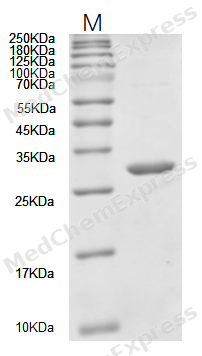
Purity - SDS-PAGE
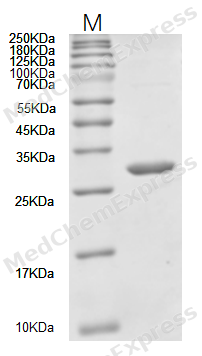
Purity - SDS-PAGE


Publications (1)
-
Journal Impact Factor
-
Most Recent


Technical Parameters
-
Species Human
-
Source E. coli
-
Tag Tag Free
-
Accession
P15559-1 (M1-K274)
-
Molecular Construction
-
N-term
-
NQO1 (M1-K274)
Accession # P15559-1 -
C-term
-
-
Protein Length
Full Length of Isoform-1
-
Synonyms
NQO1; DHQU; Prev. NMOR1; NAD(P)H Dehydrogenase, Quinone 1; Prev. DIA4; NAD(P)H-Quinone Oxidoreductase; DT-Diaphorase; NAD(P)H:Quinone Acceptor Oxidoreductase Type 1; QR1; NAD(P)H:Menadione Oxidoreductase 1; DTD; NAD(P)H:Quinone Oxireductase; NAD(P)H Dehyd
-
AA Sequence
MVGRRALIVLAHSERTSFNYAMKEAAAAALKKKGWEVVESDLYAMNFNPIISRKDITGKLKDPANFQYPAESVLAYKEGHLSPDIVAEQKKLEAADLVIFQFPLQWFGVPAILKGWFERVFIGEFAYTYAAMYDKGPFRSKKAVLSITTGGSGSMYSLQGIHGDMNVILWPIQSGILHFCGFQVLEPQLTYSIGHTPADARIQILEGWKKRLENIWDETPLYFAPSSLFDLNFQAGFLMKKEVQDEEKNKKFGLSVGHHLGKSIPTDNQIKARK
-
Predicted Molecular Mass
31 kDa
-
Molecular Weight
Approximately 33 kDa, based on SDS-PAGE under reducing conditions.
-
Purity
≥ 95%, as determined by reducing SDS-PAGE.


Product Properties
Lyophilized powder
Lyophilized from a 0.22 μm filtered solution of 50 mM Tris-HCl, 300 mM NaCl, pH 7.4, 5% trehalose, 5% mannitol and 0.01% Tween 80 or PBS, pH 7.4, 8% trehalose.
Note: For SPR assay, please replace the buffer. Primary amine components (e.g., Tris, imidazole) can affect protein-coupled chips.
<1 EU/μg, determined by LAL method.
It is not recommended to reconstitute to a concentration less than 100 μg/mL in ddH2O.
Stored at -20°C for 2 years from date of receipt. After reconstitution, it is stable at 4°C for 1 week or -20°C for longer (with carrier protein). It is recommended to freeze aliquots at -20°C or -80°C for extended storage.
Room temperature in continental US; may vary elsewhere.


Documentation
-
Data Sheet (237 KB)
-
SDS (254 KB)
- English - EN (254 KB)
- Français - FR (254 KB)
- Deutsch - DE (254 KB)
- Norwegian - NO (254 KB)
- Español - ES (254 KB)
- Swedish - SV (254 KB)
- Italian - IT (254 KB)
- Korean - KR (254 KB)
- Portuguese - PT (254 KB)
-
Handling Instructions (2659 KB)

Calculators
Concentration (start) × Volume (start) = Concentration (final) × Volume (final)


 Powered by Bioz

