



GPNMB/Osteoactivin Protein, Mouse (HEK293, His)
Based on 2 publication(s) in Google Scholar
GPNMB/bone active protein shows promise as a melanogenic enzyme, possibly involved in melanin synthesis. Its regulatory influence on melanin production highlights its critical role in pigment formation. GPNMB/Osteoactivin Protein, Mouse (HEK293, His) is the recombinant mouse-derived GPNMB/Osteoactivin protein, expressed by HEK293 , with C-His labeled tag.
- Species: Mouse
- Source: HEK293
-
Storage:Stored at -20°C for 2 years from date of receipt. After reconstitution, it is stable at 4°C for 1 week or -20°C for longer (with carrier protein). It is recommended to freeze aliquots at -20°C or -80°C for extended storage.


To place orders, for customer services and technical support, please contact: MedChemExpress USA
Tel: 609-228-6898 E-mail: [email protected] [email protected]


-
 Biological Activity
-
Technical Parameters
-
Product Properties
- Documentation
- Help & FAQs


-

HY-P70836
GPNMB/Osteoactivin Protein, Human (HEK293, His) -
HY-13818
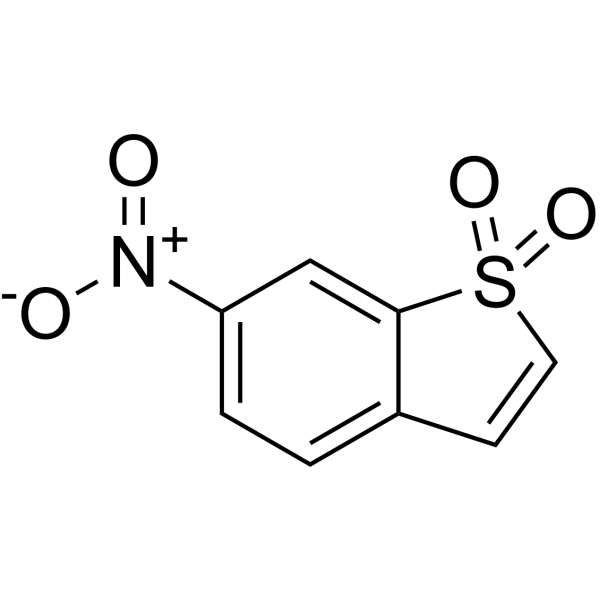
StatticSTAT3 Inhibitor -
HY-P75951
GPNMB/Osteoactivin Protein, Human (Isoform 2, HEK293, Fc) -
HY-P7118
TGF beta 1/TGFB1 Protein, Human (CHO) -
HY-P75174A
GAS6 Protein, Mouse (HEK293, His) -
HY-N7142
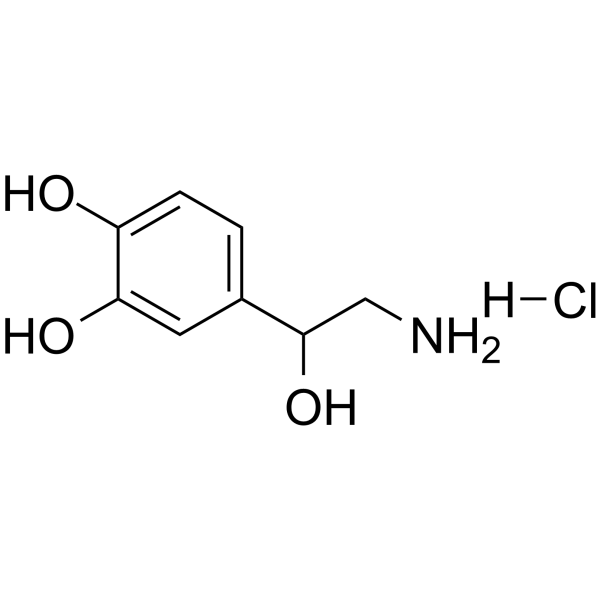
DL-Norepinephrine hydrochlorideRacemic Catecholamine Neurotransmitter


Biological Activity
Description
GPNMB/bone active protein shows promise as a melanogenic enzyme, possibly involved in melanin synthesis. Its regulatory influence on melanin production highlights its critical role in pigment formation. GPNMB/Osteoactivin Protein, Mouse (HEK293, His) is the recombinant mouse-derived GPNMB/Osteoactivin protein, expressed by HEK293 , with C-His labeled tag.
Background
The GPNMB/Osteoactivin protein emerges as a promising candidate for a melanogenic enzyme, suggesting its potential involvement in the synthesis of melanin. Recent research underscores the regulatory influence of GPNMB/Osteoactivin on melanogenesis, highlighting its pivotal role in the intricate process of pigment formation. The protein's capacity to modulate melanin production emphasizes its significance in unraveling the complexities of skin biology and pigmentation pathways. Investigating the molecular mechanisms governing GPNMB/Osteoactivin's role in melanogenesis holds promise for uncovering new insights into the control of skin pigmentation, offering potential avenues for innovative approaches to address disorders associated with pigmentation.
Verified Bioactivity
Measured by the ability of the immobilized protein to support the adhesion of SVEC4-10 mouse vascular endothelial cells. When 5× 10⁴ cells/well are added to GPNMB-coated plates (0.25 μg/mL and 100 μL/well), approximately >22.59% will adhere after 30 minutes at 37°C.
MCE Validation Data
-
Purity - SDS-PAGE

Purity - SDS-PAGE


Publications (2)
-
Journal Impact Factor
-
Most Recent
-
Cell
Comprehensive human proteome profiles across a 50-year lifespan reveal aging trajectories and signatures. [Abstract]2025 Oct 2;188(20):5763-5784.e26. PMID: 40713952 -
Nat Neurosci
Microglial mitochondria transfer to astrocytes via GPNMB-enriched extracellular vesicles alleviates cognitive deficits in tauopathy mice. [Abstract]2026 Jul;29(7):1573-1584. PMID: 42192197


Technical Parameters
-
Species Mouse
-
Source HEK293
-
Tag C-His
-
Accession
Q99P91 (K23-N502)
-
Molecular Construction
-
N-term
-
GPNMB (K23-N502)
Accession # Q99P91 -
His
-
C-term
-
-
Protein Length
Extracellular Domain
-
Synonyms
GPNMB; Glycoprotein Nonmetastatic Melanoma Protein B; Glycoprotein Nmb; Osteoactivin; HGFIN; Hematopoietic Growth Factor Inducible Neurokinin-1; NMB; Transmembrane Glycoprotein HGFIN; Glycoprotein (Transmembrane) Nmb; Uncharacterized Protein GPNMB; Transm
-
AA Sequence
KRFRDVLGHEQYPDHMREHNQLRGWSSDENEWDEHLYPVWRRGDGRWKDSWEGGRVQAVLTSDSPALVGSNITFVVNLVFPRCQKEDANGNIVYEKNCRNDLGLTSDLHVYNWTAGADDGDWEDGTSRSQHLRFPDRRPFPRPHGWKKWSFVYVFHTLGQYFQKLGRCSARVSINTVNLTAGPQVMEVTVFRRYGRAYIPISKVKDVYVITDQIPVFVTMSQKNDRNLSDEIFLRDLPIVFDVLIHDPSHFLNDSAISYKWNFGDNTGLFVSNNHTLNHTYVLNGTFNLNLTVQTAVPGPCPPPSPSTPPPPSTPPSPPPSPLPTLSTPSPSLMPTGYKSMELSDISNENCRINRYGYFRATITIVEGILEVSIMQIADVPMPTPQPANSLMDFTVTCKGATPMEACTIISDPTCQIAQNRVCSPVAVDGLCLLSVRRAFNGSGTYCVNFTLGDDASLALTSTLISIPGKDPDSPLRAVN
-
Predicted Molecular Mass
54.4 kDa
-
Molecular Weight
Approximately 80-115 kDa, based on SDS-PAGE under reducing conditions, due to the glycosylation.
-
Glycosylation
Yes
-
Purity
≥ 95%, as determined by reducing SDS-PAGE.


Product Properties
Lyophilized powder
Lyophilized from a 0.22 μm filtered solution of 20 mM PB, 150 mM NaCl, pH 7.4, 8% trehalose.
<1 EU/μg, determined by LAL method.
It is not recommended to reconstitute to a concentration less than 100 μg/mL in ddH2O.
Stored at -20°C for 2 years from date of receipt. After reconstitution, it is stable at 4°C for 1 week or -20°C for longer (with carrier protein). It is recommended to freeze aliquots at -20°C or -80°C for extended storage.
Room temperature in continental US; may vary elsewhere.


Documentation
-
Data Sheet (239 KB)
-
SDS (254 KB)
- English - EN (254 KB)
- Français - FR (254 KB)
- Deutsch - DE (254 KB)
- Norwegian - NO (254 KB)
- Español - ES (254 KB)
- Swedish - SV (254 KB)
- Italian - IT (254 KB)
- Korean - KR (254 KB)
- Portuguese - PT (254 KB)
-
Handling Instructions (2659 KB)

Calculators
Concentration (start) × Volume (start) = Concentration (final) × Volume (final)


 Powered by Bioz

