



Irisin Protein, Human/Mouse/Rat (HEK293, Fc)
Based on 1 publication(s) in Google Scholar
Irisin Protein is an important cytokine secreted by muscles during exercise, which has multiple functions such as regulating metabolism and improving health. Irisin Protein, Human/Mouse/Rat (HEK293, Fc) is a recombinant Irisin Protein expressed by HEK293 and carrying a C-hFc tag.
- Species: Rat; Mouse; Human
- Source: HEK293
-
Storage:Stored at -20°C for 2 years from date of receipt. After reconstitution, it is stable at 4°C for 1 week or -20°C for longer (with carrier protein). It is recommended to freeze aliquots at -20°C or -80°C for extended storage.


-
 Biological Activity
-
Technical Parameters
-
Product Properties
- Documentation
- References
- Help & FAQs



Biological Activity
Irisin Protein is an important cytokine secreted by muscles during exercise, which has multiple functions such as regulating metabolism and improving health. Irisin Protein, Human/Mouse/Rat (HEK293, Fc) is a recombinant Irisin Protein expressed by HEK293 and carrying a C-hFc tag[1][2][3].
Irisin is a myokine secreted by skeletal muscles that promotes fat metabolism, induces browning of white adipose tissue, participates in liver metabolism, and maintains glucose and lipid homeostasis. Additionally, Irisin can protect the cardiovascular system, skeletal muscles, and exert neuroprotective effects. The main receptor for Irisin is integrin αV/β5, which mediates its actions in tissues such as adipose, liver, and bone[1][2][3].
Irisin Protein (Human/Mouse/Rat; 100 ng/mL; 24 h) inhibits ROS production and MDA levels, enhances SOD activity, and reverses the increased expression of GSDMD-N, NLRP3, cleaved caspase-1 and the increased secretion of IL-1β and IL-18 in high glucose-treated Min6 cells[4].
Irisin Protein (Human/Mouse/Rat; 0-200 ng/mL; 72 h) inhibits tau K18-induced expression of P53, P21, P16 and SA-β-gal activity, as well as reduces the levels of pro-inflammatory factors TNF-α and IL-6 in BV2 microglial cells[5].
Irisin Protein (Human/Mouse/Rat; 0.25 μg/kg; intraperitoneal injection; 8 weeks) exerts a therapeutic effect in a mouse model of type 2 diabetes, restoring islet morphology, increasing the number of β-cells, and improving insulin resistance[4].
Irisin Protein (Human/Mouse/Rat; 250 µg/kg; weekly intraperitoneal injection; 3 months) exhibits neuroprotective effects in P301S transgenic mice, inhibiting microglial senescence and improving cognitive function and synaptic structure in mice[5].
1.Measured by its ability to inhibit proliferation of A549 cells. The IC50 for this effect is 0.651 ng/mL, corresponding to a specific activity is 1.5361×10⁶ units/mg.
2.Measured by its ability to induce p38 MAPK activation in 3T3-L1 mouse embryonic fibroblast adipose-like cells. 1 μg/mL of Recombinant Human Irisin can effectively induce p38 MAPK activation.
-
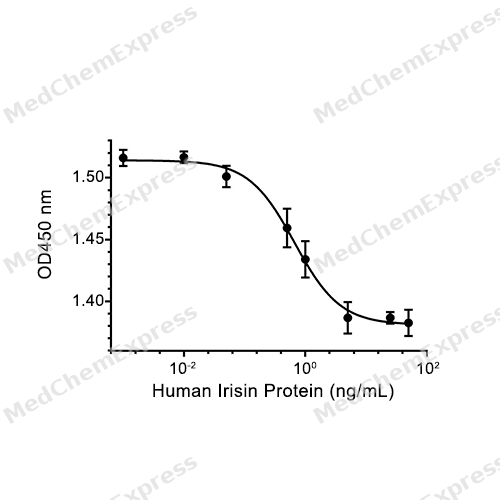 Measured by its ability to inhibit proliferation of A549 cells. The IC50 for this effect is 0.651 ng/mL, corresponding to a specific activity is 1.5361×10⁶ units/mg.

Publications (1)
-
Journal Impact Factor
-
Most Recent
-
Cell Death Dis
Irisin regulates oxidative stress and mitochondrial dysfunction through the UCP2-AMPK pathway in prion diseases. [Abstract]2025 Feb 3;16(1):66. PMID: 39900919

Technical Parameters
-
Species Rat; Mouse; Human
-
Source HEK293
-
Tag C-hFc
-
Accession
A0A0A0MRR6 (D32-E143)
-
Molecular Construction
-
N-term
-
Irisin (D32-E143)
Accession # A0A0A0MRR6 -
hFc
-
C-term
-
-
Protein Length
Partial
-
Synonyms
Fibronectin type III domain-containing protein 5; Fibronectin type III repeat-containing protein 2; Irisin; FNDC5
-
AA Sequence
DSPSAPVNVTVRHLKANSAVVSWDVLEDEVVIGFAISQQKKDVRMLRFIQEVNTTTRSCALWDLEEDTEYIVHVQAISIQGQSPASEPVLFKTPREAEKMASKNKDEVTMKE
-
Predicted Molecular Mass
38.7 kDa
-
Molecular Weight
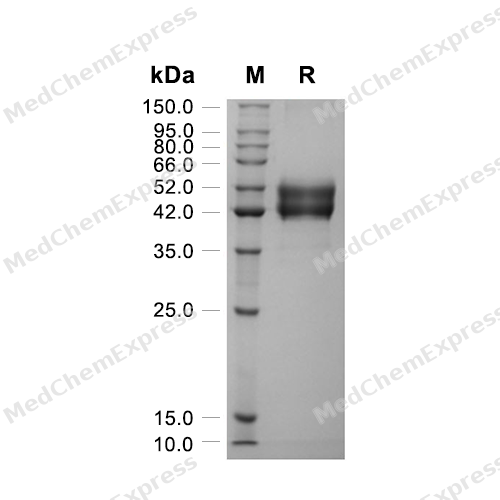
Approximately 50-60 kDa, based on SDS-PAGE under reducing conditions.
-
Glycosylation
Yes
-
Purity
≥ 95%, as determined by reducing SDS-PAGE.
-
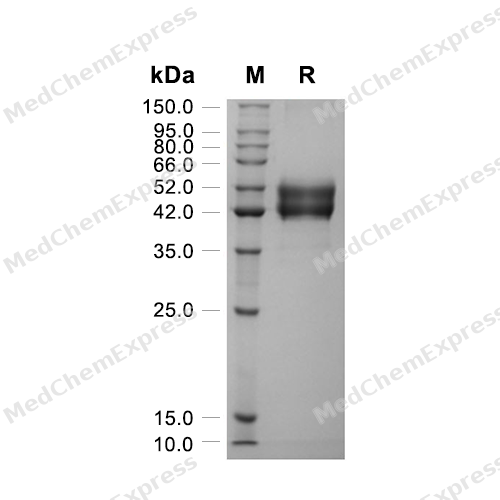 ≥ 95%, as determined by reducing SDS-PAGE.
-

Product Properties
Lyophilized powder
1.Lyophilized from a 0.22 μm filtered solution of PBS, pH 7.4.
2.Lyophilized from a 0.22 μm filtered solution of 20 mM PB, 150 mM NaCl, pH 7.4.
3.Lyophilized from a 0.22 μm filtered solution of PBS, pH 7.4, 5% trehalose, 5% mannitol, 0.01% Tween 80.
4.Lyophilized from a 0.22 μm filtered solution of PBS, pH 7.4, 8% trehalose.
Please refer to the lot-specific COA for specific buffer information.
<1 EU/μg, determined by LAL method.
It is not recommended to reconstitute to a concentration less than 100 μg/mL in ddH2O. For long term storage it is recommended to add a carrier protein (0.1% BSA, 5% HSA, 10% FBS or 5% Trehalose).
Stored at -20°C for 2 years from date of receipt. After reconstitution, it is stable at 4°C for 1 week or -20°C for longer (with carrier protein). It is recommended to freeze aliquots at -20°C or -80°C for extended storage.
Room temperature in continental US; may vary elsewhere.


Documentation
-
Data Sheet (264 KB)
-
SDS (252 KB)
- English - EN (252 KB)
- Français - FR (252 KB)
- Deutsch - DE (252 KB)
- Norwegian - NO (252 KB)
- Español - ES (252 KB)
- Swedish - SV (252 KB)
- Italian - IT (252 KB)
- Portuguese - PT (252 KB)
-
Handling Instructions (2659 KB)


References
[1]. Hyeonwoo Kim, et al. Irisin Mediates Effects on Bone and Fat via αV Integrin Receptors. Cell. [Content Brief]
[2]. Polyzos SA, et al. Irisin in metabolic diseases. Endocrine. 2018 Feb;59(2):260-274. [Content Brief]
[3]. Liu S, et al. Role of irisin in physiology and pathology. Front Endocrinol (Lausanne). 2022 Sep 26;13:962968. [Content Brief]
[4]. Li T, et al. Irisin suppresses pancreatic β cell pyroptosis in T2DM by inhibiting the NLRP3-GSDMD pathway and activating the Nrf2-TrX/TXNIP signaling axis. Diabetol Metab Syndr. 2023 Nov 22;15(1):239. [Content Brief]
[5]. Wang C, et al. Irisin inhibits microglial senescence via TFAM-mediated mitochondrial metabolism in a mouse model of tauopathy. Immun Ageing. 2024 May 14;21(1):30. [Content Brief]


Calculators
Concentration (start) × Volume (start) = Concentration (final) × Volume (final)


 Powered by Bioz

