



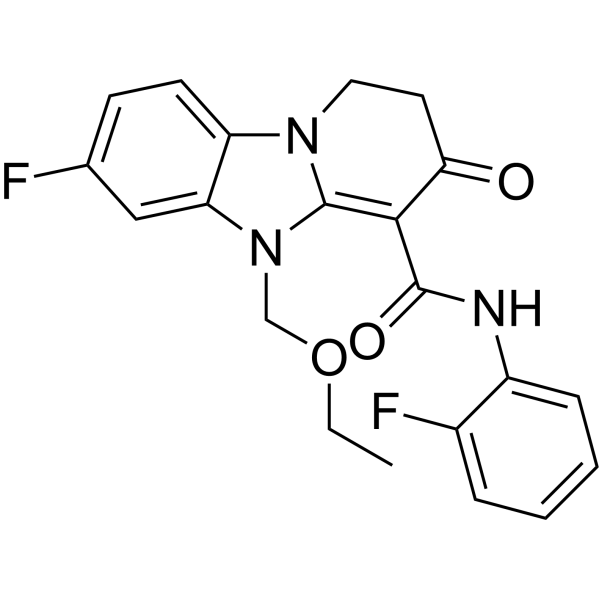
RWJ-51204
RWJ-51204 is a partial agonist of GABA(A) receptor, with Ki of 0.2-2 nM to the benzodiazepine site on GABA(A) receptors.
For research use only. We do not sell to patients.
- CAS No.: 205701-85-5
- Formula: C21H19F2N3O3
- Molecular Weight:399.39
-
Storage:
Please store the product under the recommended conditions in the Certificate of Analysis.


-
 Biological Activity
-
Chemical Information
- Protocol
- Purity & Documentation
- References
-
 Help & FAQs




Biological Activity
Ki: 0.2-2 nM (GABA(A))[1]
RWJ-51204 binds to receptors in the cerebral cortex, cerebellum, or medulla-spinal cord with Ki ranging from 0.2 to 0.6 nM.
MedChemExpress (MCE) has not independently confirmed the accuracy of these methods. They are for reference only.
MedChemExpress (MCE) has not independently confirmed the accuracy of these methods. They are for reference only.


Chemical Information
-
CAS No. 205701-85-5
-
Molecular Weight 399.39
-
Formula C21H19F2N3O3
-
SMILES
O=C(C1=C2N(COCC)C3=CC(F)=CC=C3N2CCC1=O)NC4=CC=CC=C4F
-
Shipping
Room temperature in continental US; may vary elsewhere.
-
Storage
Please store the product under the recommended conditions in the Certificate of Analysis.

Protocol
For each sample, a portion of the membrane fraction containing 0.1 to 0.2 mg of protein is incubated in 2 mL of a 3 mM phosphate-buffered solution containing 0.1 M NaCl and 0.01 to 0.03 μCi of a 3H-labeled ligand [3H]Ro15-4513, [3H]flumazenil. The receptor-ligand binding reaction is allowed to reach equilibrium at an ambient temperature of 21-23°C (30 min) and then the reaction is terminated by vacuum filtration to separate the incubation medium from the biological membranes. The membrane samples are washed to remove unbound ligand. The3H bound to each membrane sample is quantified using liquid scintillation spectrometry.
MedChemExpress (MCE) has not independently confirmed the accuracy of these methods. They are for reference only.
Adult rats are deprived of water for 48 h and are deprived of food for at least 16 h before testing. After the first 24 h of water deprivation, they are placed in a sound-attenuating chamber for a training period, in which they are allowed 200 licks from a bottle containing tap water. The experiment is performed the next day. Vehicle or compounds are administered orally by gavage, and at specified times after dosing, rats are placed in the chamber and allowed access to tap water. The first lick at the stainless steel sipper tube of a water bottle initiates a 3-min test session in which every 20th lick is punished by a 0.2 s, 0.5 mA shock (root mean square, measured across the electrodes) delivered via the sipper tube. If rats fail to drink within 5 min, the experiment is terminated, and they are evaluated for signs of CNS depression. Rats are not reused in this experiment. The anxiolytic effectiveness of a compound in this assay is determined from the number of rats, at each dose, that receive a number of shocks that is equal to or greater than the calculated 90th percentile of the number of shocks received by approximately 600 vehicle-treated rats. This criterion is eight shocks when rats are tested 1 h after administration and 10 shocks when rats are tested 4 h after administration.
MedChemExpress (MCE) has not independently confirmed the accuracy of these methods. They are for reference only.


Purity & Documentation
References

Calculators
Concentration (start) × Volume (start) = Concentration (final) × Volume (final)


 Powered by Bioz