



DDR2 Protein, Rhesus Macaque (HEK293, His)

Based on 1 Customer Validation
The DDR2 protein is a tyrosine kinase critical in tissue remodeling, acting as a cell surface receptor for fibrillar collagen and affecting cell differentiation, extracellular matrix remodeling, migration, and proliferation. DDR2 is critical for bone development and centrally regulates osteoblast differentiation and chondrocyte maturation through MAP kinase signaling and activation of RUNX2. DDR2 Protein, Rhesus Macaque (HEK293, His) is the recombinant Rhesus Macaque-derived DDR2 protein, expressed by HEK293 , with C-His labeled tag.
- Species: Rhesus Macaque
- Source: HEK293
-
Storage:Stored at -20°C for 2 years from date of receipt. After reconstitution, it is stable at 4°C for 1 week or -20°C for longer (with carrier protein). It is recommended to freeze aliquots at -20°C or -80°C for extended storage.



-
 Biological Activity
-
Technical Parameters
-
Product Properties
- Documentation
- Help & FAQs



Biological Activity
The DDR2 protein is a tyrosine kinase critical in tissue remodeling, acting as a cell surface receptor for fibrillar collagen and affecting cell differentiation, extracellular matrix remodeling, migration, and proliferation. DDR2 is critical for bone development and centrally regulates osteoblast differentiation and chondrocyte maturation through MAP kinase signaling and activation of RUNX2. DDR2 Protein, Rhesus Macaque (HEK293, His) is the recombinant Rhesus Macaque-derived DDR2 protein, expressed by HEK293 , with C-His labeled tag.
DDR2 protein, a tyrosine kinase integral to the regulation of tissue remodeling, functions as a cell surface receptor for fibrillar collagen, exerting control over cell differentiation, extracellular matrix remodeling, cell migration, and proliferation. Crucial for normal bone development, DDR2 plays a central role in osteoblast differentiation and chondrocyte maturation through a signaling pathway involving MAP kinases, culminating in the activation of the transcription factor RUNX2. Additionally, DDR2 regulates extracellular matrix remodeling by up-regulating collagenases MMP1, MMP2, and MMP13, thereby facilitating cell migration and tumor cell invasion. Its involvement extends to promoting fibroblast migration and proliferation, contributing to the dynamic process of cutaneous wound healing.
1.This product does not contain protein kinase domain.
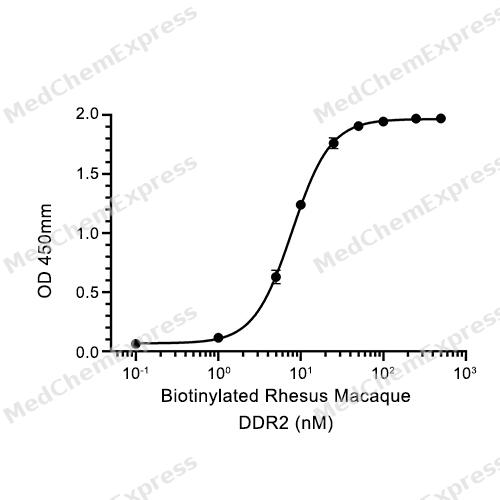
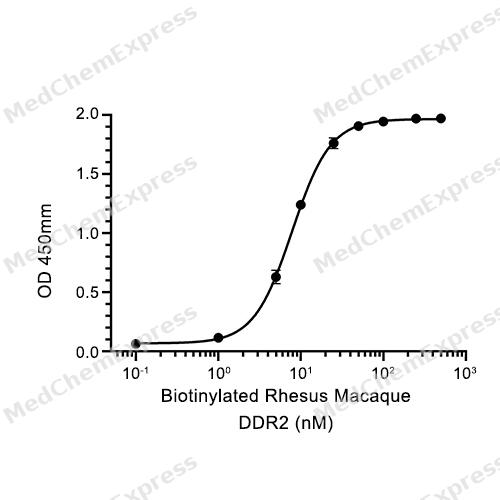
2.Measured by its binding ability in a functional ELISA. Immobilized Collagen I at 10 µg/mL can bind Rhesus Macaque DDR2 with an apparent KD is 7.846 nM.

Technical Parameters
-
Species Rhesus Macaque
-
Source HEK293
-
Tag C-6*His
-
Accession
XP_001118219.1 (Q24-R399)
-
Molecular Construction
-
N-term
-
DDR2 (Q24-R399)
Accession # XP_001118219.1 -
His
-
C-term
-
-
Protein Length
Partial
-
Synonyms
Discoidin domain-containing receptor 2; CD167b; Ddr2; Ntrkr3; Tkt; Tyro10
-
AA Sequence
QVNPAICRYPLGMSGGQIPDEDITASSQWSESTAAKYGRLDSEEGDGAWCPEIPVEPDDLKEFLQIDLHTLHFITLVGTQGRHAGGHGIEFAPMYKINYSRDGTRWISWRNRHGKQVLDGNSNPYDIFLKDLEPPIVARFVRFIPVTDHSMNVCMRVELYGCVWLDGLVSYNAPAGQQFVLPGGSIIYLNDSVYDGAVGYSMTEGLGQLTDGVSGLDDFTQTHEYHVWPGYDYVGWRNESATNGYIEIMFEFDRIRNFTTMKVHCNNMFAKGVKIFKEVQCYFRSEASEWEPNAISFPLVLDDVNPSARFVTVPLHHRMASAIKCQYHFADTWMMFSEITFQSDAAMYNNSGALPTSPMTPTTYDPMLKIDDSNTR
-
Molecular Weight
Approximately 50-70 kDa, based on SDS-PAGE under reducing conditions, due to the glycosylation.
-
Glycosylation
Yes
-
Purity
≥ 95%, as determined by reducing SDS-PAGE.
-
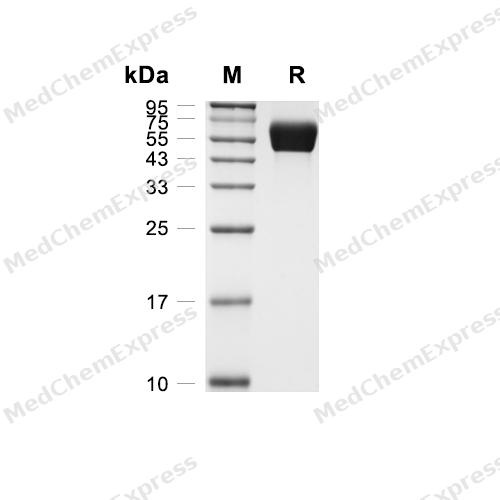 ≥ 95%, as determined by reducing SDS-PAGE.
-

Product Properties
Lyophilized powder.
Lyophilized from a 0.22 μm filtered solution of PBS, pH 7.4.
<1 EU/μg, determined by LAL method.
It is not recommended to reconstitute to a concentration less than 100 μg/mL in ddH2O. For long term storage it is recommended to add a carrier protein (0.1% BSA, 5% HSA, 10% FBS or 5% Trehalose).
Stored at -20°C for 2 years from date of receipt. After reconstitution, it is stable at 4°C for 1 week or -20°C for longer (with carrier protein). It is recommended to freeze aliquots at -20°C or -80°C for extended storage.
Room temperature in continental US; may vary elsewhere.


Documentation
-
Data Sheet (238 KB)
-
SDS (251 KB)
- English - EN (251 KB)
- Français - FR (251 KB)
- Deutsch - DE (251 KB)
- Norwegian - NO (251 KB)
- Español - ES (251 KB)
- Swedish - SV (251 KB)
- Italian - IT (251 KB)
- Portuguese - PT (251 KB)
-
Handling Instructions (2659 KB)


Calculators
Concentration (start) × Volume (start) = Concentration (final) × Volume (final)


 Powered by Bioz

