



AmmTX3 TFA

Based on 1 Customer Validation
AmmTX3 TFA is a peptide toxin identified from the venom of the scorpion Androctonus mauretanicus. AmmTX3 TFA is a highly specific blocker of Kv4 channels, which selectively and almost completely blocks transient A-type K+ currents with a Ki of 131 nM. AmmTX3 TFA induces epileptiform behaviors and causes death in mice receiving intracerebroventricular injection. AmmTX3 TFA increases the excitability of dentate gyrus granule cells, reduces GABAergic inhibition, enhances and stabilizes the EPSP-spike component of long-term potentiation, and impairs reference memory. AmmTX3 TFA can be used in research related to pain, epilepsy, and autism spectrum disorder.
Nos produits utilisent uniquement pour la recherche. Nous ne vendons pas aux patients.
- Pureté : 98.74%
- Formule: C158H262N50O48S6.xC2HF3O2
- Masse moléculaire:3822.47 (free acid)
-
Stockage:
Sealed storage, away from moisture.
Powder -80°C, 2 years , -20°C, 1 year* In solvent : -80°C, 6 months; -20°C, 1 month (sealed storage, away from moisture)

To place orders, for customer services and technical support, please contact: MedChemExpress USA
Tel: 609-228-6898 E-mail: [email protected] [email protected]


-
 Activité biologique
-
Chemical Information
-
Solvant et solubilité
- Protocole
- Pureté et documentation
- Références
-
 Help & FAQs




Activité biologique
Description
In Vitro
AmmTX3 (1 h) TFA binds with high affinity to a specific site on rat brain synaptosomes, fully displacing 125I-labelled sBmTX3 with a Ki of 19.5 pM, and exhibits a Kd of 66 pM for its own binding site[1].
AmmTX3 (0.1 nM-10 μM) TFA potently blocks the A-type K+ current in primary striatal neurons in culture, with a Ki of 131 nM, and its inhibitory effect is reversible[1].
AmmTX3 (0.5 μM) TFA potently blocks Kv4.2 channel currents in CHO-K1 cells co-expressed with DPP6S (with or without KChIP1), but only weakly blocks Kv4.2 + KChIP1 currents, demonstrating DPP6S confers high AmmTX3 TFA sensitivity to Kv4.2 channels[3].
AmmTX3 (0.5 μM) TFA potently blocks Kv4.3 channel currents in CHO-K1 cells co-expressed with DPP10a, but only weakly blocks Kv4.3 + KChIP1 currents, demonstrating DPP10a confers high AmmTX3 TFA sensitivity to Kv4.3 channels[3].
MedChemExpress (MCE) has not independently confirmed the accuracy of these methods. They are for reference only.
In Vivo
AmmTX3 (0.75 mg; i.c.v.; single injection) TFA increases and stabilizes the EPSP-spike component of long-term potentiation in the dentate gyrus from 90 minutes post-high-frequency stimulation, with no effect on basal synaptic transmission or short-term plasticity[2].
MedChemExpress (MCE) has not independently confirmed the accuracy of these methods. They are for reference only.
-
Animal Model:Sprague Dawley (male, 280-400 g)[2]
-
Dosage:0.75 mg
-
Administration:i.c.v.; single injection
-
Result:Showed no significant differences in reference or working memory errors when injected 30 minutes before session 2.
Significantly increased reference memory errors in sessions 2 and 3, delayed learning by 1 day, and significantly increased total turns and 45° turns in sessions 2, 3, and 4 when injected immediately after session 1.
Significantly increased reference memory errors in session 4 when injected immediately after session 3.
Showed no significant differences in reference or working memory errors when injected immediately after session 5.
-
Animal Model:Sprague Dawley (male, 280-400 g)[2]
-
Dosage:0.75 mg
-
Administration:i.c.v.; single injection
-
Result:Showed no significant differences in basal transmission (input-output curves, baseline field EPSP slope, population spike amplitude) or short-term plasticity (paired-pulse ratio) compared to vehicle group.
Increased field EPSP slope by 16.1% post-stimulation, remaining above baseline for 30 minutes, with no significant difference from vehicle group at any post-stimulation time point.
Maintained population spike amplitude above baseline for the full 4-hour recording period, while vehicle group's amplitude steadily decreased; significant difference between groups emerged 90 minutes post-induction.


Chemical Information
-
Appearance Solid
-
Masse moléculaire 3822.47 (free acid)
-
Formule C158H262N50O48S6.xC2HF3O2
-
Color White to off-white
-
Sequence
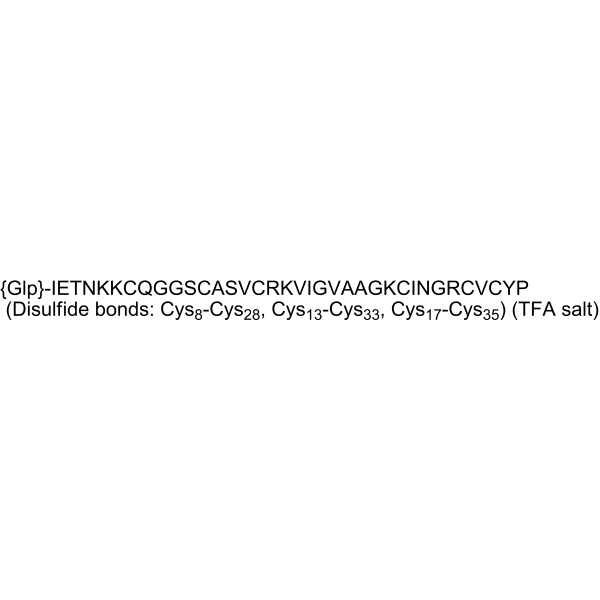
{Glp}-Ile-Glu-Thr-Asn-Lys-Lys-Cys-Gln-Gly-Gly-Ser-Cys-Ala-Ser-Val-Cys-Arg-Lys-Val-Ile-Gly-Val-Ala-Ala-Gly-Lys-Cys-Ile-Asn-Gly-Arg-Cys-Val-Cys-Tyr-Pro (Disulfide bonds: Cys8-Cys28, Cys13-Cys33, Cys17-Cys35) (TFA salt)
-
Sequence Shortening
{Glp}-IETNKKCQGGSCASVCRKVIGVAAGKCINGRCVCYP (Disulfide bonds: Cys8-Cys28, Cys13-Cys33, Cys17-Cys35) (TFA salt)
-
Livraison
Room temperature in continental US; may vary elsewhere.
-
Stockage
Sealed storage, away from moisture
Powder -80°C 2 years -20°C 1 year * In solvent : -80°C, 6 months; -20°C, 1 month (sealed storage, away from moisture)


Solvant et solubilité
In Vitro:
DMSO : 100 mg/mL (Need ultrasonic; Hygroscopic DMSO has a significant impact on the solubility of product, please use newly opened DMSO)
In Vivo:
Select the appropriate dissolution method based on your experimental animal and administration route.
- For the following dissolution methods, please ensure to first prepare a clear stock solution using an In Vitro approach and then sequentially add co-solvents:
- To ensure reliable experimental results, the clarified stock solution can be appropriately stored based on storage conditions. As for the working solution for In Vivo experiments, it is recommended to prepare freshly and use it on the same day.
- The percentages shown for the solvents indicate their volumetric ratio in the final prepared solution. If precipitation or phase separation occurs during preparation, heat and/or sonication can be used to aid dissolution.
Add each solvent one by one: 10% DMSO 40% PEG300 5% Tween-80 45% Saline
Solubility: ≥ 2.5 mg/mL; Clear solution
This protocol yields a clear solution of ≥ 2.5 mg/mL (saturation unknown).
Taking 1 mL working solution as an example, add 100 μL DMSO stock solution (25.0 mg/mL) to 400 μL PEG300, and mix evenly; then add 50 μL Tween-80 and mix evenly; then add 450 μL Saline to adjust the volume to 1 mL.
Preparation of Saline: Dissolve 0.9 g sodium chloride in ddH₂O and dilute to 100 mL to obtain a clear Saline solution.
Add each solvent one by one: 10% DMSO 90% (20% SBE-β-CD in Saline)
Solubility: ≥ 2.5 mg/mL; Clear solution
This protocol yields a clear solution of ≥ 2.5 mg/mL (saturation unknown).
Taking 1 mL working solution as an example, add 100 μL DMSO stock solution (25.0 mg/mL) to 900 μL 20% SBE-β-CD in Saline, and mix evenly.
Preparation of 20% SBE-β-CD in Saline (4°C, storage for one week): 2 g SBE-β-CD powder is dissolved in 10 mL Saline, completely dissolve until clear.
In Vivo Dissolution Calculator
Please enter the basic information of animal experiments:
-
-
-
-
Recommended: Prepare an additional quantity of animals to account for potential losses during experiments.
Please enter your animal formula composition:
-
%DMSO +
Recommended: Keep the proportion of DMSO in working solution below 2% if your animal is weak.
-
%+
-
+%Tween-80 + +
-
%Saline +
The co-solvents required include: DMSO, . All of co-solvents are available by MedChemExpress (MCE). , Tween 80. All of co-solvents are available by MedChemExpress (MCE).
Working solution concentration: 0.22 mg/mL
Method for preparing stock solution: mg drug dissolved in μL DMSO. Stock solution concentration: mg/mL. * In solvent : -80°C, 6 months; -20°C, 1 month (sealed storage, away from moisture)
1. Take μL DMSO stock solution;
2. Add μL .
μL , mix evenly;
3. Then add μL Tween 80, mix evenly;
4. Then add μL
Please ensure that the stock solution in the first step is dissolved to a clear state, and add co-solvents in sequence. You can use ultrasonic heating (ultrasonic cleaner, recommended frequency 20-40 kHz), vortexing, etc. to assist dissolution.


Pureté et documentation
-
Fiche technique (301 KB)
-
SDS (252 KB)
- English - EN (252 KB)
- Français - FR (252 KB)
- Deutsch - DE (252 KB)
- Norwegian - NO (252 KB)
- Español - ES (252 KB)
- Swedish - SV (252 KB)
- Italian - IT (252 KB)
- Korean - KR (252 KB)
- Portuguese - PT (252 KB)
-
Instruction de manipulation (2659 KB)
Références
[1]. Vacher H, et al. Expanding the scorpion toxin alpha-KTX 15 family with AmmTX3 from Androctonus mauretanicus. Eur J Biochem. 2002 Dec;269(24):6037-41. https:// [Content Brief]
[2]. Truchet B, et al. Kv4 potassium channels modulate hippocampal EPSP-spike potentiation and spatial memory in rats. Learn Mem. 2012;19(7):282-293. Published 2012 Jun 14. [Content Brief]
[3]. Maffie JK, et al. Dipeptidyl-peptidase-like-proteins confer high sensitivity to the scorpion toxin AmmTX3 to Kv4-mediated A-type K+ channels. J Physiol. 2013 May 15;591(10):2419-27. [Content Brief]

Calculators
Concentration (start) × Volume (start) = Concentration (final) × Volume (final)


AmmTX3 TFA Related Classifications
HY-P1426A Related Classifications
 Powered by Bioz