



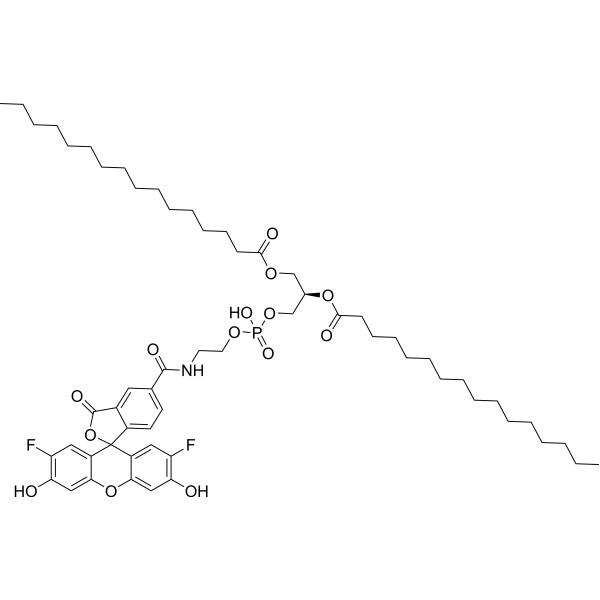
FG 488 DHPE
FG 488 DHPE is a lipid-coupled fluorochrome, has be used as a fluorophore Oregon Green 488. FG 488 DHPE monitors acidification of lipid vesicles with λex/λem=508/534 nm.FG 488 DHPE is also used for Hv1-induced proton translocation quantificatio with λex/λem=508/534 nm as well.
Nur für Forschungszwecke. Wir verkaufen nicht an Patienten.
- CAS. Nr.: 438476-80-3
- Formel: C58H82F2NO14P
- Molecular Weight:1086.24
-
Speicherung:
Please store the product under the recommended conditions in the Certificate of Analysis.

To place orders, for customer services and technical support, please contact: MedChemExpress USA
Tel: 609-228-6898 E-mail: [email protected] [email protected]


-
 Biologische Aktivität
-
Chemical Information
- Reinheit & Dokumentation
- Verweise
-
 Help & FAQs




Biologische Aktivität
Guide (The following is our recommended protocol. This protocol is only a guide and should be modified according to your specific needs).
FG 488 DHPE shows a pH-dependent fluorescence emission characteristic[1].
Monitoring acidification in Bulk vesicle assa[1]:
1.Instrument: Jasco FP6500 spectrofluorometer, 37 °C; fluorescence is excited at λex=508 nm and the emission is detected at λem=534 nm.
2.Add 100 μL proteoliposomes (cphospholipid is about 60 μM) to 680 μL ATPase buffer, containing the K+-ionophore valinomycin (5 nM) to enable a charge equilibration for transported protons.
3.Add ATP (1.2 mM) to induce proton pumping.
4.Add 1 mM NaN3 to ATP hydrolysis.
5.Add CCCP (carbonyl cyanide 3-chlorophenyl hydrazine, 0.4 μM) to deplete the proton gradient.
6.Conversion into pH-values, fluorescence intensities are normalized to the intensity obtained directly after ATP addition.
FG 488 DHPE exerts function in quantification of pH changes induced by the voltage-dependent proton channel Hv1[2].
Quantification of phospholipid concentrations[2]:
1.Add Perchloric acid (70%, 200 μL) to a sample of unilamellar vesicles containing OG488-DHPE (30 μL).
2.Heat up to 220 °C for 60 min to generate inorganic phosphate.
3.Cooling down to room temperature, add 700 μL of a solution of NH4MoO4 (0.45% (w/v)) and perchloric acid (12.6% (w/v)) and 700 μL o f a 1.7% (w/v) acetic acid solution.
4.Obtain a calibration curve to know NaH2PO4 concentrations.
5.Incubated samples at 80 °C for 10 min and measure the absorption of the samples at 820 nm.
6.Calculate phospholipid concentrations of the vesicles using the calibration curve.
Proton translocation assay[2]:
1.Instrument: Jasco FP6500 spectrofluorometer, 37 °C; fluorescence is excited at λex=508 nm (3 nm band width) and the emission is detected at λem=534 nm (3 nm band width).
2.Dilute proteoliposomes composed of POPC/POPG/Chol/OG488-DHPE (54.5:25:20:0.5) in buffer A in flux buffer generating a 14-fold K+-gradient across the vesicular membrane.
3.Add valinomycin (13 nM) to cause protonation of OG488-DHPE and quench its fluorescence intensity in case of active Hv1 channels as described above.
4.Add CCCP (6 nM) to permeabilise all vesicles for protons.
5.The normalized fluorescence intensity Fnorm is plotted as a function of time. As a control for proton leakage, protein-free vesicles were used instead of proteoliposomes.
For the experiments in the presence of the potential inhibitor 2GBI, dissolve the inhibitor (15 mM) in flux buffer and add (0.5-8.0 μL) to the proteoliposomes before addition of valinomycin to induce proton translocation.
MedChemExpress (MCE) has not independently confirmed the accuracy of these methods. They are for reference only.
534
508


Chemical Information
-
CAS. Nr. 438476-80-3
-
Molecular Weight 1086.24
-
Formel C58H82F2NO14P
-
SMILES
O=C1OC2(C3=CC(F)=C(O)C=C3OC4=CC(O)=C(F)C=C42)C5=CC=C(C(NCCOP(OC[C@@H](COC(CCCCCCCCCCCCCCC)=O)OC(CCCCCCCCCCCCCCC)=O)(O)=O)=O)C=C51
-
Versand
Room temperature in continental US; may vary elsewhere.
-
Speicherung
Please store the product under the recommended conditions in the Certificate of Analysis.


Reinheit & Dokumentation
Verweise
[1]. Schwamborn M, et al. Monitoring ATPase induced pH changes in single proteoliposomes with the lipid-coupled fluorophore Oregon Green 488. Analyst. 2017 Jul 10;142(14):2670-2677. [Content Brief]
[2]. Gerdes B, et al. Quantification of Hv1-induced proton translocation by a lipid-coupled Oregon Green 488-based assay. Anal Bioanal Chem. 2018 Oct;410(25):6497-6505. [Content Brief]

Calculators
Konzentration (Stammlösung) × Volumen (Stammlösung) = Konzentration (Ziellösung) × Volumen (Ziellösung)


FG 488 DHPE Related Classifications
HY-D1560 Related Classifications
 Powered by Bioz