



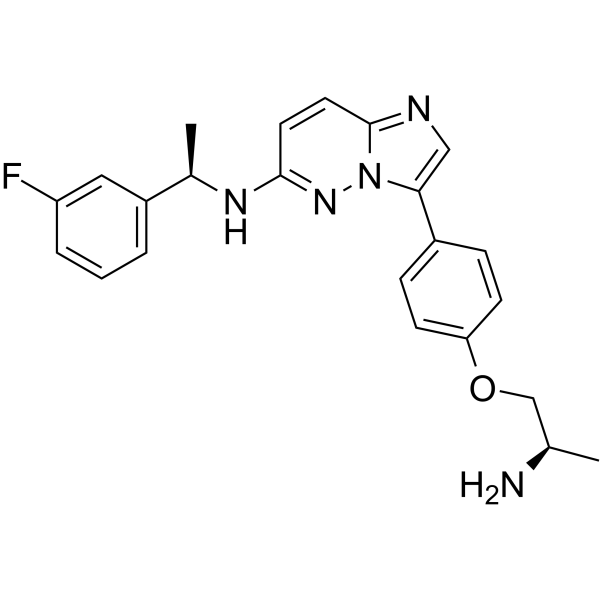
Taletrectinib free base
Based on 1 Customer Validation
Taletrectinib (DS-6051b) free base is a potent, orally active, and next-generation selective ROS1/NTRK inhibitor. Taletrectinib free base potently inhibits recombinant ROS1, NTRK1, NTRK2, and NTRK3 with IC50s of 0.207, 0.622, 2.28, and 0.98 nM, respectively. Taletrectinib free base also inhibits ROS1 G2032R and other Crizotinib-resistant ROS1 mutants.
For research use only. We do not sell to patients.
- CAS No.: 1505514-27-1
- Formula: C23H24FN5O
- Molecular Weight:405.47
-
Storage:
Please store the product under the recommended conditions in the Certificate of Analysis.


-
 Biological Activity
-
Chemical Information
- Purity & Documentation
- References
-
 Help & FAQs


Publications Citing Use of MedChemExpress (MCE) Taletrectinib free base
More

Biological Activity
The IC50 of Taletrectinib free base (1-1000 nM; 72 hours) against Ba/F3-TPM3-NTRK1, Ba/F3-ETV6-NTRK1, -NTRK2, -NTRK3, or KM12 cells is ~3-20 nM[1].
Taletrectinib free base (0.001-1000 nM; 2 hours) dose dependently inhibited autophosphorylation of ROS1 in U-118-MG cells in vitro[1].
Taletrectinib (DS-6051b) free base potently inhibits autophosphorylation of ROS1 in JFCR-165, JFCR-168, and MGH193-1B cells[1].
Taletrectinib free base partially suppresses phospho-NTRK1 at 10 nM, and completely suppresses by 100 nM. Taletrectinib free base potently inhibits recombinant ROS1, NTRK1, and NTRK3 in sub-nanomolar concentration in an ATP-competitive manner. Taletrectinib free base almost completely inhibits ACK, ALK, DDR1, and LTK at 0.2 μM among 160 kinases in the presence of 1 mM ATP, but did not inhibit other 152 kinases strongly[1].
Taletrectinib free base effectively inhibits Crizotinib-resistant ROS1 secondary mutations, including G2032R solvent front mutation[1].
MedChemExpress (MCE) has not independently confirmed the accuracy of these methods. They are for reference only.
-
Cell Line:TPM3-NTRK1-induced Ba/F3 cells, KM12 cells
-
Concentration:1-1000 nM
-
Incubation Time:72 hours
-
Result:Inhibited TPM3-NTRK1-induced Ba/F3 cells and KM12 cells viability.
-
Cell Line:U-118 MG cells (harboring FIG-ROS1 fusion gene)
-
Concentration:0.001-1000 nM
-
Incubation Time:2 hours
-
Result:Dose dependently inhibited autophosphorylation of ROS1 in U-118-MG cells.
Taletrectinib free base (6.25-200 mg/kg; p.o.; once daily for 8 days) inhibits NTRK-rearranged cancer in Balb-c nu/nu mice bearing KM12 cells[1].
Taletrectinib free base (3-100 mg/kg; p.o.; once daily for 4 days) shows rapid tumor regression in the wild-type (WT) and the G2032R-mutant Ba/F3-bearing mice without severe body weight loss[1].
MedChemExpress (MCE) has not independently confirmed the accuracy of these methods. They are for reference only.
-
Animal Model:Balb-c nu/nu mice (bearing U-118 MG cells)[1]
-
Dosage:25, 50, 100, and 200 mg/kg
-
Administration:P.o.; once daily for 18 days
-
Result:Effectively inhibited tumor growth at ≥25 mg/kg without significant body weight loss.


Chemical Information
-
CAS No. 1505514-27-1
-
Molecular Weight 405.47
-
Formula C23H24FN5O
-
SMILES
C[C@@H](NC1=NN2C(C=C1)=NC=C2C3=CC=C(OC[C@H](N)C)C=C3)C4=CC=CC(F)=C4
-
Synonyms
DS-6051b free base; AB-106 free base; IBI-344 free base
-
Shipping
Room temperature in continental US; may vary elsewhere.
-
Storage
Please store the product under the recommended conditions in the Certificate of Analysis.


Publications (2)
-
Journal Impact Factor
-
Most Recent
-
Cancer Discov
NVL-520 is a selective, TRK-sparing, and brain-penetrant inhibitor of ROS1 fusions and secondary resistance mutations. [Abstract]2023 Mar 1;13(3):598-615. PMID: 36511802 -
Mol Cancer Ther
2025 Jul 2;24(7):1005-1019. PMID: 40299789


Purity & Documentation
References
[1]. Katayama R, et al. The new-generation selective ROS1/NTRK inhibitor DS-6051b overcomes crizotinib resistant ROS1-G2032R mutation in preclinical models. Nat Commun. 2019;10(1):3604. Published 2019 Aug 9. [Content Brief]
[2]. Fujiwara Y, et al. Safety and pharmacokinetics of DS-6051b in Japanese patients with non-small cell lung cancer harboring ROS1 fusions: a phase I study. Oncotarget. 2018;9(34):23729-23737. Published 2018 May 4. [Content Brief]

Calculators
Concentration (start) × Volume (start) = Concentration (final) × Volume (final)


 Powered by Bioz