



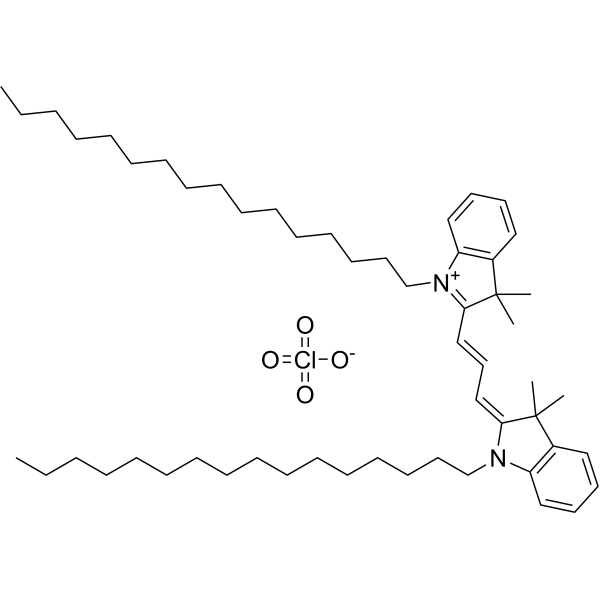
DiIC16(3)

Based on 1 Customer Validation
DiIC16(3) is a long-chain carbocyanine dye. Carbocyanine dyes are widely used as Di to label cells, organelles, liposomes, viruses and lipoproteins.
For research use only. We do not sell to patients.
- Purity: 99.34%
- CAS No.: 84109-11-5
- Formula: C55H89ClN2O4
- Molecular Weight:877.76
-
Storage:
-20°C, sealed storage, away from moisture and light
* In solvent : -80°C, 6 months; -20°C, 1 month (sealed storage, away from moisture and light)


-
 Biological Activity
-
Chemical Information
-
Solvent & Solubility
- Purity & Documentation
- References
-
 Help & FAQs




Biological Activity
Carbocyanine dyes are widely used as Di to label cells, organelles, liposomes, viruses and lipoproteins. Long-chain carbocyanines which include DiO (DiOC18(3)), DiI (DiIC18(3)), DiD (DiIC18(5)) and DiR, and dialkyl aminostyryl dye DiA (4-Di-16-ASP) are used for labeling membranes and other hydrophobic structures. DiIC16(3) has shorter alkyl substituents (C16) than DiI (C18). They have extremely high extinction coefficients, environmental dependent fluorescence and short excited-state lifetimes in lipid environments. They are oils at room temperature and weakly fluorescent in water but highly fluorescent and quite photostable when incorporated into membranes or bound to lipophilic biomolecules. These optical characteristics make them ideal for staining the cytoplasmic membranes of cells. Once applied to cells, these dyes diffuse laterally within the plasma membrane, resulting in staining of the entire cell[1].
DiO, DiI, DiD and DiR exhibit distinct green, orange, red and infrared fluorescence, respectively thus facilitating multicolor imaging and flow cytometric analysis of live cells . DiO and DiI can be used with standard FITC and TRITC filters respectively. Among them DiI and its analogs are most frequently used since they usually exhibit very low cell toxicity. In addition, DiI is widely used for determining lipoproteins such as LDL and HDL. The lipophilic aminostyryl dye DiA is also often used for neuronal tracing[2].
Guidelines (Following is our recommended protocol. This protocol only provides a guideline, and should be modified according to your specific needs).
1. Preparing Stain Solutions of DiIC16(3)
1.1 Prepare DMF, DMSO or ethanol stock solutions:
The stock solutions should be prepared in dimethyl formamide (DMF), dimethylsulfoxide (DMSO, or ethanol DMSO at 1-5 mM.
DMF is preferable to ethanol as a solvent for DiIC16(3). The stock solution should be used promptly. Any unused solution need to be aliquoted and refrozen at least -20°C. Avoid repeated freeze/thaw cycle. The solution can be stored for 6 months.
1.2 Prepare working solutions:
Dilute the stock solutions into a suitable buffer such as serum-free culture medium, HBSS or PBS to make 1-5 μM working solutions. We do not recommend storing the aqueous solution for more than one day.
Note: The final concentration of the working solution should be empirically determined for different cell types and/or experimental conditions.
2. Cell staining (Suspension cells)
2.1 Centrifuge at 1000 g at 4°C for 3-5 minutes and then discard the supernatant. Wash twice with PBS, 5 minutes each time. The cell density is 1×10⁶/mL.
2.2 Add 1 mL of DiIC16(3) working solution, and then incubate at room temperature for 5-30 minutes.
2.3 Centrifuge at 400 g at 4°C for 3-4 minutes and then discard the supernatant.
2.4 Wash twice with PBS, 5 minutes each time.
2.5 Resuspend cells with serum-free cell culture medium or PBS. Observation by fluorescence microscopy or flow cytometry.
3. Cell staining (Adherent cells)
3.1 Culture adherent cells on sterile coverslips.
3.2 Remove the coverslip from the medium and aspirate excess medium.
3.3 Add 100 μL of working solution, gently shake it to completely cover the cells, and then incubate at room temperature for 5-30 minutes.
3.4 Wash twice with medium, 5 minutes each time. Observation by fluorescence microscopy or flow cytometry.
MedChemExpress (MCE) has not independently confirmed the accuracy of these methods. They are for reference only.
525
495


Chemical Information
-
CAS No. 84109-11-5
-
Appearance Oil
-
Molecular Weight 877.76
-
Formula C55H89ClN2O4
-
Color Yellow to brown
-
SMILES
CC1(C)C(/C=C/C=C2N(CCCCCCCCCCCCCCCC)C3=C(C=CC=C3)C/2(C)C)=[N+](CCCCCCCCCCCCCCCC)C4=C1C=CC=C4.O=Cl(=O)([O-])=O
-
Shipping
Room temperature in continental US; may vary elsewhere.
-
Storage
-20°C, sealed storage, away from moisture and light
* In solvent : -80°C, 6 months; -20°C, 1 month (sealed storage, away from moisture and light)


Solvent & Solubility
DMSO : 11.67 mg/mL (13.30 mM; Need ultrasonic; Hygroscopic DMSO has a significant impact on the solubility of product, please use newly opened DMSO)
Please refer to the solubility information to select the appropriate solvent. Once prepared, please aliquot and store the solution to prevent product inactivation from repeated freeze-thaw cycles.
Storage method and period of stock solution: -80°C, 6 months; -20°C, 1 month (sealed storage, away from moisture and light). When stored at -80°C, please use it within 6 months. When stored at -20°C, please use it within 1 month.
Please refer to the solubility information to select the appropriate solvent. Once prepared, please aliquot and store the solution to prevent product inactivation from repeated freeze-thaw cycles.
Storage method and period of stock solution: -80°C, 6 months; -20°C, 1 month (sealed storage, away from moisture and light). When stored at -80°C, please use it within 6 months. When stored at -20°C, please use it within 1 month.
Concentration (start) × Volume (start) = Concentration (final) × Volume (final)


Purity & Documentation
-
Data Sheet (277 KB)
-
SDS (252 KB)
- English - EN (252 KB)
- Français - FR (252 KB)
- Deutsch - DE (252 KB)
- Norwegian - NO (252 KB)
- Español - ES (252 KB)
- Swedish - SV (252 KB)
- Italian - IT (252 KB)
- Korean - KR (252 KB)
- Portuguese - PT (252 KB)
-
Handling Instructions (2659 KB)
References
[1]. Gan WB, et al. Multicolor "DiOlistic" labeling of the nervous system using lipophilic dye combinations. Neuron. 2000 Aug;27(2):219-25. [Content Brief]
[2]. S Mukherjee, et al. Endocytic sorting of lipid analogues differing solely in the chemistry of their hydrophobic tails. J Cell Biol. 1999 Mar 22;144(6):1271-84. [Content Brief]


Complete Stock Solution Preparation Table
Please refer to the solubility information to select the appropriate solvent. Once prepared, please aliquot and store the solution to prevent product inactivation from repeated freeze-thaw cycles.
Storage method and period of stock solution: -80°C, 6 months; -20°C, 1 month (sealed storage, away from moisture and light). When stored at -80°C, please use it within 6 months. When stored at -20°C, please use it within 1 month.
| Optional Solvent | Concentration Solvent Mass | 1 mg | 5 mg | 10 mg | 25 mg |
|---|---|---|---|---|---|
| DMSO | 1 mM | 1.1393 mL | 5.6963 mL | 11.3926 mL | 28.4816 mL |
| 5 mM | 0.2279 mL | 1.1393 mL | 2.2785 mL | 5.6963 mL | |
| 10 mM | 0.1139 mL | 0.5696 mL | 1.1393 mL | 2.8482 mL |


 Powered by Bioz