



RANKL/TNFSF11 Protein, Human (HEK293)
Based on 4 publication(s) in Google Scholar
RANKL (TNFSF11), a type II transmembrane protein, is a receptor activator of NF-κB (RANK) ligand. RANKL is an activator of RANK. When binding to RANK, it induces the differentiation of monocyte/macrophage-lineage cells into osteoclasts and leads to osteoclast precursor maturation. RANKL is critical for osteoclasts maturation, bone modeling, and bone remodeling, as well as the development of lymph nodes (LNs). RANKL/TNFSF11 Protein, Human (HEK293) is a recombinant human RANKL (G64-D245) without any tag, which is produced in HEK293 cell.
研究用途以外に使用した場合、当社は一切の責任を負いかねます。
- Species: Human
- Source: HEK293
-
保管条件:Stored at -20°C for 2 years from date of receipt. After reconstitution, it is stable at 4°C for 1 week or -20°C for longer (with carrier protein). It is recommended to freeze aliquots at -20°C or -80°C for extended storage.


-
 生物活性
生物活性
-
Technical Parameters
-
Product Properties
- ドキュメント
- 参考文献
- Help & FAQs



生物活性
RANKL (TNFSF11), a type II transmembrane protein, is a receptor activator of NF-κB (RANK) ligand. RANKL is an activator of RANK. When binding to RANK, it induces the differentiation of monocyte/macrophage-lineage cells into osteoclasts and leads to osteoclast precursor maturation. RANKL is critical for osteoclasts maturation, bone modeling, and bone remodeling, as well as the development of lymph nodes (LNs). RANKL/TNFSF11 Protein, Human (HEK293) is a recombinant human RANKL (G64-D245) without any tag, which is produced in HEK293 cell[1][2].
RANKL (TNFSF11) belongs to TNF family. RANKL is a type II transmembrane protein and is a receptor activator of NF-κB (RANK) ligand. RANKL is an activator of NF-κB. RANKL binds to NF-κB and induces the differentiation of monocyte/macrophage-lineage cells into osteoclasts and leads to osteoclast precursor maturation. In bone tissue, RANKL is expressed by osteoblasts, osteocytes and immune cells, especially in osteoblasts and osteocytes[1]. RANKL is also expressed by T cells and increases proliferation and survival of dendritic cells[2].
Human RANKL shares 82.02% and 84.44% common aa identity with mouse and rat respectively. Human RANKL consists of cytoplasmic domain (1-47), helical domain (48-68), and extracellular domain (69-317). The soluble chain (140-317) is released when cleaved by enzymes such as matrix metalloproteinases (MMP3 or 7) and ADAM[1][3].
RANKL is critical for osteoclasts maturation, bone modeling, and bone remodeling, as well as the development of lymph nodes (LNs)[1].
RANKL (human, -5 ng/mL, 24 h) stimulates migration of a clear cell RCC cell line, Caki-1[4].
RANKL (human, 24 h) stimulates PAa cell migration and invasion[5].
RANKL (human, .4 or 2 mg/kg/day, s.c.) induces high bone turnover and decreases bone volume, density, and strength in C57BL/6J female mice[6].
1.Immobilized human TNFSF11 at 2 μg/mL (100 μL/well) can bind human Osteoprotegerin-hFc and the EC50 is 5-40 ng/mL.
2. Measured by its ability to induce TRAP activity, inducing osteoclast differentiation of RAW 264.7 mouse monocyte/macrophage cells. The ED50 for this effect is < 20 ng/mL.
3. Loaded Narlumosbart (HY-P99966) on AHC2 biosensor, can bind RANKL/TNFSF11 Protein, Human (HEK293) with an affinity constant of <1.000E-11 M as determined in BLI assay.
-
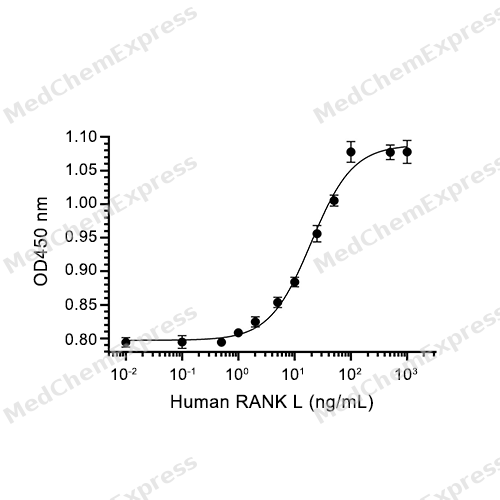 Measured by its ability to induce osteoclast differentiation of RAW 264.7 mouse monocyte/macrophage cells. The ED50 for this effect is 19.69 ng/mL, corresponding to a specific activity is 5.079×10⁴ units/mg.
 -
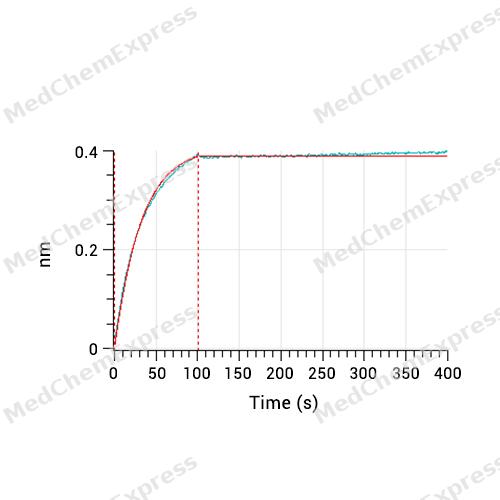 Loaded Narlumosbart (HY-P99966) on AHC2 biosensor, can bind RANKL/TNFSF11 Protein, Human (HEK293) with an affinity constant of <1.000E-11 M as determined in BLI assay.

Publications (4)
-
Journal Impact Factor
-
Most Recent
-
Nat Chem Biol
2024 Sep;20(9):1188-1198. PMID: 38811854 -
Dev Cell
A pathological role of O-GlcNAcylation-driven TR11B production and function in lung adenocarcinoma. [Abstract]2025 Sep 3:S1534-5807(25)00530-1. PMID: 40930100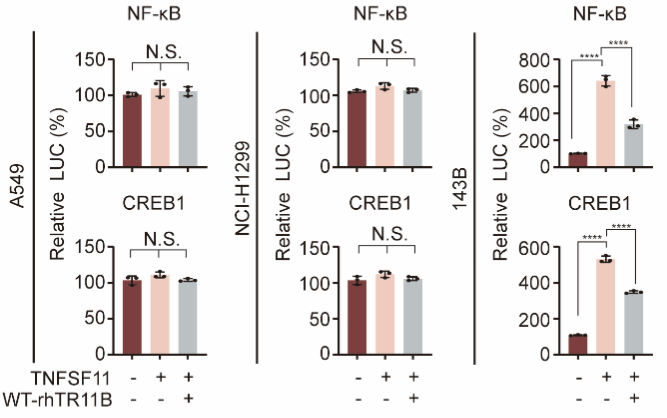
RANKL/TNFSF11 Protein, Human (HEK293) purchased from MedChemExpress. Usage Cited in: Dev Cell. 2025 Sep 3:S1534-5807(25)00530-1. [Abstract]
The luciferase activities of NF-κB and CREB1 reporter genes in A549 and NCIH1299 lung cancer cells and 143B osteosarcoma following treating with RANKL/TNFSF11 Protein, Human (HEK293) (TNFSF11, 5 ng/mL, 24 h) in the presence or absence of WT-rhTR11B (5 ng/mL, 24 h).
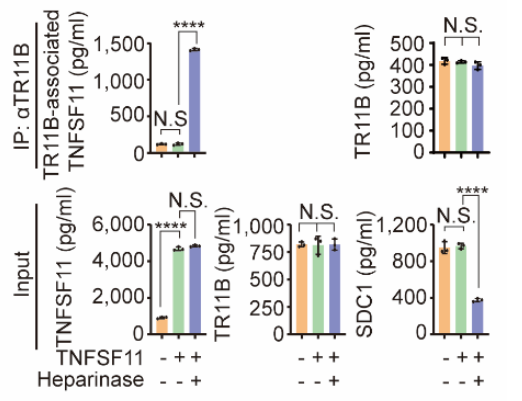
RANKL/TNFSF11 Protein, Human (HEK293) purchased from MedChemExpress. Usage Cited in: Dev Cell. 2025 Sep 3:S1534-5807(25)00530-1. [Abstract]
The interaction between extracellular TNFSF11 and TR11B in the culture media of A549 cells treated with or without RANKL/TNFSF11 Protein, Human (HEK293) (TNFSF11, 5 ng/mL; 24 h), in the presence or absence of Heparinase (5 U/mL). TR11B was immunoprecipitated by anti-TR11B antibodies. Extracellular TR11B, TNFSF11, and SDC1were measured by ELISA.
-
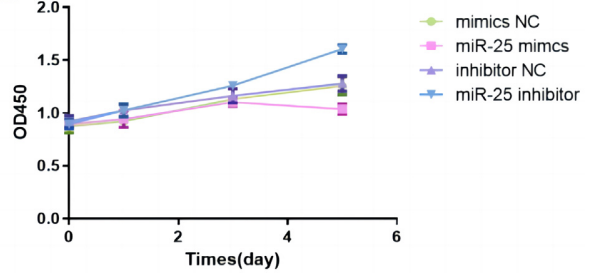
RANKL/TNFSF11 Protein, Human (HEK293) purchased from MedChemExpress. Usage Cited in: Arab J Chem. 2023 Aug, 104888.
RAW 264.7 cells were cultured in a-MEM containing RANKL/TNFSF11 Protein, Human (HEK293) (RANKL, 50 ng/mL) for 120 h. The CCK-8 assay was used to detect proliferation.
-
Biochim Biophys Acta Mol Basis Dis
Neutrophil-derived thrombospondin-1 (THBS1) drives type 2 diabetes-induced osteoporosis via CD36-PPARγ-POU2F2 signaling. [Abstract]2025 Dec 15;1872(3):168139. PMID: 41407214

Technical Parameters
-
Species Human
-
Source HEK293
-
Tag Tag Free
-
アクセッション番号
AAC51762.1 (G64-D245)
-
Molecular Construction
-
N-term
-
RANKL (G64-D245)
Accession # AAC51762.1 -
C-term
-
-
Protein Length
Partial
-
別名
Tumor necrosis factor ligand superfamily member 11; RANKL; CD254; ODF; OPGL; TNFSF11; TRANCE
-
AA Sequence
GSQHIRAEKAMVDGSWLDLAKRSKLEAQPFAHLTINATDIPSGSHKVSLSSWYHDRGWGKISNMTFSNGKLIVNQDGFYYLYANICFRHHETSGDLATEYLQLMVYVTKTSIKIPSSHTLMKGGSTKYWSGNSEFHFYSINVGGFFKLRSGEEISIEVSNPSLLDPDQDATYFGAFKVRDID
-
Predicted Molecular Mass
20.5 kDa
-
分子量
Approximately 27-33 kDa, based on SDS-PAGE under reducing conditions, due to the glycosylation.
-
Glycosylation
Yes
-
純度
≥ 90%, as determined by reducing SDS-PAGE.

Product Properties
Lyophilized powder
1.Lyophilized from a 0.22 μm filtered solution of PBS, pH 7.4, 5% trehalose, 5% mannitol, 0.01% Tween 80.
2.Lyophilized from a 0.22 μm filtered solution of 20 mM PB, 150 mM NaCl, pH 7.4.
Please refer to the lot-specific COA for specific buffer information.
<1 EU/μg, determined by LAL method.
It is not recommended to reconstitute to a concentration less than 100 μg/mL in ddH2O. For long term storage it is recommended to add a carrier protein (0.1% BSA, 5% HSA, 10% FBS or 5% Trehalose).
Stored at -20°C for 2 years from date of receipt. After reconstitution, it is stable at 4°C for 1 week or -20°C for longer (with carrier protein). It is recommended to freeze aliquots at -20°C or -80°C for extended storage.
Room temperature in continental US; may vary elsewhere.


ドキュメント
-
データシート (264 KB)
-
SDS (252 KB)
- English - EN (252 KB)
- Français - FR (252 KB)
- Deutsch - DE (252 KB)
- Norwegian - NO (252 KB)
- Español - ES (252 KB)
- Swedish - SV (252 KB)
- Italian - IT (252 KB)
- Portuguese - PT (252 KB)
-
取扱説明書 (2659 KB)


参考文献
[1]. Ono T, et al. RANKL biology: bone metabolism, the immune system, and beyond. Inflamm Regen. 2020 Feb 7;40:2. [Content Brief]
[2]. Li B, et al. Roles of the RANKL-RANK Axis in Immunity-Implications for Pathogenesis and Treatment of Bone Metastasis. Front Immunol. 2022 Mar 21;13:824117. [Content Brief]
[3]. Tobeiha M, et al. RANKL/RANK/OPG Pathway: A Mechanism Involved in Exercise-Induced Bone Remodeling. Biomed Res Int. 2020 Feb 19;2020:6910312. [Content Brief]
[4]. Mikami S, et al. Increased RANKL expression is related to tumour migration and metastasis of renal cell carcinomas. J Pathol. 2009 Aug;218(4):530-9. [Content Brief]
[5]. Peng X, et al. Differential expression of the RANKL/RANK/OPG system is associated with bone metastasis in human non-small cell lung cancer. PLoS One. 2013;8(3):e58361. [Content Brief]
[6]. Lloyd SA, et al. Soluble RANKL induces high bone turnover and decreases bone volume, density, and strength in mice. Calcif Tissue Int. 2008 May;82(5):361-72. [Content Brief]


Calculators
濃度 (開始) × 体積 (開始) = 濃度 (終了) × 体積 (終了)


 Powered by Bioz

